Talk:Flip-flop (electronics)
From Wikipedia, the free encyclopedia
[edit] T flip-flop
Could the explanation for a T flip-flop be expanded? Is Q updated every clock cycle? What does it mean "the input is strobed" - the clock or T?by Ny7K 131.111.8.102 22:59, 13 November 2005 (UTC)
- There's a sentence in the T flip-flop section that isn't even a sentence:
- A toggle flip-flop composed of a single SR flip-flop that becomes an oscillator, when it is clocked.
- I'm not sure how to fix it because I don't know what was meant. The next sentence is confusing also. I'd be for dropping that, and the next two sentences:
- To achieve toggling, the clock pulse must have exactly the length of half a cycle. While such a pulse generator can be built, a toggle flip-flop composed of two SR flip-flops is the easy solution.
- Is the single SR flip-flop implementation actually useful in any practical situation? Can someone provide a citation?
Ccrrccrr (talk) 04:09, 27 February 2008 (UTC)
- Indeed, that's lame. So I took it out. If someone figures out something to say there, put it in. Dicklyon (talk) 05:01, 27 February 2008 (UTC)
[edit] Flip flop or flip-flop
The correct, or at least "electronics industry-standard" terminology is "flip-flop," that is, with the hyphen.
-
- I now replaced "flip flop" with "flip-flop" in the whole text. Should the page also be moved to "flip-flop"? We would need to first delete the redirect in the other direction in that case. Colin Marquardt 13:45, 28 Aug 2003 (UTC)
-
-
- Well, I did a cut and paste move. I couldn't find a page where I could request a move or delete the redirect. 172.196.215.224
-
[edit] Circuit diagrams
Some circuit diagrams would be extremely helpful here, but I'm not qualified to draw them... can someone with a bit more knowledge of electronics put one in? Kwertii 22:13, 27 Nov 2003 (UTC)
- I will try to modify Heron's for the other types. - Omegatron 18:58, Jul 5, 2004 (UTC)
-
- I added the Q' for JK and SR, since they are always shown that way. T and D often are, too. We should probably add timing diagrams and NOR circuits, too, right? - Omegatron 19:31, Jul 5, 2004 (UTC)
[edit] Truth tables
I would like it to have "truth tables". I started one for RS. There are different ways of representing it, though. I have included two. Probably the explicit type is better. Feel free to remove or modify or whatever. I wanted to set the outputs apart from the inputs, though, and just made it bold for now. there is a better way, involving tables. I am going to try to do these symbols, first, though. - Omegatron 18:58, Jul 5, 2004 (UTC)
http://www.rfcafe.com/references/electrical/flip_flop_table.htm
http://poppy.snu.ac.kr/~kchoi/class/lc_intro/sequential.pdf
[edit] T flip-flop equation
The characteristic equation for a T flip-flop is given as  . Should this be
  ? Josh Cherry 23:57, 17 Sep 2004 (UTC)
- It's not right the way it is. I don't remember what that symbol is, but if the truth table matches, then yes, change it (and remind readers like me what the symbol means, with a link to appropriate article). - Omegatron 03:38, Sep 18, 2004 (UTC)
-
- Looks like xor, judging from the truth table...
[edit] Internal Composition
What's inside? A Flip-flop is treated as a black box in this article. Can we add something about logic gates and transistors and describe how they allow the Flip-flop to function as it does? - Lokiskoll 09:51, Dec 17, 2004 (EST)
[edit] Different clocking types
This article does not explain the difference between flip-flops which are level sensitive (e.g. latches), master/slave, or edge sensitive. Anon April 26, 2005
- Moreover, it's totally incorrect to structure flip-flop by timing type and then by functioning type, 'cause these two are different types of classification. E.g. an RS flip-flop can be both level- and edge-triggered.
- We should first consider functioning types and then place a chapter "Level-triggered and edge-triggered flip-flops"
- btw i'm going to handle this when it's summer and i have some spare time :^) Ivan Pozdeev 15:08, 25 May 2006 (UTC)
[edit] J-K flip flop naming a myth?
A recent Slashdot post mentioned the possibility that J-K flip flops were not actually named after Jack Kilby. Does anyone buy this?
-
- His name will forever be engraved in the J-K flip-flop.
- This is probably an urban legend. More likely it was the initials of John J. Kardash [google.com], who in the 1950's arbitrarily used his initials on these pins on his blueprints, and it stuck.
(quoted from Slashdot post #12877710; see the Google Answers result for more information) - McCart42 (talk) 17:52, 2005 Jun 22 (UTC)
This should be fixed here as well as the kilby page and the Integrated circuits page. By fixed I mean either removed or finding some fairly reputable source for the information and citing it. Danny31415 4 July 2005 10:37 (UTC)
Presumably the above was written before the note about Dr. Nelson was added to the flip-flops page. I was at Hughes Aircraft at the same time as Dr. Nelson, and can confirm the origin there of the J-K flip-flop. Neither Kilby nor Kardash had anything to do with it.MontyPh 18:05, 10 January 2007 (UTC)Montgomery Phister
[edit] Ambiguous term?
There seem to exist at least two meanings of the term flip-flop:
- A generic term for all bistable devices, including direct latch, gated latch and edge-triggered devices
- Edge-triggered devices only. Datasheets tend to follow this convention
I believe the latter is the only correct use. Ed de Jonge 11:44, 10 March 2006 (UTC)
- I aggree the latter is "correct" in the sense that it is the convention used in datasheets, and also taught at many universities. However, this is very arbitrary, as it has little to to with technical meaning or historical usage of the words; it also seem to have resulted in widespread confusion, also in wikipedia articles - the bistable circuit called SR latch, under "latch", is exactly the same cross coupled NAND-gates as is described as a RS flip-flop in this article; other parts of the texts are carefully trying to explain the (arbitrary) distinction between the two names.
- Dare I suggest that this confusion is partially due to the tradition (in English) of assigning very,very precise meanings to simple words, instead of specifying the exact meaning by a few extra words when actual usage calls for it ? I wouldn't know for sure, as I'm obviously no native english speaker.
- However, if the edge-triggered characteristic differentiates flip-flops from latches, it would be wrong to state that the flip-flop was invented in 1919 by William Eccles and F. W. Jordan, as this circuit was built by only two triodes - a minimalistic clock-less bistable circuit - despite this, named "flip-flop". There has also been other types of "flip-flops", such as those built by relays (which sounded "flip" and "flop" as well...), long before edge-clocked devices, such as 7473 and the like, became mainstream.
- The distinctions between the common bistable elements could just as well be spelled out explicitly:
-
- simple SR latches
- gated (transparent) latches
- pulse-clocked (i.e. master-slave) latches
- edge-clocked latches
- All of which may have JK, D, and other variations
- The word "latch" may be replaced by words like "bistable", "register", "flip-flop", or even "memory".
- Not very surprisingly, I suggest a MERGE of the latch and the flip-flop articles.
- I also belive the article should mention that bistable elements can be built in more than one way, even if we restrict ourselves to electronics; logic gates is one way, discrete bipolar transistors another (old fashioned), and CMOS transmission gates mixed with ordinary CMOS gates, a third. - HenkeB 11:55, 9 June 2006 (UTC)
-
- I second that. However, the widespread convention of only referring to edge-triggered devices as flip-flops should be visibly acknowledged (maybe even within the discussion of every individual variation) to avoid confusion and (inadvertent) edit wars. Also, I have to say that I really like the term "latch" for the gated D-type since it so nicely visualizes the behavior of the circuit, "opening" to make the input visible on the output, and "closing" to "latch" the last value in place. --128.130.60.57 20:35, 23 October 2006 (UTC)
- I agree for the greater part, but the circuit you refer to as simply a "latch", is what I would call a "transparent" or "gated" latch. This is because even (so called) flip-flops have this latching function, without the transparent gating behaviour you described so nicely! /HenkeB 00:46, 15 November 2006 (UTC)
-
-
- I don't think a merge is a good idea, the pages have the potential to become pretty large (because of all the different types) and it makes sense to separate based on level-triggered componenents vs edge-triggered components. I'm trying to fix the problem, we should note the ambiguity, but choose an unambiguous way to present it on wikipedia - so that people can understand us. Fresheneesz 21:37, 3 November 2006 (UTC)
-
- I do not mean to be rude here, but the very term "level-triggered" is something of a contradiction, at least in this context. All digital circuits which can be triggered to go from a state A into another state B (depending on type as well as various other inputs), are triggered by the edge of some signal; they change state (or not!) at the edge, be it "latches" or "flip-flops". The term "level-triggered" could maybe be appropriate for inputs which are sampled at regular intervals, such as interrupt lines on microprocessors (i.e those which are not latching the interrupt-signal by the use of an extra flip-flop) as the word "triggered" aims at another (higher) level in this case.
- In case someone didn't know, an edge-triggered latch or flip-flop is basically a master-slave device which has its own circuitry for generating a very short trigger-pulse. This is to keep it open (in the sense of a level-controlled latch) for the shortest possible time, thereby minimizing the risk for analog oscillations in systems with feedback (such as state machines in computers).
- To conclude, the various basic bistable elements can be characterized as follows:
- (1) SR-latches and gated latches are controlled by static levels, but reacts (triggers) on the edges.
- (2) master-slave devices reacts internally on the first edge and externally on the second edge.
- (3) edge-controlled devices are fully controlled by one of the edges.
- That is, all types are "triggered" by the edge of a signal.
- /HenkeB 00:46, 15 November 2006 (UTC)
-
- The distinction between edge-triggered and level-triggered is somewhat arbitrary, but it is nevertheless important. Edge-triggered devices can only change their state on a clock edge. Level-triggered devices can change state at any point that their enable input is true. If you use a clock as the enable input to a D-latch, the state can change any time during one half of the clock cycle (and as many times as its input changes). Hence, it's transparent during that period. For a D flip-flop, no matter how many times the D input changes, the state is only updated once per clock cycle.
-
- It's very uncommon to see latch mean anything other than a transparent circuit or flip-flop mean anything other than a clock-edge-triggered circuit. I think the people who are trying to blur the distinction are making something out of nothing. Incidentally, SRAM is almost always made out of latches, not flip-flops (SRAM cells are synchronously controlled, but that circuitry is outside of the memory cells themselves). But I suppose that's a byproduct of the article's misleading terminology. 142.59.195.50 01:14, 30 April 2007 (UTC)
-
-
- Have you read my comments above?! As you (seem to) imply yourself, the real distinction is really between transparent and non-transparent devices (or modes); my main point is that the terms "level triggered" and "edge triggered" are semantically meaningless - you cannot trig on a static level, and a level that changes is an edge... Also, you have the problem that the first flip-flops "were" latches! /HenkeB 12:05, 2 August 2007 (UTC)
-
[edit] New picture
No wonder its sticks out like a sore thumb, the picture was added yesterday. I added a little caption, but since the picture isn't explained, I don't even know what its supposed to represent, or where the inputs and outputs are. Not to mention the way the picture shows unconnected wires is not intuitive. It looks like its some sort of display the way it is. Like a spinning circle.. In fact thats what it could be.. but - in any case, that picture isn't at all clear. If someone could tell me where the inputs and outputs are, and what the hell it is, I could redo it so it looks much better. Fresheneesz 06:08, 13 March 2006 (UTC)
- This is a nonexisitng 'looped' circuit combined of AND-NOT (NAND) gates.
- It doesn't explain anything (moreover, it DOES confuse) so i think it should be at the end of an article about gates as an funny example, if it should be at all. Ivan Pozdeev 14:03, 14 March 2006 (UTC)
-
- Nonexisting? What does that mean? And looped circuit? You're not saying its representing a perpetual motion circuit are you? Sounds like this thing should be deletized. Fresheneesz 04:03, 16 March 2006 (UTC)
When a picture is next to a T-flip flop paragraph, what would it represent, a T-flip-flop maybe? So prove, that this is not a T-flip flop! And I think I added a caption, at least about the color codes. If you have a better driving signal for the T-flip-flop then a square signal, then this will be ok with me, but most T-flip-flips are used in counters and thus get a square signal!--Arnero 13:54, 23 March 2006 (UTC)
- I'm afraid most readers are going to be utterly confused by this image. Where's T, Q, and Clk? The routing through the middle doesn't make sense: it appears to be all connected together, so how is it red and blue at the same time? Try to see it from a beginner's perspective. - mako 23:49, 23 March 2006 (UTC)
- There are also T-flip-flops/clock dividers without a T input (ie, it's assumed that the output always toggles) 129.128.210.68 17:37, 1 May 2007 (UTC)
[edit] Flip-Flop definition
Flip-Flop is not a bistable multivibrator. It can implement one with peripheral components, but it is not even its main use. I would change the definition to the following: In electronics and digital circuits, the flip-flop is a pulsed digital circuit capable of serving as a one-bit memory. --Michagal 15:14, 23 May 2006 (UTC)
- I disagree, the basic RS flip flop (from which afaict all the other variants developed) is simply a bistable multivibrator implemented using logic gates rather than discrete components. Plugwash 17:58, 23 May 2006 (UTC)
[edit] Circuit diagram in D-Type Transparent Latch.svg
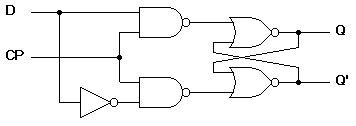
The diagram does not seem to be right. If the clock is zero then both outputs are 1. A correct implementation can be found e.g. at http://wearcam.org/ece385/lectureflipflops/flipflops/ , or more exactly http://wearcam.org/ece385/lectureflipflops/flipflops/fig5a.gif
I agree -- the picture of the D flip-flop is wrong (for the reasons mentioned above). The picture should be removed (and preferably corrected). -- Milom 00:16, 19 September 2006 (UTC)
[edit] SR flip flop
_Flip-flop.svg/100px-SR_(Clocked)_Flip-flop.svg.png)

I don't know if there is such a thing (separate from an SR latch), but i'm putting the picture here until we have a section on an edge triggere SR latch, which i'm sure can be made. Fresheneesz 19:25, 4 November 2006 (UTC)
-
- There is such a thing, but it's very rare in actual use. If you take an SR flip-flop and put an inverter between S and R, then you have a D flip-flop with the "S" input becoming your "D" input. 142.59.195.50 01:17, 30 April 2007 (UTC)
[edit] Master-slave D flip-flop
Regarding the graphic in Master-slave D flip-flop, the double NOT logic from C is quite unnecessary -- it's easier just to branch C and not one side and leave the other side normal. St.isaac 02:15, 1 March 2007 (UTC)
- Master-Slave DFF has two images: the complete implementation using logic gates and partial schematic using two D-latches. I feel that this is redundant and propose to remove the partial implementation (image on the left) and to change the central image to reflect the fact that it is composed of two D-latches with a NOT in between. Michagal 08:50, 29 March 2007 (UTC)
[edit] Q
Is Q an abbreviation for something? --Abdull 15:01, 6 March 2007 (UTC)
- Welcome to the world of digital electronics! The real answer is nobody knows. Just like how nobody knows why Vcc and Vss are often used for power connections. They are merely standards that have been adopted because certain papers whom used the values become popular many many years ago.--Dacium 06:54, 5 April 2007 (UTC)
[edit] shakeel_abbasqau@yahoo.com
Note that it is just to store data temporarily, this type of memory formed by the flipflops is volatile which means that it depends on voltage —The preceding unsigned comment was added by 202.83.169.218 (talk) 06:14, 3 May 2007 (UTC).
[edit] Additional information (correction) about SR flip-flops and news about JK flip-flops
A lot of articles has been written about SR flip-flops. Although the SR flip-flop is very simple, I have read some wrong conclusions. Very often it is forbidden to connect both inputs S and R simultaneously with 1-signal (NOR-gates used), or in other cases the status of the flip-flop is called 'unstable'. In my opinion this is wrong. The only consequence is, that this status cannot be stored. There is only one problem if S and R get a 0-signal simultaneously after S and R has received a 1-signal before. In this case it is indefinite which state will follow (Q=1 or Q=0). Especially this 3rd status of a SR flip-flop makes it possible to create ideal pulse circuits to pulse flip-flops (normally RC combinations are used) for instance. The usage of such ideal pulse circuits can be a basis to construct non clocked JK flip-flops
Perhaps it might be necessary in future to differ between edge-triggered clock and other inputs. Please find the details and diagrams of ideal pulse circuits and non clocked JK flip-flops in an article "Ideal pulse circuit without RC-combination and non-clocked JK flip-flop"
on my homepage below.
http://www.hpc-berlin.de/dokumente/flipflop_en.pdf
--Klaus-Eckart 12:51, 13 September 2007 (UTC)
[edit] Timing and metastability
Under "Timing and metastability", this line "In many cases, metastability in flip-flops can be avoided by ensuring that the data and control inputs are held constant for specified periods before and after the clock pulse, called the setup time (tsu) and the hold time (th) respectively." is a bit unclear and ambiguous. I first thought tsu and th was the time the flip-flop waited before it accepted any input. So "the data and control inputs" refers to _external_ drives? Should the sentence be reformulated? 129.241.203.41 12:14, 11 October 2007 (UTC)
- I agree. The metastability can be avoided in ``all cases``, not ``in many cases`` by observing Ts and Th. The definition of tsu and th is the specified time flip-flop's input has to remain '0' or '1' before and after clock's active edge. Michagal 12:32, 11 October 2007 (UTC)
[edit] Edge-triggered D flip-flop
I was wondering how the picture below is positive edge triggered. When the signal changes from high to low the data is stored, not when it changes from low to high. Is the clock signal inverted? If so, it should be stated that the picture is negative edge triggered.

[edit] Gate bias
The article does not explain the historical bias/suitability of NAND gates over AND, OR, XOR, NOR and XNOR to implement flip-flops.Anwar (talk) 17:26, 22 May 2008 (UTC)