Eugene Lyons
From Wikipedia, the free encyclopedia
Eugene Lyons (1 July 1898–7 January 1985) was a U.S. journalist and writer. At one time a Communist fellow-traveler, he became highly critical of the Soviet Union after he lived there for a few years.
He was born to a Jewish family in Uzlyany in what is now Belarus but grew up on the East side of New York City among the teeming and odiferous tenements of Sidney Kingsley’s Dead End.
Contents |
[edit] Education
Lyons attended the Socialist People’s School. In his Socialist Sunday School on East Broadway, he had chanted such hymns as Arise, ye prisoners of starvation and The People's flag is deepest red. From there he graduated to the Young People’s Socialist League where he was schooled in the alternative vision of life without the capitalist exploiters. In 1916, he enrolled in the College of the City of New York. The next year he transferred to Columbia University. He enlisted in the Army in 1918. He wrote in "Assignment in Utopia" that he was demobilized and honorably discharged, and that on the day he removed his uniform wrote his very first story.
[edit] Early Life
He wrote his first story for Elizabeth Gurley Flynn and the Workers Defense Union. It was a publicity story that appeared in the New York Call and other socialist publications.
In 1922, Lyons became editor of Soviet Russia Pictorial, an early illustrated American magazine glorifying the new Bolshevik state. Lyons would describe it as “the mouthpiece of the Friends of Soviet Russia.”
Lyons wrote of this period, "Unhesitatingly, I cast my lot with the communists. I devoted the next five years largely to Soviet activities."[1]
[edit] Sacco and Vanzetti
His first book, published in 1927, was “The Life and Death of Sacco and Vanzetti” in which he argued their innocence. The book made him a sort of hero among the left-wing, and is still cited as a principal source for the case.
His coverage of Sacco and Vanzetti sent him not only to Boston, but to Italy where he found Sacco's elder brother was the "the Socialist sindaco (mayor) of Torremaggiore. Lyons wrote, "Red flags were flying over the municipal building and the cooperative store, and nearly every infant born since November, 1917, was named for some Bolshevik deity."[2] By the time Sacco and Vanzetti were executed on August, 23, 1927, Lyons had become famous.[3]
[edit] Moscow Days
He was working for Tass, the official Soviet news agency, when he joined United Press International as its Moscow correspondent. Although Lyons never joined the Communist party, he was considered a fellow traveler and had close ties to the Communist Party of the USA. UPI thought his background and his close contacts would give it an edge over its competition. He sailed to Russia and held the position from 1928 until 1934.
The years Lyons spent in the USSR were an eye-opening experience and transformed him from a friend of the Soviet State and Communism into a tireless and fierce critic of both for the rest of his life.
[edit] His Meeting with Stalin
The highlight of his Moscow days was his meeting with Stalin. On November 23, 1930, he was summoned to the Kremlin.
Lyons was the first of only six Occidentals to interview Stalin during this period.
In "Moscow Carrousel", Lyons wrote, "Since 1927, when he assumed supreme control, Stalin has talked for publication to only six foreigners. In the order in which this boon was granted, the unique six were: Eugene Lyons, Walter Duranty, George Bernard Shaw, Emil Ludwig, Henri Barbusse, and H. G. Wells." Lyons began his interview with Stalin by asking, "Comrade Stalin, may I quote you to the effect that you have not been assassinated?" At the time, world headlines were proclaiming his assassination. Time Magazine reported on this scoop on December 8, 1930, in its article, Moscow Scoop.
[edit] Assignment in Utopia
Possibly his most important work was Assignment in Utopia. Published in 1937, it was partly an autobiography but mostly an account of his time in the USSR. It was highly critical of Stalin and his regime, although from within a left-wing standpoint. (For example, he did not claim that the Russian people were actually better off under Tsarism, although they may well have been better off under NEP.)
The book received favorable comments from a number of people and influential magazines.
One was George Orwell. [4] The book was an influence on Orwell and on his novel Nineteen Eighty-Four. One of the chapters in the Lyons' book was titled, Two Plus Two Equals Five. Lyons wrote that this was common slogan shouted and posted throughout the Stalinist Soviet. Orwell later used this slogan in his classic novel 1984. (See Two + two = five.)
Leon Trotsky initially praised the book but [5] but later became quite critical of Lyons.[6]
[edit] Shakhty Sabotage Trial
In his coverage of the Shakhty Trial of 1928, a precursor to the later show trials, the one time champion of Sacco and Vanzetti could not rid himself of his belief that those charged must be guilty of something even as he came to believe the trial was a hoax and that the accused men were baited and badgered and denied a chance to defend themselves.
He wrote in Assignment in Utopia, "I had proceeded on the assumption that the revolution could do no wrong, since even its crimes are justified by its mystical mandates from History."[7]
He continued:
"...I felt certain of only these things: First, that most, if not all, of the accused men were guilty either of actual sabotage against the Soviet regime, or of such utter apathy toward their work that the results amounted to sabotage...Second, that the melodramatic international plot projected by the Soviet rulers to impress their people and the outside world was largely a figment of their own stagecraft. Third, that behind the trial was a story of mass arrests, forced confessions, unprincipled and inhuman third-degree methods that broke the body and the spirit of its victims." [8]
[edit] Red Decade
He also wrote The Red Decade, an examination of CPUSA influence on American cultural life during the 1930s. Ironically it did not prove very popular at the time it was published, since soon after this the Soviet Union became an American ally, but its title became a byword during the era of McCarthyism. In 1941, Time Magazine reported that Corliss Lamont filed suit against Lyon's publisher for naming him as a fellow traveler. Time article: World War
[edit] Exposing Duranty
Lyons was among the earliest writers to expose the perfidies of New York Times Moscow reporter Walter Duranty and the deliberate concealments of Anna Louise Strong. Writing about Duranty in the "Red Decade", Lyons would say, "Of all his elliptical writing, perhaps his handling of the famine was the most celebrated. It was the logical extreme of his oft-repeated assertion that 'you can't make an omelet without breaking eggs.' Now he made his omelet by referring to the famine as 'undernourishment.' "
[edit] Denying Jones
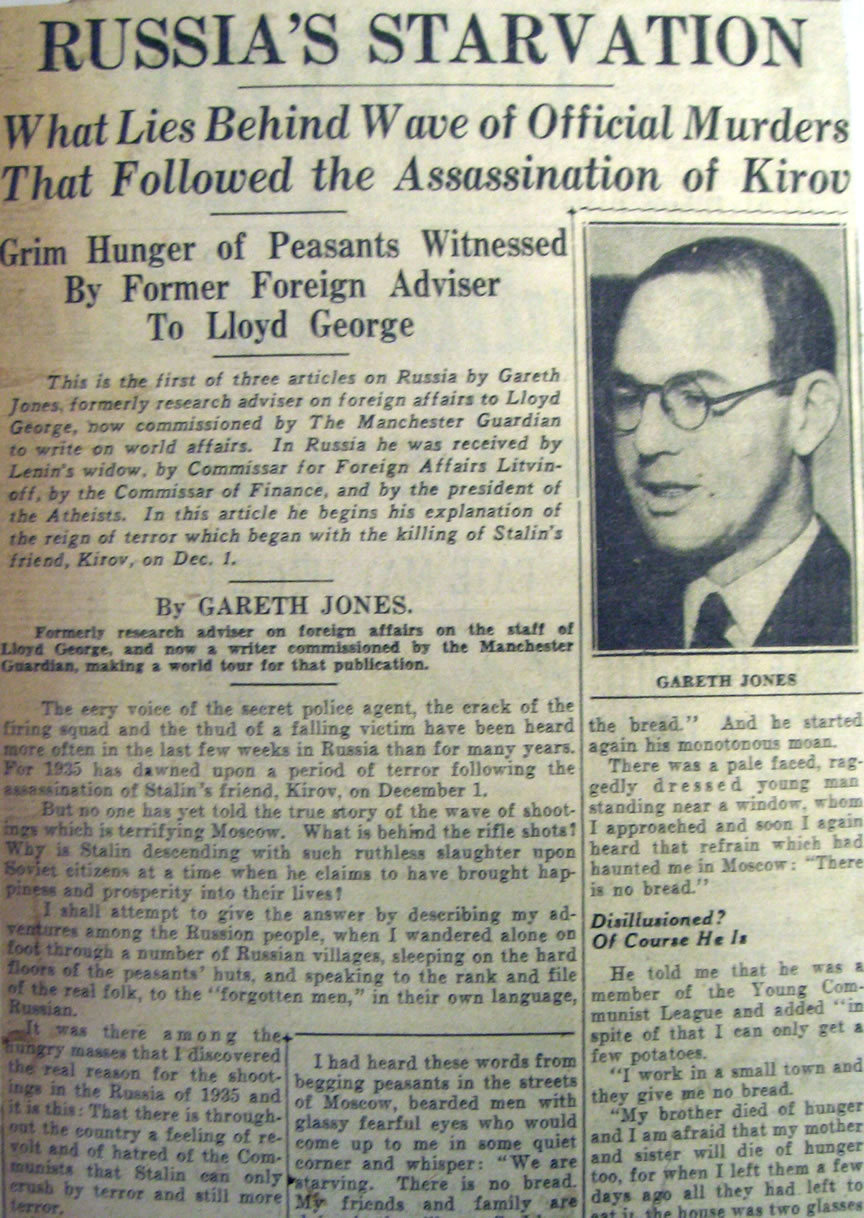
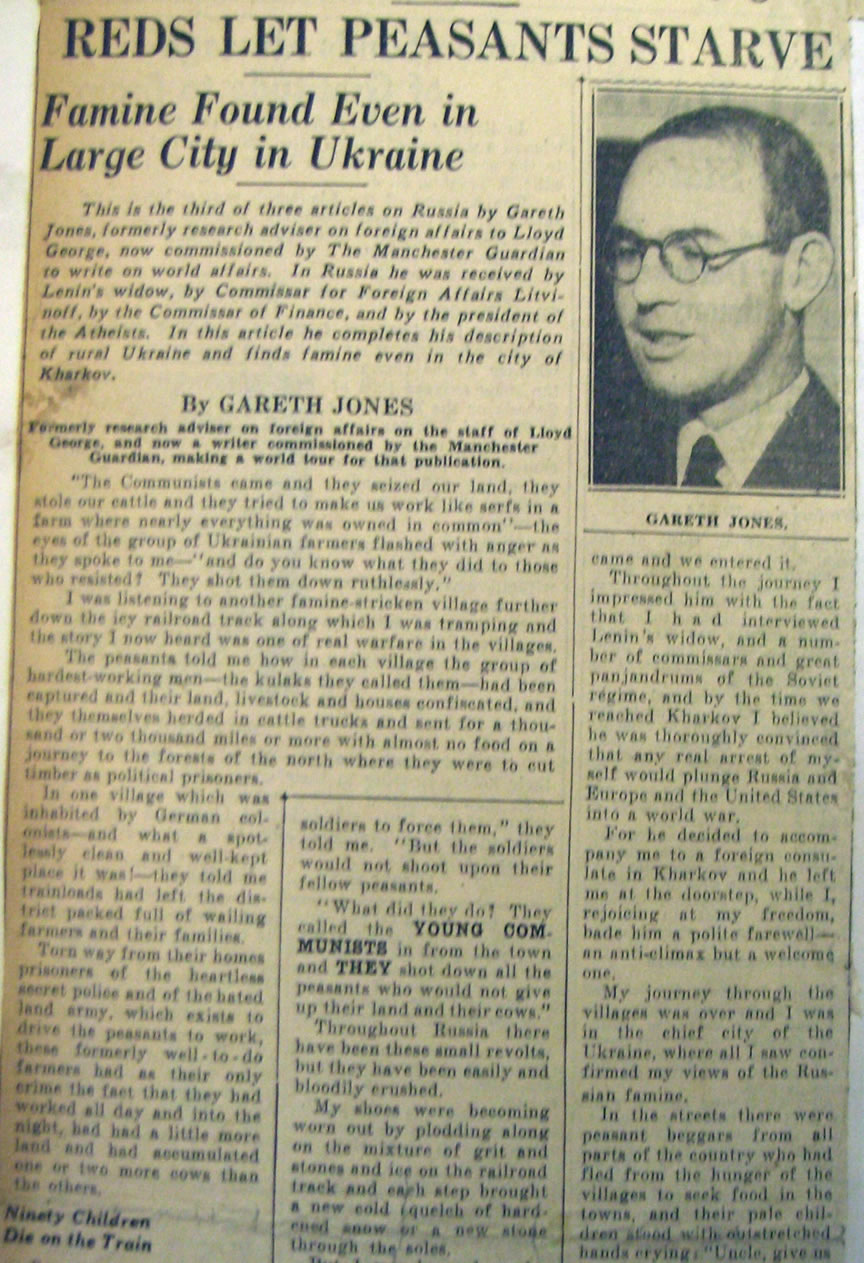
Lyons himself had played an earlier role in the concealment of the famine in the Ukraine when he denounced, as did Duranty, journalist Gareth Jones, as a liar. Jones had written the first reliable reports of the famine. Lyons wrote in Assignment to Utopia, "Throwing down Jones was as unpleasant a chore as fell to any of us in years of juggling facts to please dictatorial regimes—but throw him down we did, unanimously and in almost identical formulas of equivocation. Poor Gareth Jones must have been the most surprised human being alive when the facts he so painstakingly garnered from our mouths were snowed under by our denials."
[edit] Later Life
In later years his political views shifted to the right, and for a time he was editor with Reader's Digest, Plain Talk and National Review. He was also involved with Radio Free Europe.
Eugene Lyon's first cousin was David Sarnoff, the chairman of the Radio Corporation of America and founder of NBC. Lyons wrote a biography on him.
In 1935, Lyons, along with Charles Malamuth translated and adapted the popular Russian comedy, Valentin Katayev's Squaring the Circle which had been staged at the Moscow Art Theater in 1928.
[edit] External links
- guide to his papers with a short biography
- Extract from Assignment in Utopia on the famine of 1932-33
- essay which discusses The Red Decade
- Time Magazine article on the publication of "The Red Decade"
- The denigration of Gareth Jones by Walter Duranty in The New York Times, Friday March 31st 1933.
- Time Magazine on Assignment to Utopia
- Old & New Bolsheviks - an article about Lyon's views of the Moscow Trials.
- Stalin Laughs! - Time Magazine's report of the Lyon's interview of Stalin where Lyon's described Stalin as the Soviet Teddy Roosevelt.
- Kataev's Squaring the Circle
[edit] Bibliography
- The Life and Death of Sacco and Vanzetti. International publishers, New York 1927.
- Modern Moscow. Hurst & Blackett, London 1935.
- Moscow carrousel. Knopf, New York 1935.
- Assignment in Utopia. Harcourt, Brace & Co, New York 1937.
- Stalin, czar of all the Russias. Lippincott, Philadelphia 1940.
- The red decade; the Stalinist penetration of America. Bobbs-Merrill, Indianapolis 1941.
- Our unknown ex-President, a portrait of Herbert Hoover. Doubleday, Garden City 1948.
- Our secret allies, the peoples of Russia. Duell, Sloan and Pearce, New York 1953.
- Herbert Hoover, a biography. Doubleday, Garden City 1964.
- David Sarnoff, a biography. Harper & Row, New York 1966.
- Workers’ paradise lost; fifty years of Soviet communism: a balance sheet. Funk & Wagnalls, New York 1967.
[edit] References
- ^ Eugene Lyons, Assignment in Utopia, Harcourt, Brace and Company, (1937) P. 37
- ^ Eugene Lyons, Assignment in Utopia, Harcourt, Brace and Company, (1937) p. 24
- ^ An American Engineer in Stalin's Russia, The Memoirs of Zara Witkin, 1932–1934, Editor's Introduction p. 3, UNIVERSITY OF CALIFORNIA PRESS, (1991)
- ^ The Collected Essays, Journalism and Letters of George Orwell
- ^ Leon Trotsky: Twenty Years of Stalinist Degeneration (1938)
- ^ Leon Trotsky: 1942: In Defense of Marxism Chapter IV
- ^ Eugene Lyons, Assignment in Utopia, Harcourt, Brace and Company, (1937) P. 118
- ^ Eugene Lyons, Assignment in Utopia, Harcourt, Brace and Company, (1937) P. 132