Talk:Enhanced Fujita Scale
From Wikipedia, the free encyclopedia


Here are the first two tornadoes that may be ranked on the new scale. They occurred on 2/1/07:
0815 LADY LAKE LAKE FL 2893 8193 PRELIMINARY REPORT. DOWNED TREES, POWER LINES AND DAMAGE TO STRUCTURES IN LADY LAKE AREA VICINITY HWY 27 AND OAK HILL ROAD (MLB)
0820 THE VILLAGES LAKE FL 2895 8194 POSSIBLE TORNADO. LAKE COUNTY E. M. REPORTS EXTENSIVE DAMAGE TO HOMES AND MOBILE HOMES IN THE VILLAGES AND LADY LAKE AREAS WITH AT LEAST ONE POSSIBLE FATALITY. ADDITION (MLB)
- Its too bad that the new scale will be used so soon. LK Thurisaz 16:28, 6 February 2007 (UTC)
could someone please proofread this page (and related pages):
"obselete"? "cleanly connected"?
Contents |
[edit] Image for EF5 damage
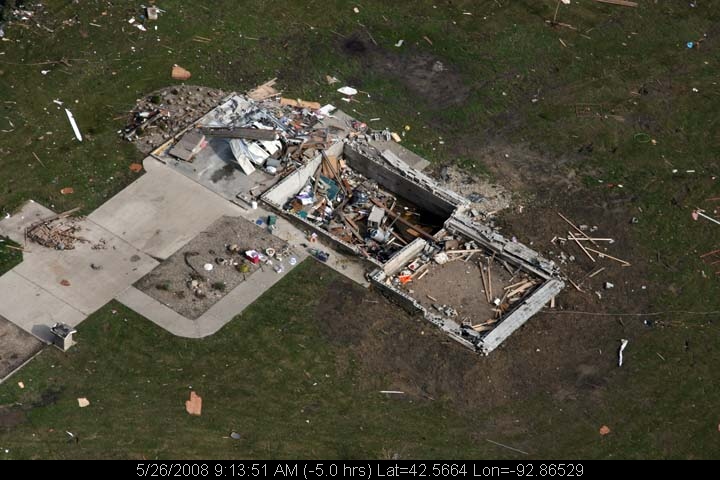
131.81.200.158 18:23, 8 February 2007 (UTC)I suggest that the picture at this link: http://www.srh.noaa.gov/oun/storms/19990503/damage/mikeb.html may be useful to indicate damage at the EF5 level. It is from the Moore, OK tornado of 3 May 1999. The foundation of a frame house has been stripped *clean* and clearly shows the marks left by the adhesive used to fix the carpet battens. Even the carpet battens themselves were blown away. It is available on a US government site, and as such is uncopyrightable.
- It does indicate F5 damage, but I am unsure that it would qualify as an EF5, as the new scale predicts complete destruction of frame houses at EF4 intensity. I do agree that that would probably be rated EF5, but until an outside source confirms it. -RunningOnBrains 17:16, 14 February 2007 (UTC)
-
- To be fair, none of the other pictures are of "real" EF-based damage, either. They're historical pictures that were used as samples. I agree that recent pictures would be better, but I think the NWS's images should be considered standard until such images are available - especially in the obvious case of the Moore, OK tornadoes. 5minutes 13:18, 25 April 2007 (UTC)
-
-
- Yes, they're historical examples, but historical examples that do meet the EF criteria (associated wind speed for DOD for the respective DI); so in that sense it's irrelevant when the rating occurred, just as tornadoes back to 1950 were assessed well after the fact during the 1970s (and further back for the Tornado Project/Grazulis database). New events are preferable, I agree, but any event that meets the criteria is better than not having any example. The problem is that there are no examples provided in the EF-Scale document meeting the new EF5 criteria. If an official source (TTU or other qualified engineers like Tim Marshall, the NWS, maybe SPC, etc.) is found then provide it, but it must be authoritatively rated and sourced. For what it's worth, the current F5 example is a photograph by Chuck Doswell and appears to be EF5 if construction quality and other mediating factors aren't negative --which one would guess are not if Doswell rated the structure. In WISE's October 2006 revision, the maximum DOD for FR12 has an associated wind speed of 200 mph, which is EF5. Evolauxia 16:10, 25 April 2007 (UTC)
-
-
-
-
- I feel ya. The whole migration from the old scale to the new scale seems to be a bit haphazard, and I think this article is merely a victim of the whole process. Frankly, I'm not a fan of it. I'm not even a fan of measuring based on damage. I say we need to measure the blasted things based on estimated wind speeds. If Saffir-Simpson can do it, so can the descendants of Fujita. 5minutes 15:03, 27 April 2007 (UTC)
-
-
-
-
-
-
- Except in a practical sense that is impossible. The task of measuring the windspeed for the entire lifetime of every tornado is rediculous. Many times, tornadoes are not recognized until hours or even days after they have already dissipated.
-
-
-
-
-
-
-
- The reason a windspeed scale works for tropical cyclones is that not only are the maximum winds in a TC spread out over several, sometimes dozens of miles, but they do not change intensity over the scale of seconds, as tornadoes do. TCs rarely change more than a few mph over an hour, except when weakening over land. Also, TCs with the same intensity tend to have the same characteristics when viewed by a satellite, thus the Dvorak scale can be used.
-
-
-
-
-
-
-
- The appearance of a tornado only loosely correlates to its intensity. Tornadoes with different wind speeds can cause different damage. Also, when a tornado passes only over open fields, there is no way to even approach a good estimate on the wind speeds. Therefore a damage scale is the only reasonable thing to use, with wind estimates used loosely. -RunningOnBrains 20:04, 27 April 2007 (UTC)
-
-
-
-
- So, is the picture related to EF5 damage going to be changed to something that actually explicitly shows EF5 damage? Its very inconsistent to show explicitly the damage to a home in all other pictures, then show a helicopter shot containing mostly EF2-4 damage with EF5 damage hard to spot. It has nothing to do with the spatial distribution of damage. --Slincoln (talk) 05:19, 28 May 2008 (UTC)
[edit] EF-scale elsewhere
Is the scale being used in other countries, or are they staying with the old Fujita scale (at least for now)? CrazyC83 22:35, 13 February 2007 (UTC)
- No idea - but the new scale doesn't make any sense at all. It is next to impossible to measure the windspeed of a tornado and that's the only thing that changes in the new scale. The tornado's strength will still be measured by the damage it caused. The new scale is no enhancement but sheer nonsense. --Maxl 13:49, 14 February 2007 (UTC)
- Except it is an improvement. The wind speeds are based on estimates by experts in meteorology and engineering. And while they are still just estimates, they are much better than the previous scale. Also, on the old scale there were few or no provisions for estimating the damage on structures other than ordinary frame houses. The new scale has damage levels for 26 different types of structure, and for hardwood and softwood trees. It is very much an improvement over the old system. -RunningOnBrains 17:16, 14 February 2007 (UTC)
- If this is so the article still lacks a lot of info on all those 26 different types of structure. It should make sense to explain them all in at least some depth. --Maxl 23:13, 22 February 2007 (UTC)
- Except it is an improvement. The wind speeds are based on estimates by experts in meteorology and engineering. And while they are still just estimates, they are much better than the previous scale. Also, on the old scale there were few or no provisions for estimating the damage on structures other than ordinary frame houses. The new scale has damage levels for 26 different types of structure, and for hardwood and softwood trees. It is very much an improvement over the old system. -RunningOnBrains 17:16, 14 February 2007 (UTC)
Most other countries will continue to use the Fujita scale (or TORRO scale), for the foreseeable future. There has been some discussion of similar projects for Europe and other areas, as the new scale is biased towards US construction practices, but the resources aren't there yet. The EF scale is an improvement, the wind speeds *were* overrated and it is less ambiguous and much more detailed degrees of damage with many more damage indicators, but it is not without its new problems. I've added the DIs, and will add the DODs eventually (that will be a chore). Evolauxia 08:28, 7 April 2007 (UTC)
[edit] Possible First EF-5
First EF-5? One of the local news stations is reporting that the tornado that hit Greensburg, KS on May 4th has been rated an EF-5 (http://www.kake.com/home/headlines/7359591.html). However, I can't find any other news sources to corroborate this, nor can I yet find a public domain image of the damage. Just giving a heads-up. 68.102.231.121 18:13, 6 May 2007 (UTC)
- The NWS, which is the only organization that can issue official ratings, issues "Public Information Statements" and other communiqués that should be taken as the only official source. I've yet to see anything from the Dodge City NWSFO (PNSs) or any other statements. Evolauxia 18:52, 6 May 2007 (UTC)
[edit] EF5 example
Although I have confirmed that the Dodge City NWSFO and NWS Quick Response Team have determined EF5 damage and announced this to the media, there is as yet no official documentation of this. Furthermore, there is nothing stating what was the EF5 damage, or specifically where it was. Evolauxia 19:38, 6 May 2007 (UTC)
-
- There are many examples of EF5 damage. Look for pictures from any of the big recent tornadoes - Moore, Greensburg, Parkersburg, to name some recent ones. Here is a good example that could be used for the EF5 image: [http://mesonet.agron.iastate.edu/cases/080525/iowa_helicopter_survey/IMG_6391.jpg Iowa Helicopter Aerial Survey of Parkersburg, IA Slincoln (talk) 05:24, 28 May 2008 (UTC)
- I think you are confused by the timing of the above comment; it was made more than a year ago. Regardless, what's needed is a close-up picture of confirmed EF5 damage, which would probably be from an NWS source. Supposedly pictures and more information will be posted tomorrow about the most recent EF5, I'll keep an eye out.-RunningOnBrains 05:42, 28 May 2008 (UTC)
- There are many examples of EF5 damage. Look for pictures from any of the big recent tornadoes - Moore, Greensburg, Parkersburg, to name some recent ones. Here is a good example that could be used for the EF5 image: [http://mesonet.agron.iastate.edu/cases/080525/iowa_helicopter_survey/IMG_6391.jpg Iowa Helicopter Aerial Survey of Parkersburg, IA Slincoln (talk) 05:24, 28 May 2008 (UTC)
[edit] EF0 limit
I know all the sites for the EF scale have shown the lower limit of EF0 at 65 mph. However, several storm surveys have used lower numbers (such as 60 mph) as wind estimates for EF0 tornadoes. Is it really an open-ended lower limit as well? CrazyC83 (talk) 04:28, 9 February 2008 (UTC)
[edit] "well-constructed"
What makes a well-constructed building? --Abdull (talk) 09:34, 9 February 2008 (UTC)
[edit] EF5 possible addition
I am curious, and learning a bit about the editing policies on Wikipedia. When I read over the EF5 description, I recalled a particular movie, "Twister", I believe, in which a character makes an odd interjection, calling the EF5 tornado the "Finger of God". While I am no religious nut in affiliation of this, I wonder, would it be applicable to include a notation to this, if only to reaffirm the recognition of the amazing damages the EF5 can produce? It seems a harmless statement, and it can be rearranged in a number of ways. As said, I am simply curious, and wonder if anyone else can confirm me on this? Jwguy (talk) 07:33, 5 April 2008 (UTC)