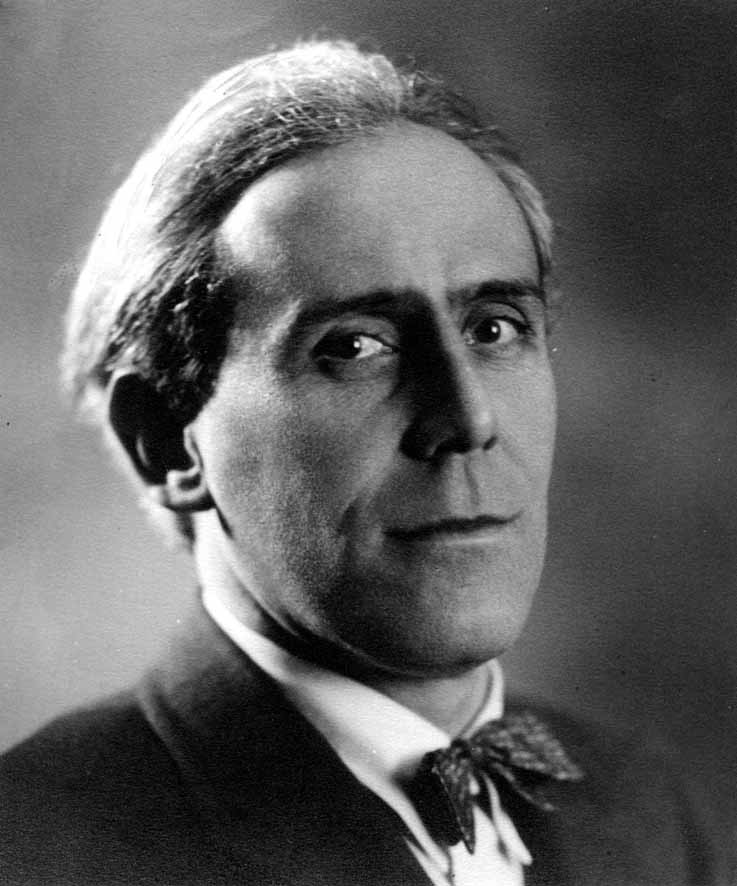
Emil Julius Gumbel
From Wikipedia, the free encyclopedia
Emil Julius Gumbel (July 18, 1891 - September 10, 1966 in New York), was a German mathematician and political writer. Shortly before the outbreak of the First World War he graduated at the University of Munich. Professor of Mathematical Statistics at the University of Heidelberg. Following the murder of a friend he investigated several political murders and published his findings in "Four Years of Political Murder" in 1922.
With L.H.C. Tippett and R.A. Fisher he pioneered the mathematical field of extreme value theory.
Gumbel was a passionate defender of democracy, social justice, and intellectual freedom in Weimar Germany. However his commitment to the causes of peace and justice extended far beyond the chronological and geographical boundaries of interwar Germany. His life was dominated by "the duality of...political and scholarly enterprises" While international recognition for his academic accomplishments as a statistician came later in his life, Emil Gumbel' s political and social activism began quite early. Born in 1891 into an upper-middle class Jewish family in Munich, Gumbel attended the elite Kaiser-Wilhelms-Gymnasium and went on to study at the University of Munich between 1910-1914.
Gumbel became involved in the international peace movement in the final years before the outbreak of World War One. During the war, he moved to Berlin and joined the "Federation for a New Fatherland" and the Unabhangige Sozialdemokratische Partei Deutschlands (USPD). As Brenner suggests, Gumbel's wartime activism and campaign against government propaganda convinced the young activist that "silence equalled calamity". Gumbel's commitment to speakout and defend his beliefs regardless of the consequences became a hallmark of his future career as an academic and a political activist.
Gumbel's democratic, nonrevolutionary socialist vision led him to support the Weimar Republic, while openly condemning the extremist Right which sought to destroy it. Brenner argues that Gumbel's weapon of choice in the campaign against political violence was the expose. His two best known works, Zwei Jahre Mord and Vier Jahre politischer Mord, provided damning evidence of the pernicious role of right-wing violence perpetrated by Geheimbunde and Ferngerichte, as well as the clear rightist bias of the Weimar legal system.
However, Gumbel's outspoken critique of right-wing violence and the senselessness of war ultimately destroyed his academic career – see the "Gumbel Affair" at the University of Heidelberg from 1924-1932. Appointed to the university as a Privatdozent in statistics, Gumbel frequently faced heavy criticism within and outside of the university for his controversial political positions. Brenner persuasively demonstrates how Gumbel's professional and social marginalization gradually eroded any lingering support for the controversial professor. In 1932, after losing a lopsided battle with the press, conservative faculty, and vocal Nazi-led student groups, the university revoked his teaching license and terminated his appointment. Ironically, it was Gumbel's removal in 1932 that probably saved his life.
In 1932 Gumbel emigrated to Paris and lived the trying life of an exile in France and the United States until his death in 1966. While Gumbel continued to work with CmigrC groups like the "German Popular Front" and the "Council for a Democratic Germany," Gumbel' s academic career became increasingly important in this period. From 1953 until 1966, Gumbel produced his finest scholarly work while serving as an adjunct professor of engineering at Columbia University.
Unfortunately, Gumbel did not keep a diary and his personal correspondence was either lost in Europe or destroyed after his death.
Emil Gumbel: Weimar German Pacifist and Professor by Arthur Brenner
Books about Emil Gumbel:
- Arthur David Brenner, Emil J. Gumbel: Weimar German Pacifist and Professor, ISBN 0-391-04101-0
[edit] See also
[edit] External links
 |
This article about a German mathematician is a stub. You can help Wikipedia by expanding it. |