Edinger-Westphal nucleus
From Wikipedia, the free encyclopedia
| Brain: Edinger-Westphal nucleus | ||
|---|---|---|
 |
||
| Section through superior colliculus (unlabeled) showing path of oculomotor nerve. ("Edinger-Westphal nucleus" is not on diagram, but would be near oculomotor nuclei.) | ||
 |
||
| Figure showing the different groups of cells, which constitute, according to Perlia, the nucleus of origin of the oculomotor nerve. 1. Posterior dorsal nucleus. 1’. Posterior ventral nucleus. 2. Anterior dorsal nucleus. 2’. Anterior ventral nucleus. 3. Central nucleus. 4. Nucleus of Edinger and Westphal. 5. Antero-internal nucleus. 6. Antero-external nucleus. 8. Crossed fibers. 9. Trochlear nerve, with 9’, its nucleus of origin, and 9", its decussation. 10. Third ventricle. M, M. Median line. |
||
| Latin | nuclei accessorii nervi oculomotorii | |
| NeuroNames | hier-489 | |
| Dorlands/Elsevier | n_11/12580082 | |
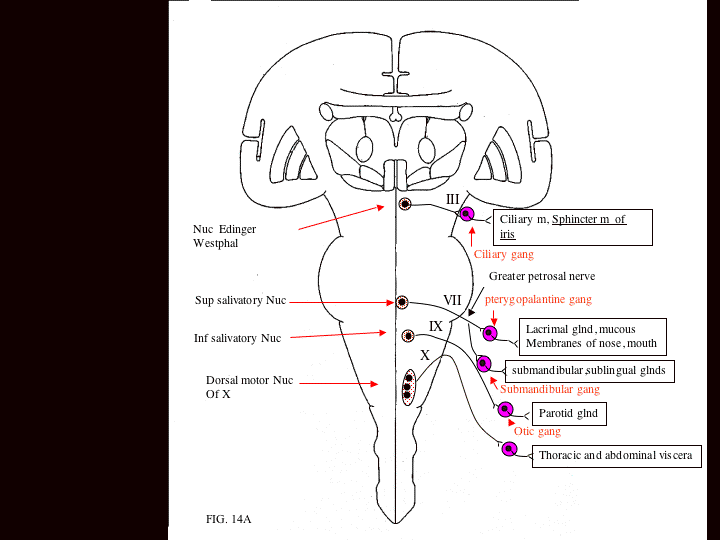
The Edinger-Westphal nucleus (also known as the accessory oculomotor nucleus ) is the accessory parasympathetic cranial nerve nucleus of the oculomotor nerve (cranial nerve III), supplying the constricting muscles of the iris.
Contents |
[edit] Location
The paired nuclei are posterior to the main motor nucleus (oculomotor nucleus) and anterolateral to the cerebral aqueduct in the rostral midbrain at the level of the superior colliculus.
It is the most rostral of the parasympathetic nuclei in the brain stem.
[edit] Function
The Edinger-Westphal nucleus supplies preganglionic parasympathetic fibers to the eye, constricting the pupil and accommodating the lens.
[edit] Eponym
The nucleus is named for both Ludwig Edinger, who demonstrated it in the fetus in 1885, and for Karl Friedrich Otto Westphal, who demonstrated it in the adult in 1887.[1]
[edit] See also
[edit] Additional images
 The cranial nerve nuclei schematically represented; dorsal view. Motor nuclei in red; sensory in blue. |
 Nuclei of origin of cranial motor nerves schematically represented; lateral view. |
 Primary terminal nuclei of the afferent (sensory) cranial nerves schematically represented; lateral view. |
[edit] References
[edit] External links
|
|||||||||||||
|
|||||||||||||||||||||||||||||||||||||||||||||||||||||||||||||||||
 |
This neuroanatomy article is a stub. You can help Wikipedia by expanding it. |
 |
This eye article is a stub. You can help Wikipedia by expanding it. |