Dundee-Happy Hollow Historic District
From Wikipedia, the free encyclopedia
| Dundee-Happy Hollow Historic District | |
|---|---|
| (U.S. Registered Historic District) | |
| Location: | Omaha, Nebraska |
| Architect: | Thomas Rogers Kimball; John and Alan McDonald; others |
| Architectural style(s): | Late 19th And 20th Century Revivals, Late 19th And Early 20th Century American Movements |
| Added to NRHP: | July 22, 2005 |
| NRHP Reference#: | 05000726 |
| Governing body: | Local |
The Dundee-Happy Hollow Historic District is located in Midtown Omaha, Nebraska. It covers the area between Leavenworth Street on the south, Hamilton Street on the north, Happy Hollow Boulevard on the west, and 46th Street on the east. The "heart" of Dundee is located at 50th and Underwood Avenue in Omaha, Nebraska, United States. Founded in 1880 and annexed into the city in 1915, Dundee is home to Warren Buffett, the richest man in the world.
Contents |
[edit] History
The neighborhood was developed in 1880 by John Nelson Hayes Patrick, and has been dubbed Omaha's first suburb.
Patrick hired Shannon Brothers of Kansas City to construct six homes between 48th and 52nd Street, Capitol to California. The brothers had just converted the Kansas City Fairgrounds on the edge of Downtown Kansas City into a planned residential development called Dundee Place and they hoped to do the same in Omaha. Unlike other suburban development where the houses look similar, the houses in Dundee were built to look distinctive.
The Omaha Herald on October 30, 1888 noted neighborhood covenants required that the buildings be for residential purposes only, stand at least 25 feet away from the street, cost least $2500, and not be "used for any immoral or illegal business, nor shall any spirits or malt liquors be sold or bartered away."
The houses did not initially sell well and the developers set out to create the neighborhood as a self-contained village. Developers planted 2,000 maple trees along the roadways (one of which was named Underwood for one of the developers). In 1905 developer Walter L. Selby offered free lots if the buyer built. If the buyer stayed for more than a year he got a bonus of $500. Interest in the neighborhood skyrocketed and the developers expanded to be south of Dodge Street and north of Cuming Street.
C.C. and J.E. George laid out Happy Hollow Boulevard and developed the area south of Dodge and west of 50th to Elmwood Park. They filled in the creek that ran along 50th Street and added sidewalks and the Dundee lights. Homes in the area reflected the Colonial, Georgian and Tudor Revival styles. Omaha annexed Dundee on June 20, 1915. At that time it was 0.7 mi² and had 2500 residents.[2]
[edit] World War II bombing
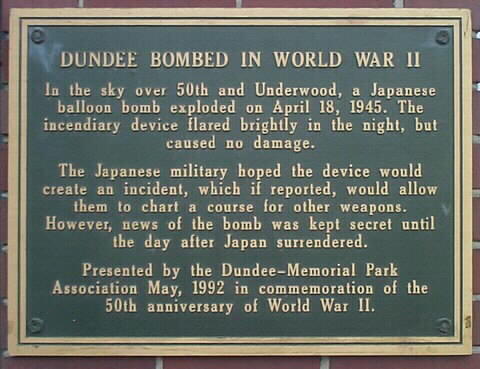
In April 1945 a Japanese fire balloon exploded over Dundee. The incident was part of a large World War II campaign by the Japanese military to cause mass chaos in American cities. However, the story was suppressed by the American military until after the war was over. Nobody was hurt in the explosion.[3][4]
[edit] Present
This central Omaha neighborhood is home to Dundee Elementary School, which is in the Omaha Public Schools district. Brownell-Talbot School is a historic, traditionally Episcopalian school. The area is renowned for its numerous historic residences. Two major area parks are in the neighborhood: Memorial Park and Elmwood Park. St. Margaret Mary Catholic Church and Dundee Presbyterian Church are among many congregations in Dundee. The area is home to numerous businesses, including Dundee Dell. The area is promoted and preserved by Dundee-Memorial Park Association.
Warren Buffett, the "Oracle of Omaha" who is ranked by Forbes Magazine as the richest man in the world, lives in a house bought for $31,500 in 1958 in Dundee.
[edit] See also
[edit] References
- ^ National Register Information System. National Register of Historic Places. National Park Service (2007-01-23).
- ^ History of Nebraska - Chapter 35, retrieved 14dec2006
- ^ (2004) "Omaha Was Bombed During WWII: Keeping Secret Was Some People's Effort To Help War," KETV.com. 7/14/07. Retrieved 7/7/07.
- ^ (nd) Dundee Bombing. HistoricOmaha.com. Retrieved 7/7/07.
[edit] External links
- Dundee-Memorial Park Association
- Dundee Presbyterian Church Website
- Dundee Place Plat, 1891. Dundee Place, Douglas Co., Neb Original Plat, 1891. Retrieved on August 3, 2005.
- Dundee Place Plat, 1915. Dundee Place, Douglas County, Nebr Plat, 1915. Retrieved on August 3, 2005.
- Dundee-Happy Hollow Historic District is at coordinates Coordinates:
|
||||||||||||||
|
||||||||||||||||||||