Defence Research and Development Organisation
From Wikipedia, the free encyclopedia
| Defence Research and Development Organization | |
 DRDO Seal |
|
| Agency overview | |
|---|---|
| Formed | 1958 |
| Headquarters | DRDO Bhavan, New Delhi |
| Employees | 30,000 (5,000 scientists) |
| Annual Budget | US$ 1.18 billion (2006)[1] |
| Minister Responsible | A.K. Antony, Defence Minister of India |
| Agency Executive | M. Natrajan, Director General, DRDO and Scientific Adviser to Defence Minister |
| Website | |
| www.drdo.org | |
|
|||||||||||||||||||||||||||||
The Defence Research and Development Organisation (DRDO) (Hindi: रक्षा अनुसंधान एवं विकास संघठन, Rakṣā Anusandhān evaṃ Vikās Saṃghaṭhan) is one of Asia's largest defence contractors and a leading aerospace manufacturer, headquartered in New Delhi, India. It was formed in 1958 by the merger of Technical Development Establishment and the Directorate of Technical Development and Production (DTDP) with the Defence Science Organisation (DSO).
DRDO has a network of 51 laboratories which are deeply engaged in developing defence technologies covering various disciplines, like aeronautics, armaments, electronic and computer sciences, human resource development, life sciences, materials, missiles, combat vehicles development and naval research and development. The organisation includes more than 5,000 scientists and about 25,000 other scientific, technical and supporting personnel.
Contents
|
[edit] Projects

In recent years, the DRDO has achieved success in several projects whilst it has been also dogged by criticism that others have faced time and cost overruns.
[edit] Aeronautics


- The DRDO is responsible for the ongoing Light Combat Aircraft program. A 4.5th generation jet fighter, the LCA is intended to provide the Indian Air Force with a modern, Fly by wire, multi-role fighter, as well as develop aviation industry in India. The program has been ambitious, with time and cost over-runs as in similar programs worldwide. The LCA program has allowed DRDO to progress substantially in field of avionics , flight control systems, aircraft propulsion and composite structures, along with aircraft design and development.[2]
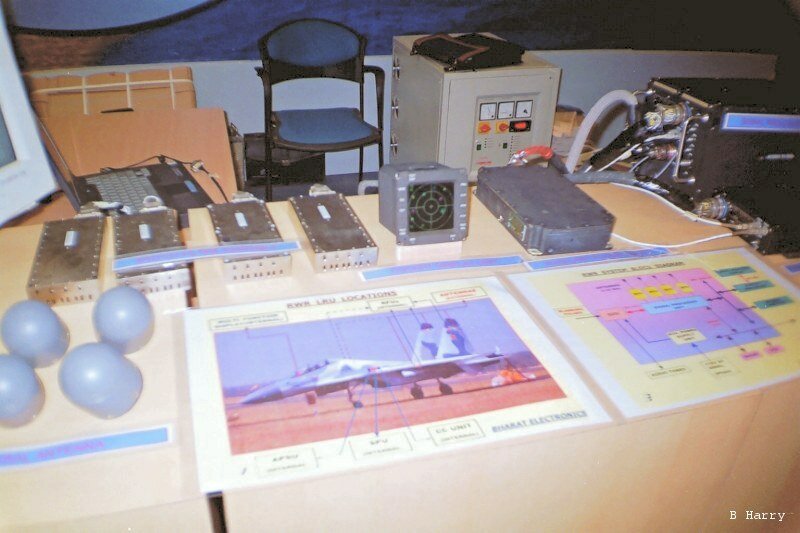
- The DRDO provided key avionics for the Sukhoi Su-30MKI program under the "Vetrivel" program. Systems developed by DRDO include Radar warning receivers, Radar and Display Computers. DRDO's radar computers, manufactured by HAL are also being fitted to Malaysian Su-30 MKM .[3]
- The DRDO is part of the Indian Air Force's upgrade programs for its MiG-27 and Sepecat Jaguar combat aircraft upgrades, along with the manufacturer Hindustan Aeronautics Limited. DRDO and HAL have been responsible for the system design and integration of these upgrades, which combine indigenously developed systems along with imported ones. DRDO contributed subsystems like Tarang Radar warning receiver, Tempest Jammer, Core Avionics Computers, Brake prachutes, Cockpit instrumentation and displays.
[edit] Avionics
The DRDO's avionics program has been a success story; its Mission computers, radar warning receivers, high accuracy direction finding pods, airborne jammers, flight instrumentation, are used across a wide variety of Indian Air Force aircraft. The organization began developing these various items for its upgrades, and for the LCA project. Variants were then developed for other aircraft. The lead designer in several of these efforts has been DARE, or the Defence Avionics Research Establishment. Other laboratories have also chipped in, from the radar specialist LRDE, to Electronic warfare focused DEAL to the ADE, which develops UAVs and flight control systems. The DRDO is also codeveloping more advanced avionics for the Light Combat Aircraft and the IAF's combat fleet. These include a range of powerful Open Architecture computers, better Defensive avionics including modern RWR's, Self protection jammers, Missile approach warning systems and integrated defensive suites, Optronics systems (such as Infrared search and track systems) and navigational systems such as Ring Laser Gyro based Inertial navigational systems. Other items under development include digital Map generators, a Modern multi-mode fire control radar (the LCA-MMR), Helmet mounted displays and Smart multifunctional displays.
[edit] Other Hindustan Aeronautics Limited programs
Apart from the aforementioned upgrades, DRDO has also assisted Hindustan Aeronautics with its programs. These include the HAL Dhruv helicopter and the HAL HJT-36. Over a hundred LRU (Line Replaceable Unit)'s in the HJT-36 have come directly from the LCA program. Other duties have included assisting the Indian Air Force with indigenization of spares and equipment. These include both mandatory as well as other items.
[edit] Unmanned aerial vehicles


The DRDO has also developed two unmanned aerial vehicles- the Nishant (Restless in Hindi) tactical UAV and the Lakshya (Target in Hindi) Pilotless Target Aircraft (PTA).[4] The Lakshya PTA has been ordered by all three services for their gunnery target training requirements. Efforts are on to develop the PTA further, with an improved all digital flight control system, and a better turbojet engine to be manufactured at HAL.[5] The Nishant is a hydraulically launched short ranged UAV for the tactical battle area, and 12 units have been ordered by the Indian Army. It is currently being evaluated by the Indian Navy and the Indian Paramilitary forces as well. The Indian Air Force is unlikely to order the type since it is a tactical UAV and does not meet their requirements for a long range, high endurance UAV with a heavy payload. The DRDO is also going ahead with its plans to develop a new class of UAVs. These draw upon the experience gained via the Nishant program, and will be substantially more capable. Referred to by the HALE (High Altitude Long Endurance) and MALE (Medium Altitude Long Endurance) designations, these two UAVs will see a consortium approach, with DRDO being supported by partner laboratories including the National Aerospace Laboratories, and private and public firms, including Hindustan Aeronautics Ltd.. The HALE has been tentatively named the Rustom, in honor of Dr Rustom Damania of NAL, and will feature canards and carry a range of payloads, including optronic, radar, laser designators and ESM. The MALE, will be a derivative of the Nishant, but beefed up with more payload, and range ability and will have conventional landing and take off capability. The HALE UAV will probably feature SATCOM links, allowing it to be commanded beyond line of sight. Other tentative plans speak of converting the LCA into a UCAV (unmanned combat aerial vehicle), and weaponizing UAVs.
[edit] Indigenization efforts
DRDO has been responsible for the indigenization of key defence stores and equipment. Indian Air Force pilots use DRDO developed g-suits, flight suits overalls, helmets, oxygen masks, gloves and automatic inflatable life jackets.[6]
DRDO has assisted Hindustan Aeronautics Ltd and the IAF with the indigenization of spares and assemblies for several aircraft. DRDO laboratories have worked in coordination with academic institutes, the CSIR and even ISRO over projects required for the Indian Air Force and its sister services. DRDO's infrastructure is also utilized by other research organizations in India.
[edit] Armaments
DRDO often cooperates with the state owned Ordnance Factory Board for producing its items. These have led to issues of marginal quality control for some items, and time consuming rectification. Whilst these are common to the introduction of most new weapons systems, the OFB has had issues with maintaining the requisite schedule and quality of manufacture owing to their own structural problems and lack of modernisation. Criticism directed at the OFB is invariably used for the DRDO, since the users often make little distinction between the developer and the manufacturer.[citation needed] OFB has got more access to funding in recent days, and this is believed to have helped the organization meet modern day requirements.
Even so, India's state owned military apparatus meets the bulk of its ammunition and the need for "bread and butter" items. The DRDO has played a vital role in the development of this ability since the role of private organizations in the development of small arms and similar "bread and butter" items has been limited. A significant point in case is the INSAS rifle which has been adopted by the Indian Army as its standard battle rifle and is in extensive service. There have been issues with rifle quality in usage under extreme conditions in the cold, the OFB has stated that it will rectify these teething troubles with higher grade material and strengthening the unit for extreme conditions. Prior teething troubles were also dealt with in a similar manner.[6] In the meanwhile, the rifle has found favour throughout the army formations and has been ordered in number by other paramilitary units and police forces. Army officers have commented favourably on the system.[7][8]
In recent years, India's booming economy has allowed the OFB to modernise with more state funding coming its way, to the tune of $400 million to be invested during 2002-07. [7] The organization hopes that this will allow it to become world class; it has also begun introducing new items, including a variant of the Ak-47 and reverse engineered versions of the Denel 14/20 mm anti-material rifles.[9]
In the meanwhile, the DRDO has also forged partnerships with several private sector industrial partners, which have allowed it to leverage their strengths. Successful examples of this include the Pinaka MBRL, which has been assisted significantly by two private developers, Larsen and Toubro Ltd. as well as TATA, apart from several other small scale industrial manufacturers.
The DRDO's various projects may be grouped as follows:
[edit] Small arms
.jpg/250px-INSAS_rifle_(Browngirl06).jpg)
- The INSAS weapon system has become the standard battle rifle for the Indian Army and paramilitary units, with 528,000 rifles required by the Indian Army. By 2000, 269,612 had been supplied. [8] Bulk production of a LMG variant commenced in 1998 [9] and with Army requirements for 37,600. It was designed by the DRDO's ARDE and the Indian Ordnance Factory Board, which manufactures these weapons.[10] The INSAS rifles are stated to be superior to the AK series weapons, in terms of accuracy and lethality. [11] A carbine version has also been developed and 30,000 have been ordered by the Indian Ministry of Home Affairs for its paramilitary units. Various variants of the INSAS have been developed, these include a low powered 9 mm version for police units, as well as the Excalibur, a version with all black furniture and a full-auto mode. The standard Insas has single fire, and 3-round burst, as the Indian Army specified the same. They based this on their combat experience in Sri Lanka, where soldiers, in the heat of battle, often squeezed off entire clips of ammunition, without proper aim and would run short of ammunition later. Aimed 3 round bursts were also stated to be more controllable and precise compared to fully automatic fire.
[edit] Artillery systems and ammunition

- For the Indian Army, the DRDO developed the Pinaka Multi Barrel Rocket Launcher. This system has seen significant success, and orders for two regiments have been placed, apart from the one in service. The Army expects to raise more units in the future. This system saw the DRDO cooperate extensively with the privately owned industrial sector in India, namely the TATA Group's Strategic Electronics Division, and Larsen & Toubro Ltd. [12]
- Under development: A new long range Tactical Rocket System, as of yet not publicly named. The DRDO has commenced a project to field a long range Tactical strike system, moving on from the successful Pinaka project. The aim is to develop a long range system able to strike at a range of 100-120 km, with each rocket in the system, having a payload of up to 250 kg. As a run up to the project, in 2005, the ARDE (DRDO) organised a `brainstorming' meet in Pune. The topic: Aerodynamic and ballistics aspects in the design of spinning long range unguided rockets. Various experts from the DRDO, other institutions and academia participated. The meeting deliberated on preparing a road map with experts discussing problem areas, and deliberating which institutes could make specific contributions and how tasks would be divided. The new MBRS's rocket will have a maximum speed of 4.7 mach and will rise to an altitude of 40 km, before hitting its target at 1.8 mach. There is also a move to put a guidance system on the rockets whilst keeping cost constraints in mind. The DRDO has acquired the IMI-Elisra developed trajectory control system and its technology, for use with the Pinaka, and a further development of the system could presumably be used with the new MBRL as well. The new MBRS is to be ready by 2012 for demonstration to the Army.[10]
- DRDO's ARDE developed 81 mm [13], 120 mm illuminating bombs[14] and 105 mm illuminating shells [15] for the Indian Army's infantry and Artillery.
- The DRDO's ARDE developed a 51 mm Light Weight Infantry Platoon Mortar for the Indian Army. A man portable weapon, the 51 mm mortar achieves double the range of 2 inch mortar without any increase in weight. Its new HE bomb uses pre-fragmentation technology to achieve vastly improved lethality vis a vis a conventional bomb. Besides HE, a family of ammunition comprising smoke, illuminating and practice bombs has also been developed. [16] The weapon system is under production at Ordnance Factories. [17]
- Proximity fuses for missiles and artillery shells. Proximity fuses are used with artillery shells for "air bursts" against entrenched troops and in anti-aircraft and anti-missile roles as well. These systems are in production at various defence public sector units and Ordnance factories. [18]
- Training Devices: These include a Mortar training device for the 81 mm mortar used by the Infantry, a Mortar training device for the 120 mm mortar used by the Artillery, and a 0.50 inch subcalibre training device for 105 mm Vijayanta tank gun.[11]
- The Indian Field Gun, a 105 mm field gun was developed for the Indian Army and is in production at the Ordnance Factory Board. [19] This was a significant challenge for the OFB, and various issues were faced with its manufacture including reliability issues and metallurgical problems. These were rectified over time.
- For the Indian Navy, the DRDO developed Submerged Signal Ejector cartridges (SSE), limpet mines, Short range anti-submarine rockets (with HE and practice warheads), the Indian Sea Mine which can be deployed against ships and submarines both. The DRDO also designed short and medium range ECM rockets which deploy chaff to decoy away anti-ship homing missiles. In a similar vein, they also developed a 3 in (76.2 mm) PFHE shell, prefragmented and with a proximity fuse [20], for use against anti-ship missiles and other targets, by the Navy. All these items are in production.[12][13]
- For the Indian Air Force, DRDO has developed Retarder Tail Units and fuze systems for the 450 kg bomb used by strike aircraft, 68 mm "Arrow" rockets (HE, Practice and HEAT) for rocket pods used in an air to ground and even air to air (if need be), a 450 kg high speed low drag (HSLD) bomb (as draggy munitions adversely impact aircraft payload and endurance) and practice bombs (which mimic different projectiles with the addition of suitable drag plates) and escape aid cartridges for Air Force aircraft. All these items are in production at the State owned Ordnance Factories.[14][15]
[edit] Tank armament

DRDO's ARDE also developed other critical systems, such as the Arjun Main Battle Tank's 120 mm rifled main gun and is presently engaged in the development of the armament for the Future IFV, the "Abhay". The DRDO is also a member of the trials teams for the T-72 upgrade and its Fire control systems. Earlier on, the DRDO also upgraded the Vijayanta medium tank with new fire control computers.
[edit] Electronics and computer sciences
The following are some of the more well known projects, as available from public sources.
[edit] Electronic warfare
[edit] EW systems for the Army
- Samyukta is India's largest electronic warfare system. It is a land based EW project, comprising of 145 vehicles. The Samyukta consists of ESM and ECM stations for both communication and non-com (radar etc) systems. The Indian Army has ordered the Samyukta with its Signal Corps being a prime contributor in the design and development stage, along with the DRDO's DLRL. Prominent partners in the effort included India's multi-billion dollar Tata Group of Industries and state owned Bharat Electronics and Electronics Corporation of India. Various other industries supplied locally made components. The scale of this venture is substantial- it comprises COMINT and ELINT stations which monitor different bands for both voice/ data as well as radar transmissions, as well as jam them. In contrast to other systems, many of which perform some of the functions of the Samyukta, the latter is an integrated entity, which can perform the most critical battlefield EW tasks in both COM and Non-COM roles. The system will be the first of its type in terms of its magnitude and capability, in the Army. Its individual modules can also be operated independently. The project has assisted the development of a local ancillary industry, for supplying critical electronic components. Command entities of the COM segment, intended for intercepting and jamming communications transmissions have been delivered. The non-Com (radar) segment is currently under trials and to be delivered by 2007. The Samyukta project has followed a consortium approach and with the end user, namely the Army's Corp of Signals, being closely involved throughout the project. Various public and private firms have been involved in the program, as system integrators to subsystem designers and manufacturers, with DRDO being responsible for high level design and program management authority. The Army plans to field more variants of the Samyukta system.[16] A follow on system known as Samrat is under development.[17]
- The Safari IED suppression system for the Army and paramilitary forces, plus the Sujav ESM system meant for high accuracy direction finding and jamming of communication transceivers. Both systems have been ordered in substantial numbers and are in production.[18]
[edit] EW systems for the Air Force
- State of the art radar warning receivers for the Indian Air Force- the Tarang (wave in Hindi) series. These have been selected for most of the Indian Air Force's aircraft- MiG-21 Upgrade ( designation: Bison), MiG-29, Su-30 MKI, MiG- 27 Upgrade, Jaguar Upgrade as well as self protection upgrades for the transport fleet (Il-76, An-32). The Tranquil RWR for MiG -23s (superseded by the Tarang project). Tempest jamming system for the Air Force's MiG's. The latest variant of the Tempest jamming system is capable of noise, barrage, as well as deception jamming as it makes use of DRFM (Digital radio frequency memory). The DRDO has also developed a High Accuracy Direction Finding system (HADF) for the Indian Air Force's Su-30 MKIs which are fitted in the modular "Siva" pod capable of supersonic carriage.[19] This HADF pod is meant to cue Kh-31 Anti radiation missiles used by the Su-30 MKI for SEAD (Suppression of Enemy Air Defences).
- The DRDO is also developing an all new ESM project in cooperation with the Signals Intelligence Directorate, under the name of "Divya Drishti" (Divine Sight in Sanskrit). Divya Drishti will field a range of static as well as mobile ESM stations that can "fingerprint" and track multiple airborne targets for mission analysis purposes. The system will be able to intercept a range of radio frequency emissions, whether radar, navigational, communication or electronic countermeasure signals. The various components of the project will be networked via SATCOM links.
- Additional DRDO EW projects delivered to the Indian Air Force have include the COIN A and COIN B SIGINT stations. DRDO and BEL developed ELINT equipment for the Indian Air Force, installed on the service's Boeing 737's and Hawker Siddeley Avro aircraft. DRDO has also developed a Radar Fingerprinting System for the IAF and the Navy. The Indian Air Force's AEW&C systems currently being developed by the DRDO will also include a comprehensive ESM suite, capable of picking up both radars as well as conduct Coment (communication intelligence).
[edit] Radars
Starting with a modest design aim, the DRDO has steadily increased its radar development footprint across a range of systems. The result has been substantial progress in India's ability to design and manufacture high power radar systems of its own design and with locally manufactured components and systems. The path began with the development of short range 2D systems (Indra-1) and has now extended to high power 3D systems intended for strategic purposes (LRTR). Several other projects span the gamut of radar applications, from airborne surveillance (AEW & C) to firecontrol radars (land based, and airborne). The key aim, as far as DRDO is concerned, is self reliance, both in terms of design as well as manufacture. In this respect, the DRDO has built up a network of suppliers from across India who assist it on these projects.
The DRDO's productionized as well as production ready radar systems include:
- The INDRA series of 2D radars meant for Army and Air Force use. Indra, stands for the "Indian Doppler Radar", and coincidentally enough, Indra is also the King of the deities in Hindu scripture. This was the first high power radar developed by the DRDO, with the Indra -I radar for the Indian Army, followed by Indra Pulse Compression (PC) version for the Indian Air Force, also known as the Indra-II, which is a low level radar to search and track low flying cruise missiles, helicopters and aircraft. These are basically 2D radars which provide range, and azimuth information, and are meant to be used as gapfillers. The Indra 2 PC has pulse compression providing improved range resolution. The IAF has ordered seven Indra-II's from Bharat Electronics Ltd (the manufacturer). Thirty Indra-I's have been previously ordered by the IAF. The Army is another customer for the Indra-II and has ordered a number of the type.[20]
- The 3D Rajendra fire control radar for the Akash SAM: Whilst Blocks 1 and 2 are ready, and being used for trials, an improved Block 3 has now been revealed. The Rajendra Block 3 is stated to be ready and is being used for trials. However, it can be expected that further iterative improvements will nonetheless be made; as this is the case in all programs of this nature worldwide. The Rajendra is a high power, Passive electronically scanned array radar, able to guide up to 12 Akash SARH SAM's against aircraft flying at low to medium altitudes. The Block III has a detection range of 80 km with 18 km height coverage against small fighter sized targets and is able to track 64 of them, engaging 4 simultaneously, with up to 3 missiles per target. The Rajendra features a fully digital high speed signal processing system with adaptive moving target indicator, coherent signal processing, FFTs, and variable pulse repetition frequency. The Radar comprises surveillance antenna array with 4000 elements operating in the G/H-Band (4-8 GHz), an engagement antenna array with another 1000 elements operating in the I/J-Band (8-20 GHz) for command guidance, a 16-element IFF array and steering. The critical phase control modules were developed by CEL Ltd., India in cooperation with IIT Delhi and the DRDO. The manufacturing facility was set up by CEL Ltd. and transferred to BEL, for bulk production of the phase control modules. The Block III is substantially different from the earlier blocks in that its fielded on a T-72 chassis instead of a BMP, and its entire PESA antenna array can now swivel 360 degrees on a rotating platform. This allows the radar antenna to be rapidly repositioned, and even conduct all round surveillance.[21]
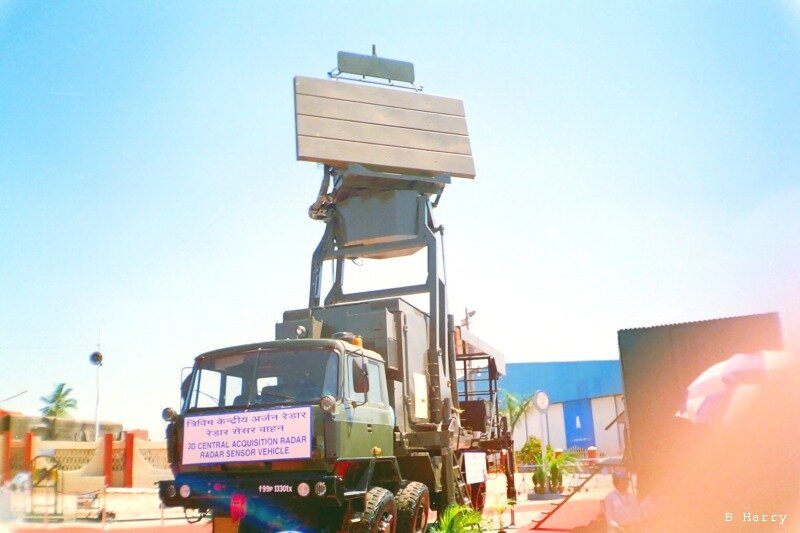
- The 3D medium range Central Acquisition Radar, a state of the art planar array, S Band radar operating on the stacked beam principle. With a range of 180 km against fighter sized targets, it can track while scan 200 of them. Its systems are integrated on high mobility, locally built TATRA trucks for the Army and Air Force; however the CAR design is meant to be used by all three services. The Planar array was codeveloped by DRDO with a European firm with both the DRDO and the firm sharing design rights, whereas the rest of the hardware and signal processing were done locally. Initially developed for the long running Akash SAM system, the radar tasted success, when seven were ordered by the Indian Air Force for their radar modernization program, and two of another variant were ordered by the Indian Navy for their P-28 Corvettes. Since 4-6 P-28 Corvettes are ultimately planned, additional orders for the CAR are very likely, once the Navy finalizes its production run. The CAR has been a significant success for radar development in India, with its state of the art signal processing hardware. The order for 9 ROHINI radars by the IAF is worth Rs 360 crores, or approximately 81 million USD at 2006 prices.[22] The ROHINI is the IAF specific variant while the REVATHI is the Indian Navy specific variant. The ROHINI has a more advanced Indian developed antenna in terms of power handling and beamforming technology compared to the 3D CAR while the REVATHI adds two axis stabilisation for operation in naval conditions, as well as extra naval modes.
- The 2D BFSR-SR, a short range Battle Field Surveillance Radar, meant to be manportable. 1176 have been ordered by the Army from BEL and it is being exported as well. Designed and developed by LRDE, the project was a systematic example of concurrent engineering, with the production agency involved through the design and development stage. This enabled the design to be brought into production quickly. Other features were the high amount of involvement of the private sector, which LRDE maintained throughout the project. Private firms supplied the rotational assembly and tripod, the Control and display unit as well as electronics assemblies after design and technology transfer by LRDE. This has continued into the substantial production run.[23] 100 radars will be exported to Indonesia.[24] The radar continues to progress further in terms of integration, with newer variants being integrated with thermal imagers for visually tracking targets detected by the radar.
- The 3D airborne Super Vision-2000 naval surveillance radar, meant for helicopters and light transport aircraft. The SV-2000 is a lightweight (approximately 100 kg), yet high performance, slotted array radar operating in the X Band. It can detect sea-surface targets such as a periscope or a vessel, against heavy clutter, and can also be used for navigation, weather mapping and beacon detection. The radar can detect a large vessel at over 100 nautical miles (370 km). The SV-2000s design has been accepted by the Navy and it is currently under modification to be fitted to the Advanced Light Helicopter, and the Navy's Do-228's. Variants can be fitted to the Navy's Ka-25's as well. In October 2004, Defense News reported that the Indian Navy had ordered 10 SV-2000s from Bharat Electronics Ltd. (the designated manufacturer) at a cost of US$600,000 each. The SV-2000 reportedly cost US$2.2 million to design and develop. BEL would also look for exporting the system, once naval requirements are met.[25] The radar is currently in an advanced stage of user trials.
- The 3D AESA Long Range Tracking Radar: The LRTR was developed with assistance from Elta of Israel, and is similar to Elta's proven GreenPine long range Active Array radar. The DRDO developed the signal processing and software for tracking high speed ballistic missile targets as well as introduced more ruggedization. The radar uses mostly Indian designed and manufactured components such as its critical high power, L Band Transmit-Receive modules plus the other enabling technologies necessary for active phased array radars. In 2004, DRDO noted that its LRTR could track 200 targets and had a range of above 400 km. In 2006, more details emerged; the LRTR could detect targets as far away as 500 km and beyond, including Intermediate Range Ballistic Missiles, and that India now had the capability to manufacture these radars on its own. In the words of Dr VK Saraswat, the Anti Ballistic Missile program project Director, the project was launched in the beginning of 2000, and a functional radar was ready some five years later. Dr. Saraswat also noted that the LRTR would be amongst the key elements of the Indian ABM system; DRDO would provide the technology to private and public manufacturers to make these high power systems, and BEL India would make these systems locally. A similar arrangement was employed in the successful 3D CAR project with several public and private firms receiving and productionizing the technology provided by the DRDO.[26] The DRDO has corrected statements that the LRTR is the GreenPine or that GreenPine radars would be imported from Israel, repeatedly pointing out that the GreenPine involved US assistance and is hence not available for reexport, and that the LRTR designed with IAI assistance, would be built totally inhouse in India.
- The 3D Multi Function Control Radar: A substantial project by itself, the MFCR was developed as part of the Indian anti-ballistic missile program in cooperation with THALES of France. The MFCR is an active phased array radar and complements the Long Range Tracking Radar, for intercepting ballistic missiles. The MFCR will also serve as the fire control radar for the AAD second tier missile system of the ABM program. The AAD has a supplementary role against aircraft as well, and is to engage missiles and aircraft up to an altitude of 30 km. The MFCR fills out the final part of the DRDO's radar development spectrum, and allows India to manufacture long range 3D radars that can act as the nodes of an Air Defence Ground Environment system. As with the LRTR, the MFCR was used successfully in India's BMD interception effort. Both the MFCR and LRTR will be built entirely in India, with components supplied by private and publicly owned firms, and with the complete system integrated by the state owned Bharat Electronics Ltd.
- The 2D Low Level Lightweight Radar(LLLR) for the Army, which require many of these units for gapfilling in mountainous terrain. The Indian Air Force will also acquire the same for key airbases. The LLLR is a 2D radar with a range of 40 km against a 2Sq Mtr target, intended as a gapfiller to plug detection gaps versus low level aircraft in an integrated Air Defence Ground network. The LLLR makes use of Indra-2 technology, namely a similar antenna array, but has roughly half the range and is much smaller and a far more portable unit. The Indra 2 is vehicle deployed and has a larger logistical footprint. Named the "Bharani", the LLLR can track while scan 100 targets and provide details about their speed, azimuth and range to the operator. The LLLR makes use of the BFSR-SR experience and many of the subsystem providers are the same. Multiple LLLRs can be netted together. The LLLR is meant to act as a tripwire against low level intruders, and will alert Army Air Defence fire control units (which use Bharat Electronics manufactured Improved Reporter 3D radars) to cue their weapon systems.[27] A 3D LLLR has also been revealed in 2008, with a system displayed at Defexpo 2008, at New Delhi.
- DRDO has indigenised components and improved subsystems of various other license produced radars manufactured at BEL, India, with the help of BEL scientists and other researchers. These improvements include new radar data processors for license produced Signaal radars as well as local radar assemblies replacing the earlier imported ones. Several of these items, which include waveguide arrays and antennas have better performance than the original systems that they replaced.
Apart from the above, the DRDO has also several other radar systems currently under development or in trials, these include:
- The 3D Weapon Locating Radar: Successfully developed from the Rajendra fire control radar for the Akash system, this radar uses a passive electronically scanned array to detect multiple targets for fire correction and weapon location. The system has been developed and demonstrated to the Army and orders have been placed upon BEL to gear up for series manufacture of 28 of these radars. It is currently in the penultimate series of user trials to fine tune its features. Concurrent engineering has been adopted to save money and time. The orders will be worth Rs/- 3000 Crore (Over 660 Million $) spread over several years.[28]. In terms of performance, the WLR is stated to be superior to the AN/TPQ-37, several of which were imported by India as an interim system while the WLR got ready.
- The 3D Multi-mode radar, a HAL project of which DRDO is a subsystem provider, this project to develop an advanced, lightweight Multimode fire control radar for the LCA Tejas fighter, has faced stiff challenges and been struck by delay. Help has been sought from other R&D organizations, manufacturers to bring it to fruition. The multimode radar is a greater than 100 km range (detection of a small fighter target), 10 target track, two target engage, lightweight system with an all-up weight of only 130 kg. At the Aero India Trade fair in 2007, it was revealed that an all new combined signal and data processor had been developed, replacing the original separate units. Substantial weight and volume savings apart, the new unit is much more powerful and makes use of contemporary ADSP processors. The other radar critical hardware has also been developed and validated, however work remains on the software front. The software for the air to air mode has been developed considerably (including search and track while scan in both look up and look down modes) but air to ground modes are being still worked upon. The radar development was shown to be considerably more mature than previously thought. More than a 100 MMRs will be manufactured, once it proves itself.[29]
- A 3D Active Phased Array radar for aircraft, a follow on to the MMR project, the APAR project aims to field the technologies necessary for a full active phased array fire control radar for fighter aircraft. While the DRDO has achieved a significant presence in the ground based radar segment with a variety of systems, it is now targeting the airborne segment to achieve similar results. Lack of prior experience in this arena led to the MMR project facing delays and technical challenges. The APAR program aims to prevent this technology gap from developing again, with a broadbased program to bring DRDO up to par with international developers in airborne systems: both fire control and surveillance.
- Synthetic Aperture & Inverse Synthetic Aperture radars: The DRDO's LRDE is currently working on both SAR and ISAR radars for target detection and classification. These lightweight payloads are intended for both conventional fixed wing, as well as Unmanned Aerial Vehicle applications. Initial prototypes have been built and the test results have been encouraging.
- A new 3D Airborne Warning and Control based on Active Electronically Scanned Array radar technology developed by the DRDO. This project was launched in 2005 for the Indian Air Force which has signed up for three AEW &C systems to begin with and with more thereafter. The design plus the first system is to be certified by 2010 and the rest delivered by 2012-14. Further orders are likely, either based on the existing design or more capable derivatives built for a larger platform such as the Boeing 737. The aim of the project is to develop inhouse capability for high power AEW&C systems, with the system covering the development of a S Band AESA array. The AEW&C aircraft platform has been reported to be Brazil's Embraer EMB-145. The aircraft will also have DRDO developed datalinks to link fighters plus communicate with the IAF's C3I infrastructure, as well as a local SATCOM (satellite communication system), along with other onboard ESM and COMINT systems of DRDO design and local manufacture.[30]
- 3D Short Range Radar for the Indian Air Force - ASLESHA: The Indian Air Force has ordered 20 of these systems from the DRDO, which are to begin delivery from 2008 onwards. The radars will have a range of approximately 50 km against small fighter-sized targets and will be able to determine their range, speed, azimuth and height. This radar will enable the Indian Air Force Air Defence units to accurately track low level intruders. The radar will make use of the alliance DRDO has forged with Indian private and public firms. The radar was revealed at Defexpo 2008 and is a semi-active phased array with a 1 meter square aperture.
- A 2D Medium Range Battlefield Surveillance Radar: A short video image of the BFSR-MR was displayed by the DRDO at Aero-India 2007, an Aerospace trade fair held in India. The Indian Army has till date, utilized imported BFSR-MR units from Elta, license manufactured by Bharat Electronics Ltd. The DRDO's BFSR-MR will supplant these radars with this locally designed and manufactured unit, with all of its attendant advantages, including the ability to modify it substantially per local requirements as and when they arise, without seeking the permission or assistance of a foreign vendor. Several private firms are expected to provide components as well. As with the BFSR-SR, the Army is expected to order a substantial number of these longer ranged units for its Surveillance and Target Acquisition Units. The BFSR-MR can be expected to be tied into the Indian Army's DRDO- BEL developed Battlefield Surveillance System via VHF/UHF links. This 2D radar will track ground targets and provide key intelligence to the Indian Army's artillery units, with the resultant information available on various tactical networks.
- 3D Medium Power Radar: A spinoff of the experience gained via the 3D MFCR project, the 3D Medium Power Radar project is intended to field a radar with a range of approximately 300 km against fighter sized targets. Intended for the Indian Air Force, the radar is an active phased array, and will be transportable. It will play a significant role acting as the nodes of the Indian Air Force's enhanced Air Defence Ground Environment System.
[edit] Command and control software and decision-making tools
- Tactical tools for wargaming: Shatranj (Chess) and Sangram for the Army, Sagar for the Navy and Air war software for the Air Force.
- C3I systems: DRDO, in cooperation with BEL and private industry has developed several critical C3I (command, control, communications and intelligence systems) for the services. The DRDO developed the Artillery Command and Control system for the Army. Known under the project name of "Shakti", the Indian Army aims to spend $ 300 Million to network all its artillery guns together using the ACCS, with the entire project completed by 2015. Developed by DRDO's Centre for Artificial Intelligence & Robotics (CAIR), the system comprises computers and intelligent terminals connected as a wide area network. Its main subsystems are the artillery computer center, battery computer, remote access terminal and a gun display unit. The ACCS is expected to improve the Army's artillery operations by a factor of 10 and by efficiently networking the artillery units, allowing for more rapid & accurate firepower. The ACCS will also improve the ability of commanders to concentrate that firepower where it is most needed. In January 2005 BEL received an order for a first batch of 50 Shakti systems, with over a 1000 to be purchased over time. The DRDO and BEL have also developed a Battle Management system for the Indian Army for its tanks and tactical units. Other programs in development for the Army include Corps level information and decision making software and tools, intended to link all units together for effective C3I (Communications, Command, Control, Intelligence). The DRDO is one of the key members in these projects, which are being driven by the Army's Signals Corp. The Indian Army is also moving towards extensive use of battlefield computers, such as the locally designed SATHI (companion]]) and these will be integrated into locally designed C3I networks. DRDO has also delivered projects such as the Combat Net Radio (currently in manufacture at BEL) and others for enhancing the Army's communication hardware.[31]
- Data management and command and control systems for the Navy have been provided by the DRDO. The Navy is currently engaged in a Naval networking project to network all its ships and shore establishments plus Maritime patrol aircraft and sensors. DRDO and BEL have played a significant role in this venture as well.
- Radar netting and multi-sensor fusion software for linking the Indian Air Force's network of radars and airbases. Other achievements include sophisticated and highly complex mission planning and C3I systems for Missiles, such as the Agni and Prithvi ballistic missiles, to the Brahmos cruise missile. These systems are common to all three services as all of them utilize different variants of these missiles. The Navy uses the Dhanush, the Naval version of the Prithvi and the Brahmos SSM, whereas the Army uses the Agni series missiles and the Prithvi, and will shortly receive its Brahmos LACMs. The Air Force uses the Prithvi SS-250 variant, and will deploy the Brahmos on its Su-30 MKI fighters.
- Simulators and training tools: DRDO and private industry have collaborated on manufacturing a range of simulators and training devices for the three services, from entry level tests for prospective entrants to the Indian Air Force, to sophisticated simulators for fighter aircraft, transports and helicopters, tanks to gunnery devices.
[edit] Computing Technologies
DRDO has worked extensively high speed computing given its ramifications for most of its defence projects. These include supercomputers for computational flow dynamics, to dedicated microprocessor designs manufactured in India for flight controllers and the like, to high speed computing boards built around Commercial Off The Shelf (COTS) components, similar to the latest trends in the defence industry.
- Supercomputing: DRDO's ANURAG developed the PACE+ Supercomputer for strategic purposes for supporting its various programs. The initial version, as detailed in 1995, had the following specifications: The system delivered a sustained performance of more than 960 Mflops (million floating operations per second) for computational fluid dynamics programs for use in aircraft projects such as the Light Combat Aircraft. Pace-Plus included 32 advanced computing nodes, each with 64 megabytes(MB) of memory that can be expanded up to 256MB and a powerful front-end processor which is a hyperSPARC with a speed of 66/90/100 megahertz (MHz). Besides fluid dynamics, these high-speed computer systems were used in areas such as vision, medical imaging, signal processing, molecular modeling, neural networks and finite element analysis. Pace-Plus was stated to be available in three versions: eight nodes with 240 Mflops sustained speed; 16 nodes with 480 Mflops sustained speed; and 32 nodes with 960 Mflops sustained speed. The product comes with a number of tools for software development. Eleven PACE systems have been installed in various institutions throughout the country, apart from the ones with the DRDO. The latest variant of the PACE series was the PACE ++, a 128 node parallel processing system. With a front-end processor, it has a distributed memory and message passing system. It runs on the Linux operating system with the programming environment called ANUPAM (ANURAGs parallel applications manager). By 2004, under Project Chitra, the DRDO was implementing a system with a computational speed of 2-3 Teraflops utilizing Commercial off the shelf components and the Open Source Linux Operating System.[32]
- Processors and other critical items: DRDO has developed a range of processors and application specific integrated circuits for its critical projects. Many of these systems are modular, in the sense that they can be reused across different projects. These include "Pythagoras processor" to convert cartesian to polar coordinates, ANUCO, a floating point coprocessor and several others, including the ANUPAMA 32-bit processor, which is being used in several DRDO projects. ANUPAMA has also been used for a Single Board computer, designed in cooperation with a private firm.[33]
- Electronic components: One of the most marked endeavours undertaken by the DRDO has been to create a substantial local design and development capability within India, both in the private and public sectors. This policy has led to several hard to obtain or otherwise denied items, being designed and manufactured in India. These include components such as radar subsystems (product specific travelling wave tubes) to components necessary for electronic warfare and other cutting edge projects. Today, there are a range of firms across India, which design and manufacture key components for DRDO, allowing it to source locally for quite a substantial chunk of its procurement. The DRDO has also endeavoured to use COTS (Commercial off the shelf) processors and technology, and follow Open Architecture standards, wherever possible, in order to pre-empt obsolescence issues and follow industry practise. One significant example is the development of an Open Architecture computer for the Light Combat Aircraft, based on the PowerPC architecture and VME64 standard. The earlier Mission computer utilizing Intel 486 DX chips has already seen success, with variants being present on the Su-30 MKI, Jaguar and MiG-27 Upgrades for the Indian Air Force.[34]
[edit] Combat Vehicles & engineering
[edit] Tanks and armoured vehicles

- The Indian Army's Ajeya upgrade for the T-72 fleet, incorporating a mix of locally made and imported subsystems. 250 have been ordered. Local systems include the DRDO developed ERA (manufactured by the OFB), the DRDO developed, BEL manufactured Laser warning system, and the Combat Net radio, the BEL Advanced land navigation system(Fibre optic gyros plus GPS), NBC protection, DRDO's Fire detection and suppression system amongst other items. Imported systems include a compact thermal imager and fire control system (meant to fit in the T-72 without modification to the existing TPD-K1 day sight and without significant modification to the tank's armour for installation; this ruled out the capable but larger, local integrated gunners main sight cum fire control system for the Arjun tank), as well as a new 1000 Hp engine.
- New anti-tank ammunition, fin stabilized armour piercing discarding sabot (FSAPDS), Mks. 1 and 2 for the 125 mm calibre, meant for India's T-72 tanks. The DRDO also developed 120 mm FSAPDS and HESH rounds for the Arjun tank, and 105 mm FSAPDS rounds for the Army's Vijayanta and T-55 tanks.[21]
- Ammunition manufacture: Significant amounts of 125 mm anti-tank rounds manufactured by the Ordnance Factory Board were rejected. The majority of these rounds belonged to a "hybrid" batch of 125 mm FSAPDS. The OFB had entered into an agreement with Russian manufacturers wherein it sought to combine Russian supplied penetrators with Indian charges. The rounds were found to have extremely poor accuracy and on occasion even blew up inside the tank. The problems were traced to improper packaging of the charges by the OFB, leading to propellant leakage during storage at high temperatures. The entire issue dismayed the DRDO since a proven design cleared after extensive trials, came into controversy on account of poor manufacturing by the OFB and storage issues. The locally developed rounds were rectified, and requalified, whereas the hybrid rounds were scrapped. Production of these local rounds was then restarted after technical audit. Since 2001, over 1,30,000 rounds have been manufactured by the OFB. In 2005, DRDO noted that it had developed a Mk2 version of the 125 mm round, with higher power propellant for greater penetration. In parallel, in 2006, OFB announced that it was also manufacturing 125 mm IMI (Israel Military Industries) rounds for which an agreement had been signed before the development of the local Mk2. It is believed that this might assist in improving the OFB's APFSDS manufacturing capability. These rounds and presumably the Mk2 round, will be used by both the T-72 and T-90 formations in the Indian Army after the requisite trials.[35][36]
- Various armour technologies and associated subsystems from composite armour and explosive reactive armour, to Radios (Combat Net Radio, frequency hopping, with encryption), to Battle Management systems. Fire-control systems for the Arjun tank, currently in production at BEL for the second batch of Arjun tanks. The first batch in production have a hybrid Sagem- DRDO one, with Sagem sights and local fire control computer.[37]
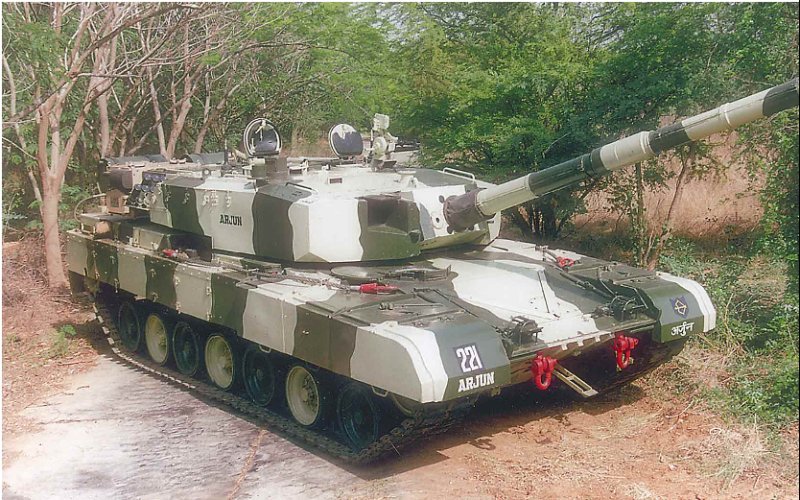
- Arjun tank: Currently in production at HVF Avadi, the Arjuns penultimate design has been accepted by the Indian Army, but production tanks will be put through intensive trials to validate the production quality at HVF. An initial batch of 5 is being currently evaluated. The Arjun has been one of the DRDO's most contentious projects, thanks to extensive time and cost overruns. Part of the reason being the Indian Army's high staff requirements for the tank, which were frequently updated, and the DRDO and Indian industry's lack of experience in building a heavy tank. Prior experience was limited to license manufactured Vickers medium tanks and the T-72. However, the Arjun is now in limited series production at HVF Avadhi.
The Arjun follows a template similar to the tanks developed by western nations such as the Leopard 2 and M1 Abrams, with containerised ammunition storage, with blast off panels, heavy Composite armour, a 120 mm gun (rifled as compared to smoothbore on most other tanks), a modern FCS with high hit probability, and a 1400 HP MTU engine with Renk transmission (to be replaced by an Indian transmission) and a 4 man crew.
The Indian Army has announced its plans to standardise on the T-90S and upgraded T-72M1 variants, for the time being. It is believed that over time, as the Arjun is put through paces and user familiarity grows, a few hundred more may be ordered. Whilst it may be tempting to dismiss the Arjun as a failure given the limited numbers ordered, such a view ignores the learning the project has afforded to Indian developers as evident in the increasing number of technology spinoffs for other Armour products, as well as the fact that the Arjun is partly the victim of requirements creep. Originally designed in response to a possible Pakistani acquisition of the M1 Abrams, the project fell into disfavour once it became clear that Pakistan was instead standardising on cheaper (and less capable) T type tanks[citation needed]. In such a milieu, acquiring the Arjun in huge numbers is simply unnecessary for the Indian Army, which can field far larger numbers of similar tanks (T-72, T-90) especially given additional logistic costs of standardising on an entirely new type. It must also be remembered that bar the United States, most western nations only have a few hundred heavy Main Battle Tanks. The UK has 386 Challenger 2, France has 408 Leclerc tanks, and both countries have significantly higher defence budgets than the Indian Army, not to mention the latter has wide ranging modernisation plans apart from armoured vehicles alone.[38][39]
[edit] Modification of BMP-2 series
India currently license manufactures the BMP-2 at its state owned OFB IFV production unit at Medak, with local components. The vehicle has been used as the basis for several locally designed modifications, ranging from missile launchers to engineering support vehicles. The DRDO's various labs (including its vehicle research units, VRDE, CVRDE, as well as R&DE, as well as others) have played a critical role in designing and developing these mission specific variants for the Indian Army.
- The Armoured Engineering Reconnaissance Vehicle for enabling the combat engineers to acquire and record terrain survey data. The instruments mounted on the amphibious vehicle viz. BMP-II are capable of measuring width of obstacle, bed profile, water depth and bearing capacity of soil of the obstacle in real time which are helpful in taking decisions regarding laying of tracks or building of bridges.[40]
- Armoured Amphibious Dozer with amphibious capability developed jointly with VRDE, a sister DRDO Establishment for earth moving operations in different terrain for preparation of bridging sites, clearing obstacles and debris and to fill craters. Self-recovery of the vehicle is also a built-in feature using a rocket-propelled anchor.[41]
- Carrier Mortar Tracked: Designed to mount and fire an 81 mm mortar from within vehicle. Capacity to fire from 40° to 85° and traverse 24° on either side; 108 rounds of mortar ammunition stowed. Currently in production at the Ordnance Factory Board, India.[42]
- Armoured Ambulance based on the BMP-2 vehicle. The Indian Army has placed an indent on Ordnance Factory, Medak for manufacturing 50 of them.
- NBC Reconnaissance Vehicle: Based on a standard weaponised BMP-2, this variant has instrumentation for determining NBC contamination, as well as bringing back samples. The vehicle includes a plow for scooping up soil samples, to instrumentation such as a radiation dosimeter amongst other key items. With India's regional rival Pakistan, having a doctrine of first use of nuclear weapons, the Indian Army is beefing up its NBC preparedness many times over.
[edit] Other engineering vehicles
- Bridge Layer Tank: Noted by DRDO to be the amongst the best bridging systems available on a medium class tank. It has an option to carry a 20 m or a 22 m class 70 MLC bridge, which can be negotiated by all tanks in service with Indian Army, including MBT Arjun. User trial completed during 1996. Twelve numbers of BLT T-72 are under production at HVF, Avadi, Chennai.
- A 42 tonne mammoth, the Amphibious Floating Bridge and Ferry System (AFFS), intended for transporting heavy armour, troops and engineering equipment across large and deep water obstacles. The 10 m x 3.6 m x 4 m vehicle can covert to a fully decked bridge configuration of length 28.4 metres, in 9 minutes. Two more vehicles can be joined in tandem to form a floating bridge of length 105 m, in 30 minutes. The bridge superstructure is integrated with floats (shown inflated) to provide stability and additional buoyancy. The vehicle has a max speed of 55 km/h on road, 40 km/h cross country and an aquatic mobility of 2.7 m/s with twin pump jets. The vehicle is also capable of retracting its wheels for use as a grounded bridge/ramp for high banks. The AFFS was developed in a record time of 34 months.[43]
- Bridge Layer Tank- Arjun: Derived from the experience on the BLT-72, the BLT-Arjun is an all-new design with a scissor type bridge laying method, which helps it avoid detection from afar. It uses the chassis of the Arjun tank and can take higher weights than the BLT-72.[44]
- Sarvatra Bridge layer: As the Bharat Rakshak Monitor notes: "The bridge can be over a water and land obstacles to provide 75 meters of bridge-length for battle tanks, supply convoys and troops. The system consists of a light aluminum alloy scissors bridge and was approved for production in March 2000 after 200 tank crossing trials. One complete set of the multi span mobile bridging system includes five truck-mounted units with a bridge-span of 15 meters each. The system is designed to take the weight of the Arjun, by far the heaviest vehicle in the Army’s inventory. According to the Sarvatra Project Director Dr P.K. Venkatachalam, a microprocessor based control system reduces the number of personnel required to deploy and operationalize the bridge. The Sarvatra project was sanctioned in 1994 and completed development in October 1999 at a total cost of Rs 230 million. The bridging equipment is carried on a Tatra Kolos chassis and the system is built by Bharat Earth Movers Ltd (BEML) at their Mysore complex. Exercise Sangharsh scheduled for the first half of the year will see the first deployment of the system. DRDO is developing a newer version of the Sarvatra with 20 meter long spans."[45]
- Mobile Decontamination System: With the NBC aspect on the Indo-Pak battlefield in the Army's mind, the DRDO developed a Tatra vehicle based Mobile Decontamination system, for decontamination of personnel, clothing, equipment, vehicles & terrain during war. The main sub-systems of mobile decontamination system are: pre-wash, chemical wash and post wash systems respectively. The pre-wash system consists of a 3000 litre stainless steel water tank and a fast suction pump. A high-pressure jet with a capacity of 3400 litre per hour (l/h) at 45-50 bar (4.5–5 MPa) and a low-pressure jet with a capacity of 900 l/h at 5 to 6 bar (500–600 kPa) and 1600 l/h at 10 to 15 bar (1–1.5 MPa) are also included. The chemical wash system is capable of mixing two powders and two liquids with variable feed rates and has a 5 litre per minute slurry emulsion flow rate. The post wash system consists of a high-pressure hot water jet, a hot water shower for personnel and provision of steam for decontamination of clothing. The subsystem can be simultaneously operated. The decontamination systems are in regular production and have already been introduced into the services. [22] The system is under production for the Army at DRDO's partnering firms, with the DRDO itself manufacturing the pilot batch.[46]
[edit] In development
- Abhay IFV: India's own IFV design currently in prototype form. Named the "Abhay" (Fearless), this IFV will have a 40 mm gun based on the proven Bofors L70 (Armour piercing and explosive rounds), a Firecontrol system derived from the Arjun project with a Thermal imager, all-electric turret and gun stabilization, a locally designed FLAME launcher for locally manufactured Konkurs-M anti-tank missiles, and an Indian diesel engine. The armour will be lightweight composite, derived from the experience with the Kanchan project on the Arjun.
- Tank-Ex, a project to mount Arjun's turret on a T-72 chassis to combine high firepower with a low silhouette. Currently in trials, to be offered to the Army once trials are complete. This is a DRDO initiative and not per a specific Army demand. However, the Army is trialling Tank-ex prototypes and the type may be used to upgrade a few hundred T-72's out of Indias vast fleet of the same.
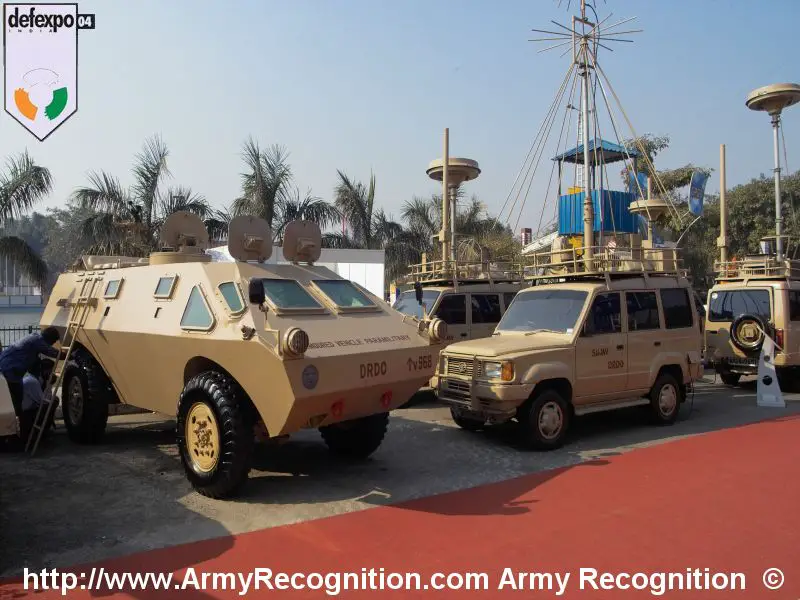
- Armoured vehicle for Paramilitary forces, Called ASHV (horse) the AVP, currently a prototype. A wheeled armoured vehicle, the AVP was displayed at Defexpo-2006, an industry trade fair held in New Delhi in 2006. The AVP has armoured glass windows and firing ports, as well as provision for heavier caliber small arms, and crowd control equipment.
- Mining and De-mining equipment: The Self Propelled Mine Burrier has been developed by the DRDO against a requirement projected by the Indian Army, its an automated mine laying system developed on a high mobility vehicle and is currently in trials. The Counter-Mine flail, is a vehicle built upon the T-72 chassis, and has a series of fast moving flails to destroy mines. A prototype has been displayed, with the program run per Army requirements.
- Remotely Operated Vehicle: This tracked robotic vehicle with staircase climbing ability has completed technical trials and is particularly intended for remote explosion of Explosive devices. The Indian Army and paramilitaries are very interested in this system. The ROV is carried in a specially designed carrier vehicle with additional armament and firing ports. The ROV itself is fairly sophisticated, with provision to carry various optronic payloads, an articulated gripper to pick up objects, an ability to traverse difficult terrain including staircases, as well as an integral waterjet projector to blow up explosive packages. In December 2006, the Indian MOD stated that User Assisted Technical Trials with Army involvement had been completed, and that user trials were ikely to be conducted shortly thereafter. After the ROV proved itself in user trials, it would be inducted by the Indian Army for Explosives handling and defusing.[47]
[edit] Naval Research and Development
[edit] Sonars
DRDO, BEL and the Indian Navy have developed and productionized a range of Sonars and related systems for the Navy's frontline combat ships. These include the APSOH (Advanced Panoramic SOnar Hull mounted), HUMVAD (Hull Mounted Variable Depth sonar) and the HUMSA (follow on to the APSOH series; the acronym HUMSA stands for Hull Mounted Sonar Array) sonars, Nagan Towed Array Sonar, Panchendriya Submarine sonar and fire control system, sonobuoy Tadpole and its airborne signal processor Simhika. Other sonars such as the airborne sonar Mihir, are in trials, whilst work is proceeding apace on "New Generation" sonars. Sonars may be considered one of DRDO's most successful achievements, with the work begun under the leadership of a young Naval officer decades back. Today, the Indian Navy's most powerful ships rely on Indian made sonars. The standard fit for a frontline Naval ship would include the HUMSA-NG (New Generation) hull mounted sonar, a HUMVAD variable depth sonar and the Nagan towed array sonar. The Mihir, is a dunking sonar meant for use by the Naval ALH, working in conjunction with its Tadpole sonobuoy. The Panchendriya is in production for the Kilo class submarine upgrades. Some ships, such as the INS Beas field a mix of local (HUMSA and HUMVAD) and imported sonars (towed array), till the local towed array was developed. The Delhi class destroyer has the HUMSA and the HUMVAD.[48][49][50]
[edit] Torpedoes
DRDO is currently engaged in developing multiple Torpedo designs. These include a lightweight torpedo (Advanced Experimental Torpedo) that has been accepted by the Navy and cleared for production (initial reports of it being unsuccessful proved to be speculative and false [23]). Other projects include the heavy weight wire-guided torpedo Varunastra and the Thakshak thermal torpedo suitable for use against both ships and submarines. The electrically powered Varunastra is now stated to be also in production. The DRDO with the help of Larsen & Toubro, India also developed and productionized a microprocessor controlled Triple tube torpedo launcher for the Indian Navy's ships as well as Towed torpedo decoy (TOTED).[51][52]
[edit] Other projects
These have included indigenisation of various components (for instance, adsorbent material for submarines, radar components), Naval ship signature reduction efforts and materials technology. DRDO has played a significant role in the development of warship grade steel in India and its productionization. DRDO has also assisted private industry in developing EW trainers, ship simulators for training and Health monitoring systems for onboard equipment. Other equipment for the Navy includes Underwater telephone sets, and VLF communication equipment, for the Navy's submarines. DRDO's IRDE has also developed Optronic fire control systems for the Navy's and the Coast Guard's ships. These consist of a locally developed autotracker, fire control system with a local fully stabilized gimbal mount containing a CCD imager and imported Thermal Imager.[53]
[edit] Information Command and Control systems
DRD0's labs have been part of ambitious and successful projects to develop sophisticated command and control systems for the Navy's ships, such as the EMCCA (Equipment Modular for Command and Control Application) which ties together various sensors and data systems. The EMCCA system gives commanders on the ship a consolidated tactical picture and adds to the ship’s maritime combat power.[54]
DRDO labs are also engaged in supporting the Navy's ambitious Naval enterprise wide networking system, a program to link all naval assets together via datalinks, for sharing tactical information.
[edit] Mines and targets
Three kinds of mines, processor based mine, moored mine and processor based exercise mine are in production for the Navy at Keltron, India. Targets developed for the Navy include a static target called the Versatile Acoustic target and a mobile target called the programmable deep mobile target (PDMT).
[edit] In development
- Submarine Escape set, used by crew to escape from abandoned submarines. The set consists of breathing apparatus (which has cleared trials) and Hydro-suit (modifications suggested and to be re-trialled).
- New generation Sonars and Electronic Warfare equipment.
- Heavyweight torpedoes, Underwater remotely operated vehicles, improved signature reduction technology for Naval applications.
[edit] Missile Systems
[edit] Integrated Guided Missile Development Program (IGMDP)
The IGMDP was launched by the Indian Government to develop a local missile design and development ability, and manufacture a range of missile systems for the three defence services.
The IGMDP has seen significant success in its two most important constituents- the Agni missile and the Prithvi missile systems, while two other programs, the Akash SAM and the anti-tank Nag Missile are still in development. The Trishul missile, a program to develop a tri-service short range SAM has faced persistent problems throughout its development, and is likely to be shut down unless the Indian Air Force places orders for the system.
[edit] IGMDP Ballistic Missiles

- Prithvi Short Range Ballistic Missile: Three variants exist- the Prithvi I, II and III. Status: In production for the Air Force and Army; a variant for the Navy has been deployed on Sukanya class vessels. Another submarine launched variant known as the K-15 is under development. The Prithvi is an extremely accurate liquid fuelled missile with a range of up to 350 km. While relatively inexpensive and accurate, with a good payload, its logistics footprint is high, on account of it being liquid fuelled. The Indian Air Force has ordered 54 SS-250 Prithvis in 2006 at a cost of approximately $460,000 each.[55]
.jpeg/250px-Agni-II_missile_(Republic_Day_Parade_2004).jpeg)
- Agni Missile series: The Agni-II is an Intermediate range ballistic missile with a range of up to 2500 km. The Agni-I is a shorter ranged unit with a range of up to 800 km. These are meant for deterrence against China and Pakistan respectively. The Agni-III is meant for a longer ranged deterrence capability against China, with a range of up to 6000 km. Status: Agni- I and II have been productionized, exact numbers remain classified. Agni-III first trial saw problems and the missile test did not meet its objectives. The second test was successful and hailed as a landmark achievement in missile technology for India. Further tests are planned; original plans were for a series of three tests to validate the missile and its subsystems, which include new propellant and guidance systems, a new re-entry vehicle and other improvements.[56]
[edit] Akash SAM

- The Akash is a medium range SAM (surface to air missile) system comprising of the command guided ramjet powered Akash missile of range 27km with dedicated service specific launchers , Battery control radar (the Rajendra Block III), a Central Acquisition radar (CAR), Battery and Group control centers.[24][25] . The Akash project has yielded spinoffs like the Central Acquisition radar and Weapon Locating radar.
- Due to delays in induction of Akash System, the Indian Air force considered an upgrade of SA-3 SAM Systems whereas the Indian Army sought an upgrade of its SA-6 missile systems. However, DRDO continued to work upon the Akash based upon IAF recommendations and the IAF decided to conduct user trials to verify the improvements. If successful, the IAF would induct the Akash system.
- In December 2007, the Akash SAM system cleared its user trials with the IAF in a flawless manner. The user trials had the Akash intercept flying targets at ITR, Chandipur from the 14th to the 21st of December 2007. The Akash missile successfully hit its targets five out of five times in this campaign. [57]. ECCM evaluation tests were carried out at Gwalior Air force base, whereas mobility trials were conducted in Rajasthan state. The Indian Air force was satisfied with the performance and ordered 2 Squadrons of the Akash, with a squadron having 16 launchers. [58] [59] The DRDO has noted that it can deliver these first two squadrons in 3 years. [60] More orders are expected as the Indian Air Force's older Pechora's retire.
[edit] Trishul SAM
The Trishul (Trident in Hindi) is a short range SAM meant for all three services, the Army, Air Force and Navy. The Trishul project relied on equipment already in service with the Indian services, to drive down logistics costs, and reduce program development costs and development time. The Army variant, relied on a locally modified variant of the Signaal (now Thales) Flycatcher radar, integrated into a single launcher with a four missile pack, along with separate electronics for missile guidance. The Air Force variant separated the missile launchers on Kolos Tatra trucks, locally manufactured by India's BEML. The Naval variant was the most ambitious, with a flight control system with an integrated radar altimeter to intercept sea skimming missiles. The Trishul's guidance was Command Line of Sight with a three beam guidance system, which proved to be the bane of the project and caused repeated failures during trials.
The Trishul's persistent development problems have meant that the Indian Air Force, the Indian Army and the Indian Navy have begun upgrading their existing Short range SAM systems or purchased replacements.
The Indian Air Force evaluated the Israeli Spyder SAM system and the French VLS Mica system as replacements for the Trishul. In February 2005, the VLS Mica system, mounted on an ACMAT multi-role vehicle of the French Army, was demonstrated for the Indian Air Force. In 2006, the Indian Air Force announced that it was procuring 18 batteries of the Spyder SAM system thanks to persistent delays in the Trishul and Akash programs.[61]
The Indian Army is upgrading its OSA-AKM/ SA-8 systems with Polish assistance. Fifty OSA-AK units are stated to have been modernised.[62]
The Indian Navy has moved on to the Barak-1, and is unlikely to purchase the Trishul.[63]
In 2005, there were efforts made to resuscitate the Trishul program as an inexpensive alternative to bulk up the IAF's short range SAM inventory. The high cost of the imports being a strike against them, despite their capability.[64]
In 2006 it was noted that the Trishul program has been effectively closed down as far as the Navy and Army were concerned, but that discussions were on with the Indian Air Force for user trials, and if successful purchase of the system. It is also reported that key technologies developed via the program may be utilized in future systems.[65]
As of 2007, it has been reported that the experience gained from the Trishul program will be utilized for a brand new SAM known as the Maitri, which will be codeveloped with the European MBDA missile agency. The Maitri Low level Quick reaction missile will have new Indian developed radars cueing the active radar homing surface to air missiles.[66]
[edit] Nag anti-tank missile
The Nag (Cobra in Hindi) is an anti-tank guided missile system intended for the Air Force and Army. The Army will deploy the Nag on ground based launchers and from helicopters, whereas the Air Force will rely on helicopter based units. The Nag has an Imaging Infrared (IIR) seeker (the other seeker is an optical Charge Coupled Device based one for day attacks), and has a top and direct attack capability, with a tandem warhead (for use against even Explosive reactive armour equipped tanks).
The Army's land missile carrier and launcher, is a BMP-2 derived vehicle developed by the DRDO and Larsen & Toubro Ltd. known as the Namica (Nag Missile Carrier) which carries several ready to use Nag's within, and four Nag missiles in an extendable launcher above the turret. The Namica has its own FLIR based sighting and fire control unit to use the Nag.[67]
The Air Force and Army will also use their Advanced Light helicopters (ALH) as Nag carriers. The ALH's will be equipped with IRDE (DRDO) developed HELITIS (Heliborne Imaging and Targeting systems) with a combination of a FLIR (forward looking infrared), Laser range finder, in a stabilized turret for target acquisition and Nag designation. Stabilization accuracy is quuoted at 30 Milliradians and detection of a tank target at 4 km.[26] The thermal imager is likely to be imported, but the gimballed turret, stabilization, laser range finder and associated electronics have been designed in India and will be manufactured locally.[68]
The Nag ATGM is regarded as a highly capable missile, even though its development has been protracted, mainly due to the technological challenges of developing a state of the art, IIR sensor equipped top attack missile, able to attack fast moving targets in the dusty battlefields of South Asia. Criticism has been directed at development time, and acquisition cost, since the fire and forget Nag is more than twice the cost of wire guided Milan and Konkurs ATGMs. However, the Nag is still cheaper than most imported missiles in its category and is earmarked for the Army and Air Force.
The Nag's Namica based version is stated to have been accepted in principle by the Army, whilst the ALH based units are still under trials. Other reports have stated that the Nag's seeker is to be miniaturised further, and it is to be available by 2007. Its unclear as to which missile variant these reports are referring to. On December 6, 2006, the Indian Defence Minister announced that the Nag and Akash missiles were ready for user trials.[69] The Akash was subsequently tested and cleared for induction. Further tests of the Nag are expected in 2008, for clearing the Nag and mass producing it.
India is also license manufacturing the Kornet, Konkurs-M (with tandem warhead), and Milan-2T ATGMs.
[edit] The Brahmos Missile

Launched as a joint venture between India's DRDO and the Russian NPO, the BrahMos program aims at creating a range of missile systems derived from the Yakhont missile system. Named the "BrahMos" after the Brahmaputra and the Moskva rivers, the project has been highly successful.
The Indian Navy has ordered the BrahMos Naval version, both slant launched and Vertically launched, for its ships, with the Indian Army ordering two regiments worth of Land launched missiles for long range strike, and an air launched version is in development for the Indian Air Force's Su-30 MKI's and the Navy's Tu-142 long range aircraft.
India has been responsible for the Navigational systems on the BrahMos, other aspects of its propulsion, airframe and seeker, plus its Fire Control Systems, Mobile Command posts and Transporter Erector Launcher. Indian firms such as Godrej Group, Larsen and Toubro, Tatas. have played a vital role in the program.[70] Twenty One Indian companies and seven Russian ones contribute components to the Brahmos program. [71]
In January 2008, Keltec, an Indian state owned firm was acquired by Brahmos Corporation.[72] Approximately Rs 1500 Crores (over US $ 300 Million) will be invested in the facility to make Brahmos components and integrate full missile systems. This was necessitated by the increased order book of the missile system, with orders having been placed by both the Indian Army and Navy. [73][74]
Brahmos 2 Program
A hypersonic follow on to the Brahmos is to be launched as a follow on to the original Brahmos. Referred to as Brahmos 2, the missile would still follow the guidelines of the MTCR but would fly at speeds of 5-7 Mach. [75] A five year development timeframe is anticipated. [76]
[edit] Critique
The significant cost and more importantly, time overruns in the DRDO's big-ticket projects such as the Akash, Trishul, Nag, Light Combat Aircraft and the Arjun, are often the subject of virulent criticism of DRDO even as the organization is engaged in completing the programs. It can be said that productionizing these systems and significant orders for them, would be a big shot in the arm for the DRDO as the criticism over these long running programs often overshadows the organization's work in many other areas.[77]
[edit] Future plans
[edit] Long range SAM
India and Israel have worked out an agreement to develop and produce the long-range Barak air defence system for both the Indian and the Israeli militaries. The initial co-development funding is about $ 350 million, of which IAI will finance 50 per cent. The venture is a tripartite one, between the DRDO, the Indian Navy, and IAI. The missile is referred to as the LRSAM in Indian Government literature, and will have a range of 72 km. Additional funding will be infused by both parties as needed.[78][79] Israel Aircraft Industries refers to the system as Barak-8. IAI states that the missile will have a dual pulse motor, is vertically launched and is able to engage both aircraft and sea skimming missiles. It has a fully active seeker, and the Barak-8 Weapons system is capable of multiple simultaneous engagements. It will have a two way datalink for midcourse update, as well as be able to integrate into larger C3I networks. The primary fire control sensor for the naval Barak-8/ LRSAM will be the ELTA MF-STAR Naval AESA radar which Israel claims to be superior to many existing systems worldwide. [80] [81] [82]
The other variant of the LRSAM will be fielded by the Indian Air Force. The Indian Air Force has projected a requirement of up to 9 Squadrons of the LRSAM. Revealed before the Akash SAM trials which were successful, the LRSAM fills a longer range requirement and both types will complement each other. The IAF wants each squadron to have 2 MR-SAM firing units. Each unit, in turn, would consist of a command and control center, with an acquisition radar, a guidance radar, and 3 launchers with eight missiles each. The total number of units would hence be 10 C2 centers, 18 acquisition radars, 18 guidance radars, and 54 launchers armed with 432 missiles ready to fire. A 4-year, $300 million System Design & Development phase to develop unique system elements and an initial tranche of the land-based missiles is estimated. The radars, C2 centers, TEL's and missiles will be codeveloped by Israel and India. In turn, IAI and its Israeli partners have agreed to transfer all relevant technologies and manufacturing capabilities to India allowing India to manufacture the LRSAM systems locally as well as support them. [83]
[edit] Astra BVRAAM
Astra is a 80 km class (against an approaching fighter target), active radar guided missile meant for beyond visual range air to air combat. Several tests of the missiles basic propulsion and guidance have taken place from land based launchers. Air launched trials will follow thereafter.[84]
[edit] Anti-Ballistic Missile Defence Project
Unveiled in 2006, the ABM project was a surprise to many observers. While DRDO had revealed some details about the project over the years, its progress had been marked by strict secrecy, and the project itself was unlisted, and not visible among DRDO's other programs. The ABM project has benefited from all the incremental improvements achieved by the DRDO and its associated industrial partners via the long running and often contentious Akash and Trishul programs. However, it is a completely new program, with much larger scope and with predominantly new subsystems.
The ABM project has two missiles—namely the AAD and PAD (Prithvi Air Defence) missiles. The former is an endo-atmospheric interceptor of new design, which can intercept targets to a height of 30 km. Whereas the latter is a modified Prithvi missile, dubbed the Axo-atmospheric interceptor (AXO) with a dedicated second stage Kill vehicle for ballistic missile interception, up to an altitude of 80 km. Both these missiles are cued by an active phased array Long Range Tracking Radar, similar to the Elta GreenPine but made with locally developed components, which include DRDO developed transmit/receive modules. The ABM system also makes use of a second radar, known as the Multi-Function Control Radar which assists the LRTR in classifying the target, and can also act as the fire control radar for the AAD missile. The key difference is that the MFCR, as the name suggests will be "multi-function", it can be used as a search radar against aircraft as well, in the sense that it will be able to rotate 360 degrees and will provide flexibility to the entire missile defence system. However, it too, is an active phased array system as is the LRTR (L-band, 600 km range).
The missile launchers are connected to a launch control center (LCC) and mission control center (MCC) which can be located up to a 1000 km away. The MCC processes the data provided by the radars and determines and clears the relevant LCC to launch the interceptors. There are multiple links between the centers and the launcher, to avoid jamming. Both wireless links (based on CDMA technology for anti-jamming purposes) and fibreoptic links are used.
The entire set up was tested in November 2006, under the Prithvi Air Defence Exercise, when a prototype AXO, with a designation of PAD01 successfully intercepted another Prithvi missile at a height of 50 km. The target missile (PAD02) was set to mimic the profile of a Tactical Ballistic missile with a 600 km range. The test was a complete success, with the hit to kill methodology successfully tested (Neither Missile had a warhead). The prototype had an active radar seeker integrated with its kill vehicle. This test was preceded by an "electronic test" in which an actual target missile was launched, but the entire interceptor system was tested electronically, albeit no actual interceptor was launched. This test was successful in its entirety, setting the pace for the actual full scale test thereafter. After the test, the program Director Dr. V.K. Saraswat noted that there were still more tests to be done (six in all) before the DRDO could certify the AXO as functional, and that it was too early to rule out cooperation with other countries. Even so, the flawless functioning of the entire setup (hardware and software) - much of which was custom developed for the project, was a big shot in the arm for the DRDO.
Advanced Air Defence (AAD) Missile was tested on 6th December 2007 which successfully intercepted a modified prithvi ballistic missile simulating M-9 and M-11 class of ballistic missiles. Interception happened at an altitude of 15km. AAD is a single stage solid rocket missile with speed of Mach 4.5, 7.5m long and weighs 1.2 tonne.[85]
The project leader also noted that they had evaluated the S-300V in depth, and that its radars and missiles would not meet the specifications of the Indian made system. [86]
[edit] References
- ^ DefenseNews.com - DRDO’s Failures Prompt Overhaul - 08/28/06 12:03
- ^ LCA workcenters
- ^ DRDO's Project Vetrivale
- ^ Indian Army orders twelve Nishants
- ^ Gallery of Dhruv, Nishant and armoured vehicles with detailed captions at ACIG.org
- ^ List of products designed by DEBEL
- ^ World Affairs Board - View Single Post - INSAS vs AK47 vs M16?
- ^ World Affairs Board - View Single Post - INSAS vs AK47 vs M16?
- ^ DEFEXPO 2004 - Part 5
- ^ Defence scientists plan artillery rockets with 100-km range
- ^ [1]
- ^ [2]
- ^ Indian Ordnance Factories: Ammunition, Explosives, Propellants & Chemicals
- ^ Indian Ordnance Factories: Ammunition, Explosives, Propellants & Chemicals
- ^ [3]
- ^ Indian President Abdul Kalam presenting a model of the Samyukta to the then Army chief, NC Vij at its induction ceremony
- ^ Samyukta and Samrat: DRDO’s indigenously integrated EW system,ForceIndia june issue
- ^ Sujav System visible in the background, image copyright Army Recognition
- ^ Tarang RWR, image copyright acig.org
- ^ Indra-I radar, image copyright Bharat Rakshak
- ^ Rajendra Radar, image copyright Bharat Rakshak and DRDO
- ^ JPEG image of the 3D CAR, image copyright Acig.org
- ^ BFSR orders and export push
- ^ BEL to export anti-infiltration radar to Indonesia
- ^ SV-2000 radar, image copyright DRDO
- ^ Details of LRTR from 2004
- ^ LLLR Specifications
- ^ WLR prototype, image copyright Bharat Rakshak
- ^ Tejas MMR, image copyright Acig.org
- ^ Aircraft for AWACS to be chosen by the IAF
- ^ ACCS specifications and details at Bharat-Rakshak
- ^ Report from 1995 on the initial PACE system
- ^ ANUPAMA processor
- ^ LCA avionics
- ^ OFB manufacturing new 125 mm round from IMI
- ^ MOD Annual Report from 2006 with details on new DRDO projects delivered, including new 125 mm MK2 FSAPDS [PDF File]
- ^ BEL IGMS Specifications
- ^ A picture of the Arjun MBT
- ^ Gallery of armoured vehicles at ACIG.org
- ^ AERV handed over to the Army
- ^ Image of the AAD, copyright DRDO
- ^ Image of the CMT, copyright PIB
- ^ AFFS, Image copyright PIB, Bharat Rakshak
- ^ The BLT Arjun followed by the AFFS, Image copyright Rediff.com
- ^ Complete text relating to the Sarvatra available at the Bharat Rakshak Monitor
- ^ [4]
- ^ ROV Development, Indian Defence Ministry press release from December 2006
- ^ Article on DRDO's NPOL
- ^ Article on DRDO's sonars
- ^ Beas specifications with HUMSA
- ^ Product list at the DRDO's NSTL laboratory
- ^ NSTL's Heavy and lightweight electrically propelled torpedoes are under production
- ^ DRDO's Naval Materials Lab
- ^ Article on EMCCA
- ^ Government approves more Prithvi missiles for Air Force
- ^ The Road to Indian Missile Development
- ^ DRDO report on Akash
- ^ Missile mission meets target
- ^ Indian air force to induct indigenous SA missiles_English_Xinhua
- ^ Link
- ^ VL MICA Short range Air Defence system
- ^ Army to upgrade OSA-AK system
- ^ Navy defends Barak deal
- ^ ""We are focussing now on the possibility of Trishul being used by the IAF," DRDO chief
- ^ Trishul gets another lease of life
- ^ Maitri LLQRM
- ^ Nag ATGM
- ^ HELITIS on a helicopter mockup
- ^ Helicopter version of Nag under way
- ^ India makes the world's fastest cruise missile, BrahMos
- ^ domain-b.com : BrahMos to roll out of Keltec unit in three years, hypersonic version under development
- ^ Modernisation and expansion after Keltec-BrahMos merger - Newindpress.com
- ^ BrahMos Aerospace (Tvm) goes live with Rs 1000-cr agenda
- ^ DNA - India - Kerala gets BrahMos unit - Daily News & Analysis
- ^ The Hindu News Update Service
- ^ Brahmos-2 to be inducted in five years- Politics/Nation-News-The Economic Times
- ^ "When the AKASH succeeds it will be a feather in DRDO and industry’s cap"
- ^ India, Israel tie up on next-gen Barak missiles
- ^ Annual Reports of the Indian Ministry of Defence
- ^ http://www.iai.co.il/Default.aspx?FolderID=34408&lang=en
- ^ EL/M-2248 MF-STAR Naval Multi-Mission Radar
- ^ Barak-8 MR-SAM Program
- ^ India & Israel Introducing MR-SAM - Defense Industry Daily
- ^ ASTRA BVRAAM at Bharat Rakshak, copyright Arun Vishwakarma
- ^ [5]Interceptor missile test-fired
- ^ Archived reports on ABM Test and LRTR
[edit] External links
- The Official Website of DRDO
- Defence Scientific Information and Documentation Centre (DESIDOC)
- DRDO's Electronics and Radar Development Laboratory
- Bharat Electronics Ltd. website. The website is yet to be updated with several products introduced over the past few years.
- Astra Microwave Ltd. subsystem provider for radars
- Astra Microwave bags defence order
- Real Time Tech solutions Ltd., an Indian system design and integration firm with several radar related projects completed
- Electronics Corporation Limited of India's Strategic Electronics Division
- DRDO: Media's whipping boy, DRDO: A stellar success, What's behind the DRDO bashing
- PDF on DRDOs varied projects
- Army Chief compliments DRDO for positive achievements
- The anti-tank missile, Nag, has been accepted by the Army
- Bharat Rakshak on the Nag ATGM
- Akash, Nag ready for user trials
- India, Russia to develop air-launched BrahMos
- IAF making alterations in Sukhoi aircraft to carry Brahmos
- India's missile programme is spurring industries' — Dr V. K. Saraswat, Director, Research Centre Imarat
- DRDO plan to export missiles
- DRDO on track for interceptor missile system: Saraswat
- Array of missiles on the anvil
- India developing new missiles; Excellent details on the ABM project
- DRDO develops tiny spy gadget


![[21]](http://www.drdo.com/products/images/fsapds2.jpg)