Image:Data from National Vital Statistics Report tPx.png
From Wikipedia, the free encyclopedia
No higher resolution available.
Data_from_National_Vital_Statistics_Report_tPx.png (623 × 434 pixels, file size: 186 KB, MIME type: image/png)
[edit] Summary
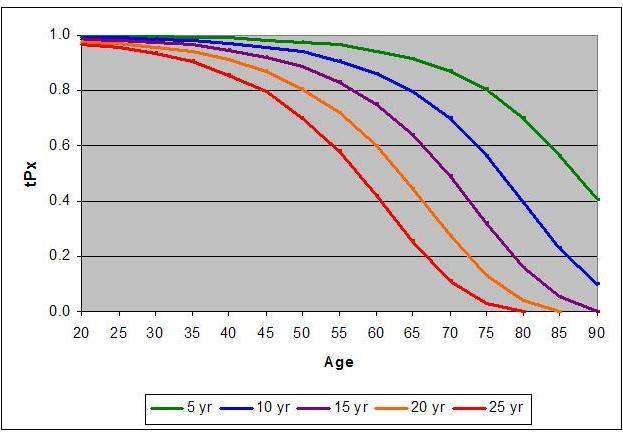
Using  from Table 1 data, the chart shows
  with x (Age) ranging from 20 to 90 years and t ranging from 5 to 25 future years.
These curves show the probability that someone at (who has reached) the age of x will live, at least, t years and can be used to discuss annuity issues from the boomer viewpoint where an increase in group size will have major effects.
For those in the age range covered by the chart, the "5 yr" curve indicates the group that will reach beyond the life expectancy. This curve represents the need for support that covers longevity requirements.
The "20 yr" and "25 yr" curves indicate the continuing diminishing of the life expectancy value as "age" increases. The differences between the curves are very pronounced starting around the age of 50 to 55 and ought to be used for planning based upon expectation models.
The "10 yr" and "15 yr" curves can be thought of as the trajectory that is followed by the life expectancy curve related to those along the median which indicates that the age of 90 is not out of the question.
[edit] Licensing
 |
I, the copyright holder of this work, hereby release it into the public domain. This applies worldwide. In case this is not legally possible, |
File history
Click on a date/time to view the file as it appeared at that time.
| Date/Time | Dimensions | User | Comment | |
|---|---|---|---|---|
| current | 01:38, 10 April 2007 | 623×434 (186 KB) | JMSwtlk (Talk | contribs) | (==Summary== Using <math>\,l_x</math> from Table 1 data, the chart shows <math>\,{}_tp_x</math> with <math>x</math> (Age) ranging from 50 to 90 years and <math>t</math> ranging from 5 to 25 future years. These curves show the probability th) |
| 15:45, 9 April 2007 | 840×525 (15 KB) | JMSwtlk (Talk | contribs) | (== Licensing == {{PD-self}} ) |
- Search for duplicate files
- Edit this file using an external application
See the setup instructions for more information.


