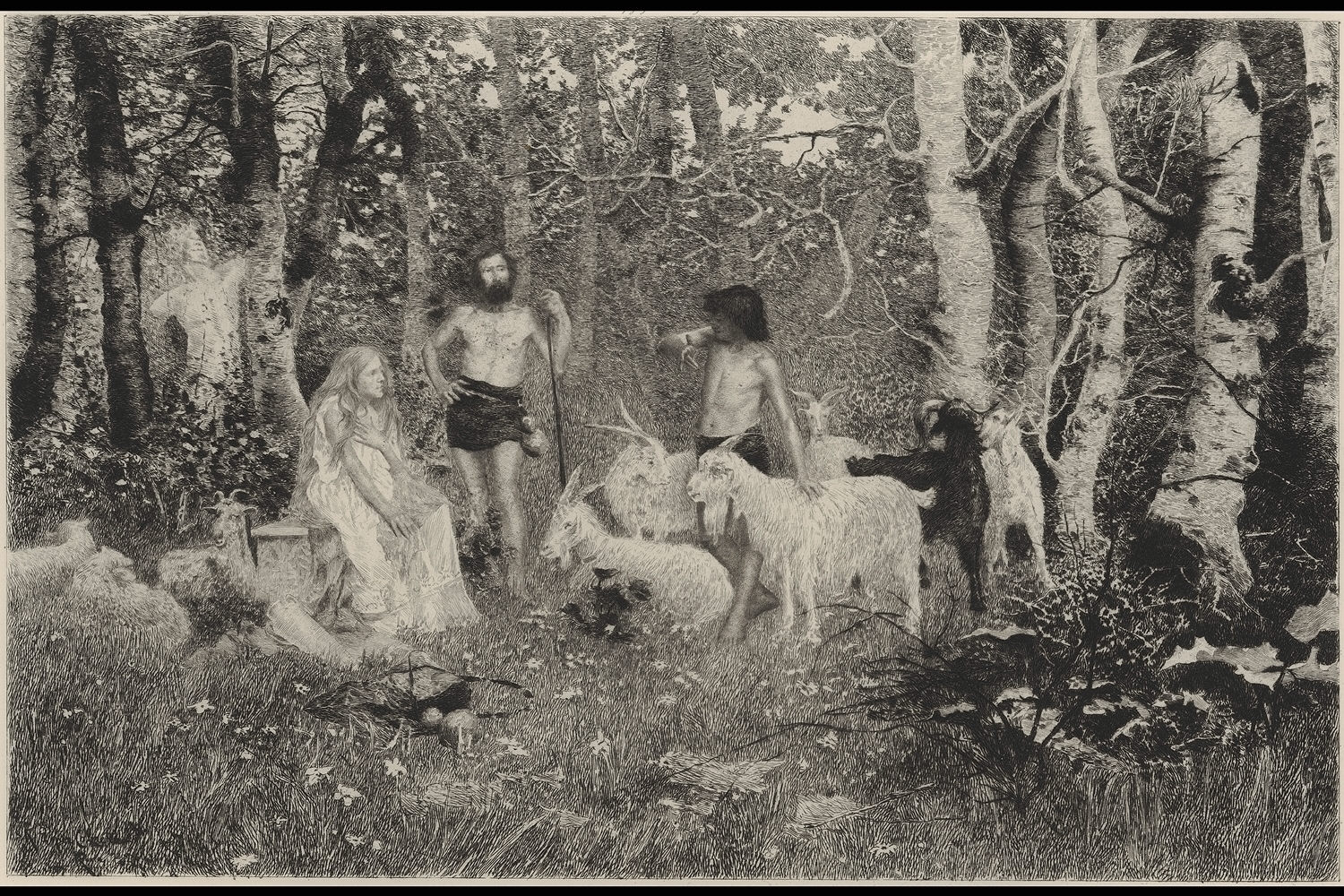
Daphnis and Chloe
From Wikipedia, the free encyclopedia


Daphnis and Chloe is the only known work of the 2nd century AD Greek novelist and romancer Longus.[1]
Contents |
[edit] Setting and style
It is set on the isle of Lesbos during the 2nd century AD, which is also assumed to be the author's home. Its style is rhetorical and pastoral, its shepherds and shepherdesses are wholly conventional, but the author imparts human interest to this idealized world. Daphnis and Chloe resembles a modern novel more than does its chief rival among Greek erotic romances, the Aethiopica of Heliodorus, which is remarkable more for its plot than its characterization.
[edit] Plot summary
Daphnis and Chloe, two children found by shepherds, grow up together, nourishing a mutual love which neither suspects. The development of their passion forms the chief interest, and there are few incidents. Chloe is carried off by a pirate, and ultimately regains her family. Rivals trouble Daphnis' peace of mind; but the two lovers are recognized by their parents, and return to a happy married life in the country.
[edit] Characters
The human characters in the novel include:
- Chloe - The heroine
- Daphnis - The hero
- Dorcon - The would-be suitor of Chloe
- Dryas - Chloe's foster father
- Lamon - Daphnis' foster father
- Myrtale - Daphnis' foster mother
- Nape - Chloe's foster mother
[edit] Reception and influences
Daphnis and Chloe was the model of La Sireine of Honoré d'Urfé, the Diana enamorada of Jorge de Montemayor, the Aminta of Torquato Tasso, and The Gentle Shepherd of Allan Ramsay. The novel Paul et Virginie echos the same story. Also, Maurice Ravel based his ballet, Daphnis et Chloé, on the story.
The French translation, as prepared by Jacques Amyot, bishop of Auxerre and revised by Paul Louis Courier, is perhaps better known than the original. It appeared in 1559. The story has been prepared in numerous illustrated editions, including a 1937 limited edition with woodcuts by Aristide Maillol, and a 1977 edition illustrated by Marc Chagall.
The 1952 work Shiosai (The Sound of the Waves), written by the well-known Japanese writer Yukio Mishima following a visit to Greece, is considered to have been inspired by the Daphnis and Chloe myth.
The Princess Bride also incorporates elements of the story in the romance between Wesley and Princess Buttercup, although it is Wesley who is abducted by the Dread Pirate Roberts.
[edit] Adaptation (2006)
The work was adapted into a 45-minute radio play by Hattie Naylor, first broadcast at 14:15 on Friday 3 March 2006, BBC Radio 3. This broadcast was repeated as the Afternoon Play 14:15 on Wednesday 27 June 2007, and made available for streaming download for 7 days on the BBC Radio Four, Afternoon Play Webpage
It was played for comedy, with the sexual encounters preceded by 'I must speak in Latin!' and each dream-sleep preceded by a sudden comic thud. The cast were as follows-
- Longus ...... Adrian Scarborough
- Chloe ...... Lyndsey Marshal
- Daphnis ...... Ben McKay
- Lamo/Megacles ...... Kim Wall
- Myrtale/Lycaenium ......Tracy Wiles
- Philetas/Dionyosophanes ...... Geoffrey Beevers
- Love/Astylus ...... Simon Trinder
- Dryas/Gnatho/Lampis ...... Anthony Glennon
- Original music - Sarah Moody
- Producer/director Jeremy Mortimer.
[edit] See also

Other ancient Greek novelists:
- Chariton - The Loves of Chaereas and Callirhoe
- Xenophon of Ephesus - The Ephesian Tale
- Achilles Tatius - Leucippe and Clitophon
- Heliodorus of Emesa - The Aethiopica
[edit] Footnotes
- ^ It has been suggested that the name Longus is merely a misreading of the last word of the title Λεσβιακῶν ἐρωτικῶν λόγοι δ in the Florentine manuscript; Seiler also observes that the best manuscript begins and ends with λόγου (not λόγγου) ποιμενικῶν.
- This article incorporates text from the Encyclopædia Britannica Eleventh Edition, a publication now in the public domain.
[edit] Further reading
[edit] Editions
- Columbani, Raphael; Henry Cuffe and Marcello Adriani (1598). Longi Pastoralium, de Daphnide & Chloë libri quatuor. Florence: Apud Philippum Iunctam. The first printed edition.
- Courier, Paul Louis (1810). Contained a previously unknown passage, after the discovery of a new manuscript.
- Athenian Society (1896). Longus, literally and completely translated from the Greek. Athens: Privately printed. Retrieved on 2007-06-22. With English translation.
- Edmonds, John Maxwell (1916). Daphnis & Chloe, by Longus; The Love Romances of Parthenius and Other Fragments, Loeb Classical Library. Cambridge, MA: Harvard University Press. ISBN 0-674-99076-5. With English translation revised from that of George Thornley.
- Dalmeyda, George [1934] (1971). Pastorales (Daphnis et Chloe) / Longus, Collection des universités de France. Paris: Belles Lettres. With French translation.
- Reeve, Michael D. [1982] (1994). Daphnis et Chloe / Longus, Editio correctior, Bibliotheca scriptorum Graecorum et Romanorum Teubneriana, Stuttgart: Teubner. ISBN 3815419328. Reeve's text is reprinted with the translation and commentary by Morgan (see below).
[edit] English translations
- Thornley, George (1657). Daphnis and Chloe: A Most Sweet, and Pleasant Pastorall ROMANCE for Young Ladies. Retrieved on 2007-08-20. A revised version is printed with Edmonds's text (see above).
- Hadas, Moses (1953). Three Greek Romances. Indianapolis: Bobbs-Merrill. ISBN 0-672-60442-6.
- Turner, Paul [1956] (1989). Longus: Daphnis and Chloe, Penguin Classics. Harmondsworth: Penguin. ISBN 0-14-044059-3.
- Gill, Christopher (1989). "Longus: Daphnis and Chloe", in Bryan P. Reardon (ed.): Collected Ancient Greek Novels. Berkeley, CA: University of California Press, pp. 285–348. ISBN 0-520-04306-5.
- McCail, Ronald (2002). Daphnis and Chloe / Longus, Oxford World's Classics. Oxford: Oxford University Press. ISBN 0-19-284052-5.
- Morgan, J. R. (2004). Longus: Daphnis and Chloe, Aris and Phillips Classical Texts. Oxford: Oxbow Books. ISBN 0-85668-562-3 (cloth); ISBN 0-85668-563-1 (pbk.). With reprint of Reeve's text and a commentary.
- Tyrrell, Wm. Blake (n.d.). Daphnis and Chloe: A Novel by Longus. Retrieved on 2007-08-20.
[edit] External links
 |
The external links in this article may not follow Wikipedia's content policies or guidelines. Please improve this article by removing excessive or inappropriate external links. |
Editions of the Greek text
- Longi Pastoralium de Daphnide et Chloe Libri IV Graece et Latine Ed. Christ. Guil. Mitscherlich, Biponti (Zweibrucken), 1794.
- Longi Pastoralia First complete Greek text of Daphnis and Chloe, edited by P.-L. Courier, with a Latin translation by G. R. Lud. de Sinner. Paris, 1829.
- Longi Pastoralia Greek text of Daphnis and Chloe with a Latin translation, edd. Seiler, Schaefer, Boissonade & Brunck. Leipzig, 1843.
- Erotici Scriptores Paris, 1856, pp. 739. Longi Pastoralia, Greek text with Latin translation, edited by G A Hirschig, pp. 174-222.
- Daphnis and Chloe The Bibliotheca Classica Selecta's 2006-2007 edition of the Greek text with the French translation of Jacques Amyot revised, corrected and completed by P.-L. Courier.
Synopses, Analyses, and Other Studies
- "A Synopsis of Longus' Daphnis and Chloe" by Jean Alvares
- An Introduction to Daphnis and Chloe Written by Kelly Blanchfield, Jamie Jones, and Carrie Lefler.
- Chirping Cicadas and Singing Crickets An article - written from the standpoint of a cultural entomologist - by Herbert Weidner, Hamburg, Germany.
- Daphnis and Chloe: Its influence on art and its impact on Goethe An entry in the Encyclopedia of World Biography which also notes the work done by William E. McCulloh, Emeritus Professor of Classics at Kenyon College, Ohio, in dating Daphnis and Chloe.
- Longus: Life, Influence & Bibliography An entry in the Encyclopedia of the Ancient World.
- J. C. Dunlop's History of Fiction London, 1888, vol. 1, pp. 45-57.
Art inspired by Daphnis and Chloe
- Daphnis and Chloe Pierre Prud'hon, Paris, 1802
- Daphnis and Chloe Oil on Canvas by Elizabeth Bouguereau (1837-1922)
- Daphnis and Chloe After the painting by Ricardo Lopez Cabrera (Spain). Etched by Gaston Manchon.
- A Pastoral Idyll Goatherd watching over a Shepherdess, Francois Boucher, 1703-1770.
- Prints of Gwen Raverat's 29 Wood Engravings for Daphnis and Chloe Exhibited at the Broughton House Gallery.
- An early edition Title-page of the 1786 edition of the Greek text published by Giambattista Bodoni at the Royal Printing Works of Parma, Italy.
- Daphnis and Chloe Baron Francois Pascal Simon Gerard, 1824