Image:Commutator - Advance for Self Induction.png
From Wikipedia, the free encyclopedia
Size of this preview: 702 × 600 pixels
Full resolution (2,346 × 2,004 pixels, file size: 559 KB, MIME type: image/png)

| This is a file from the Wikimedia Commons. The description on its description page there is shown below.
|
Contents |
[edit] Summary
[edit] Illustration Description
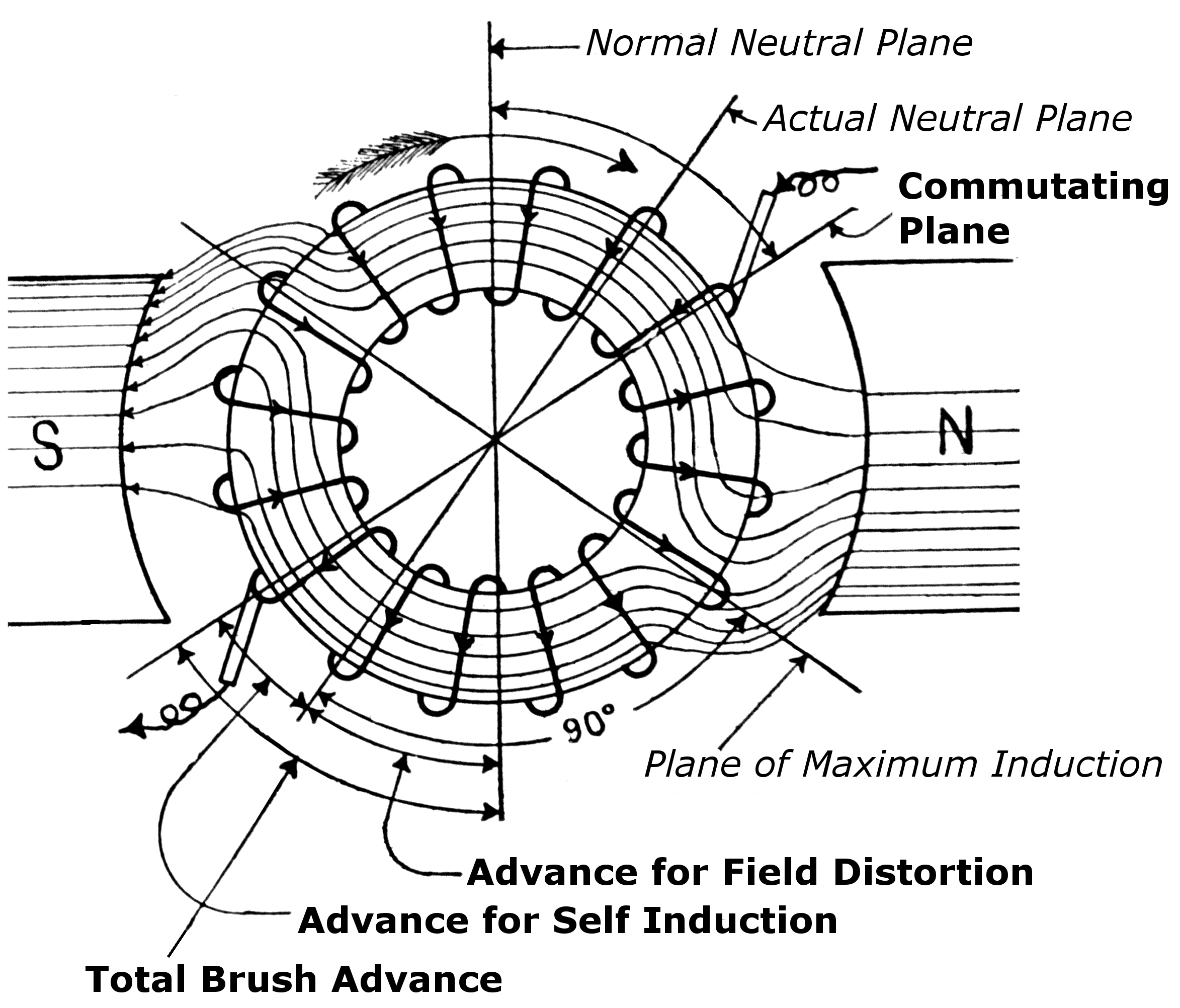
Figure 303 -- Commutator brush adjustment for self-induction
- For convenience an electric current is considered to have weight and hence possessing the property of inertia. The current then during commutation cannot be instantly brought to rest and started in the opposite direction, but these changes must be brought about gradually by an opposing force.
- Hence by advancing the brushes beyond the neutral plane as shown in this illustration, commutation takes place with the short-circuited coil cutting the lines of force so as to induce a current in the opposite direction. This opposes the motion of the current in the short circuited coil, brings it to rest, and starts it in the opposite direction, thus preventing sparks at the brush.
[edit] Public Domain Source
- Hawkins Electrical Guide, Volume 1
- Chapter 20: Commutation and the Commutator
- Page 287, Figure 303
- Copyright 1917 by Theo. Audel & Co.
- Printed in the United States
[edit] Upload Notes
- Scanned by Dale Mahalko, Gilman, WI, USA on 13:42, 20 May 2008 (UTC)
- Scanned at 600dpi, 8-bit grayscale using MicroTek ScanMaker 3600
- Level-adjusted and cleaned up using Gimp 2.4.4
[edit] See Also
For a list of all these illustrations used in Wikipedia please see the article Hawkins Electric Guide on the English Wikipedia.
[edit] Licensing:
 |
This media file is in the public domain in the United States. This applies to U.S. works where the copyright has expired, often because its first publication occurred prior to January 1, 1923. See this page for further explanation.
|
 |
|
Deutsch | English | Español | Français | Gaeilge | Galego | Italiano | Nederlands | 中文(简体) | +/- |
||
 |
This image might not be in the public domain outside of the United States (this especially applies in Canada, China (not Hong Kong, Macao, or Taiwan Area), Germany, Mexico, and Switzerland). The creator and year of publication are essential information and must be provided. See Wikipedia:Public domain and Wikipedia:Copyrights for more details. |
File history
Click on a date/time to view the file as it appeared at that time.
| Date/Time | Dimensions | User | Comment | |
|---|---|---|---|---|
| current | 13:42, 20 May 2008 | 2,346×2,004 (559 KB) | DMahalko | (== Summary == === Illustration Description === Figure 303 -- Commutator brush adjustment for self-induction * For convenience an electric current is considered to have weight and hence possessing the property of inertia. The current then during commutati) |
File links
The following pages on the English Wikipedia link to this file (pages on other projects are not listed):


