Colsterworth
From Wikipedia, the free encyclopedia
Colsterworth is a village in the English county of Lincolnshire. Colsterworth, together with the hamlet of Woolsthorpe-by-Colsterworth, had a population of 1,508 according to the 2001 census, and lies half a mile to the west of the A1 road, seven miles south of Grantham and 13 miles north of Stamford. The name Colsterworth is from the Old English colestre + worth for "enclosure of the charcoal burners"; the name appeared as Colsteuorde in the 1086 Domesday Book.
Contents |
[edit] History
The village dates from the Roman era. It is close to Ermine Street, the old Roman road that runs directly north to Lincoln.
Colsterworth is raised upon a slight limestone ridge, with the River Witham running below on the western side and bisecting the two villages. The ancient hamlet of Twyford has been engulfed by the expansion of Colsterworth to the south but the name is preserved in the names of certain houses. At one time Colsterworth lay astride the Great North Road, but was bypassed when that highway was realigned and renamed in the 1920s. Colsterworth also lies one mile to the west of Twyford Wood, which was a second world war airfield, RAF North Witham, and still retains many military artefacts, including the wide open runways and the derelict control tower. After the war the airfield part of the wood was planted with oak and conifer trees. The grassland habitat is home to a regionally-important colony of dingy and grizzled skipper butterflies.
In 1884, the Rev. J. Mirehouse, the eccentric rector of Colsterworth was responsible for the publicity stunt of the Home Office Baby.
[edit] Local architecture
The nucleus of the village lies along the High Street where, in the hey-day of the coaching trade there were numerous inns - ten at one time. The old coaching stops have been transformed into houses or business property (The George House; The Sun Pottery) or demolished completely. The White Lion alone now serves the population, standing opposite the parish church of St John the Baptist, the origins of which go back to Saxon times, as indicated by the herring-bone stonework in the chancel. The fine Norman arches were preserved during the Victorian period of renovation, of which this church is an outstanding example. The surrounding churchyard has been closed for almost a century but is kept in good order by the Parish Council. Inside the church, tucked away behind the organ and difficult to photograph, is a stone sundial plate cut with a penknife at the age of nine by Sir Isaac Newton, born in Woolsthorpe-by-Colsterworth. The stone, which has no gnomon, is mounted (upside down) below a carved wooden effigy of the scientist. Sir Isaac Newton's mother, Hannah Ayscough, and father, also called Isaac, are both buried in the graveyard.
Due to a lack of clergy, there is one Church of England priest for Colsterworth and another four parishes; the Colsterworth Group of Churches consists of The Holy Cross at Great Ponton, St Guthlac at Little Ponton, St James at Skillington and St Andrew and St Mary at North & South Stoke Rochford with Easton. There is also a Methodist Church in the village.
Although the oldest dwellings are of limestone, which requires constant attention for its upkeep, brick homes of the 1920s and 1930s are interposed amongst them, giving the village a rather patchy appearance. During the 1970s a large estate, Woodlands Drive, was built on ground previously belonging to Colsterworth House, an imposing mansion now completely obliterated. All the land between the village and the A1 has been completely developed into a new housing estate. Newcomers, in the main, tend to commute to work out of the area, some as far as London.
[edit] Economy
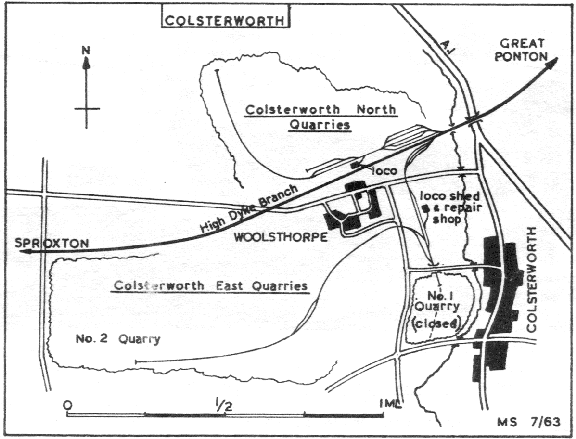
There is little employment in the village itself. During and for some time after the Second World War, work was available at the ironstone excavations,[1] but, since they ceased operations and the site was filled and levelled, only Vaculug, a tyre depot, and Christian Salvesen, the food cold-store, offer local employment. Otherwise farming, the traditional occupation that not so long ago absorbed all the available workforce, and part-time jobs at one of the quick food restaurants Little Chef and Travelodge which have sprung up along the A1, are all that the village has to offer. Some find employment at the nearby Stoke Rochford Hall, a busy East Midlands conference and function centre.
The village has a post office, a surgery, hairdresser and touring police constable. Local shopping is catered for by the Co-op and by the farm shop, while mobile shops include two greengrocers, two butchers and a fishmonger; the County Council library and travelling bank call once a week. The Church of England primary school, for children of this and neighbouring villages who are bussed in, has approximately 120 pupils divided into five classes.
[edit] Transportation
[edit] Future Road Changes
The A1 Trunk Road is a busy north-south route of strategic importance connecting the two sections of the A1(M) at Peterborough in the south and Blyth in the north. Most of this length is of a satisfactory standard but there are localised problems at six roundabouts. One of these is Colsterworth junction, a four-arm roundabout giving access to Corby Glen via the A151 and Colsterworth via the B676. Some 1.5 kilometres north of the Colsterworth roundabout is an existing crossroads which serves north Colsterworth and the Easton Cold Store via the B6403. The Highways Agency proposes to improve these junctions by constructing new two-level junctions. The most important reasons for improving these junctions are to enhance safety and reduce congestion thus alleviating the following:
- Nearly 43,000 vehicles per day use this section of the A1, up to 22% of these being heavy goods vehicles. At certain times of the day this results in substantial delays and congestion at Colsterworth roundabout.
- Crossing manoeuvres at the B6403 crossroads are difficult.
- There is inadequate provision for pedestrians and cyclists, which makes it difficult for these users to cross the A1.
- Between 1999 and 2003 there were 25 personal injury accidents in the vicinity of the existing junctions.
[edit] The Village Archive Group
Two local members of the villages of Colsterworth and Woolsthorpe-by-Colsterworth, Joy Isaac and Margaret Winn, founded a web-based organisation to record the memories of the village people in sound, vision and print for future generations, and to preserve vital oral history and accounts of village life in the twentieth and twenty-first centuries. The Village Archive Group (see external links) records this type of social history, also the Lincolnshire accent and use of dialect, as it is ever changing. A committee was formed and other volunteers joined the group to help with the interviewing, recording and planning events. They have been well supported by local people who have donated or lent old photographs and material to scan and archive, and shared their stories.
Firstly, they recorded life styles and accounts of the village during the 1900s, also wartime memories and experiences. Secondly they recorded a snapshot of village life today. This snapshot of the present will not only be of interest now, but a useful resource to another generation – possibly for use as an educational tool in schools and as a record of social history of the present day.
Funds from Lincolnshire Community Champions and the Local Heritage Initiative, now under the control of Heritage Lottery Funding, will ensure that the project can become a reality. As well as hosting a website they are producing the project as a book with DVD.
[edit] Woolsthorpe-by-Colsterworth
The local council, anxious to preserve the separate identities of Colsterworth and Woolsthorpe-by-Colsterworth, bars the building of new property between the two villages, although much infilling is taking place as large gardens are split up and odd plots, overlooked for years, are utilised.
Woolsthorpe-by-Colsterworth, although attached to Colsterworth for administration purposes, has a character all its own, being smaller and quieter. It is famous as the birthplace of Sir Isaac Newton in 1642. His home, Woolsthorpe Manor, attracts visitors from all over the world. The village hall was built as a result of an appeal in his memory and is named after him. He was christened in the church of St John the Baptist, where a copy of the entry in the register is to be seen.
[edit] Notes
[edit] External links
- Newton's Astronomical Society
- Woolsthorpe Manor information at the National Trust
- Stoke Rochford Hall website
- Details of road changes around Colsterworth
- Map of Colsterworth on aboutbritain.com
- Colsterworth Methodist Church
- The Village Archive Group