Talk:Chestnut
From Wikipedia, the free encyclopedia


Does the american chestnut blight affect the horse chestnut?
Can't imagine it would, as the trees are completely unrelated. KristianMikk
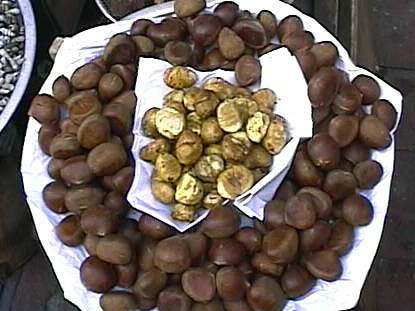
Found a good image for chestnuts at: http://www.pusanweb.com/food/guides/streetfood/chestnut.jpg I'm too lazy to check for copyrights and upload and all. Someone plz. do it for me. For more images see: http://images.google.com/images?hl=en&lr=&ie=UTF-8&oe=UTF-8&newwindow=1&q=chestnut&sa=N&tab=wi
Contents |
[edit] DOES ANYONE OUT THERE KNOW THE DIFFERENCE BETWEEN A HAZELNUT AND A CHESTNUT???


cuz i googled images and got the same results for each nut thanks!
- Wikipedia has a nice article on hazel nut that has clear pictures. What's not clear from the pictures is that hazel nuts are much smaller. --71.51.64.122 (talk) 23:21, 23 November 2007 (UTC)
-
- There are many differences. The seed are among the few things that look somewhat alike. But as entire plants they are quite dissimilar. Though they both have their male flowers in catkins for example, and in this particular case this is even a sign of their relationship (it weas once believed that most all plants with catkins would belong to a group called Hamamelididae, but this is not correct).
- Altogether, one might say that a chestnut and a hazelnut plant are about as closely related as a human and a capuchin monkey. They are not too far apart; as your question shows, one can recognize that. But they are not particularly close either. Dysmorodrepanis (talk) 17:54, 11 December 2007 (UTC)
[edit] nutritional info request
Could someone edit this article with some nutritional info? As I understand it, chestnuts differ from most other nuts in having little or no fat and very little protein -- but lots of starch. I would like to see more about content analysis for chestnuts. —Preceding unsigned comment added by 71.167.13.20 (talk) 02:22, 2 December 2007 (UTC)
[edit] Which species of chestnut is the Dwarf Chestnut?
Which species of chestnut is the Dwarf Chestnut? Reading from the [Grocer's Encyclopedia] -- search for Dwarf Chestnut, it says
a low tree, bearing fruit the size of a hazel nut. A number of species are native to the East. It does not grow south of Maryland.
—Grocer's Encyclopedia 1911
Please add the historical name of Dwarf Chestnut to the article if the correct species is found.
Thanks, Onionmon 06:50, 5 January 2007 (UTC)
- Has been added (not by me) - Castanea pumila, whose scientific name indeed literally means "tiny chestnut". Dysmorodrepanis (talk) 17:41, 11 December 2007 (UTC)
[edit] Chinkapin redirects
Someone needs to straighten out the redirects here. Chinkapins are not chestnuts. The subject word is "chestnut", a common name, not Castanea, a genus name. Chinkapins and chestnuts both belong to Castanea, which should be the topic. "Chinkapin" and "Chestnut" should redirect to Castanea.
- Partly correct, partly wrong (and fixed that). Chinkapins are a number of Fagaceae (including some Castanea), but for Castanopsis "chinkapin" is the only name that is used to any extent in English. Outside North America "chinkapin" is not used for Castanea to any extent, and scientists use it for some Castanea, all Castanopsis, and (as "golden chinkapin") for Chrysolepis with no clear pattern, says Google Scholar. So Chinkapin is now disambiguation. Dysmorodrepanis (talk) 17:38, 11 December 2007 (UTC)
[edit] chestnut & maggots
About the maggots in the chestnuts, are they 'fly' maggots? How do they get inside the chestnuts? Do the flies lay eggs outside the chestnut so the maggots will crawl into the tip of the chestnut? —Preceding unsigned comment added by 206.66.218.156 (talk) 14:52, 12 October 2007 (UTC)
- IONO exactly what maggots you refer to, but usually the insects (flies, midges...) lay their eggs inside the flowers and the larvae then grow together with the chestnut, getting inside before it gets the spiny husk. Dysmorodrepanis (talk) 17:39, 11 December 2007 (UTC)
[edit] Castanea Latin name
Castanea is not a Latin but a Greek name.Even in modern greek we call it καστανιά(castania)...It is widely known that many latin words come from greek ones...In modern greek "Kastanos andras" means brown-haired man...kastanos means dark brown from the co;our of chestnuts(kastana) —Preceding unsigned comment added by 85.75.219.17 (talk) 00:35, 19 March 2008 (UTC)