Charge amplifier
From Wikipedia, the free encyclopedia
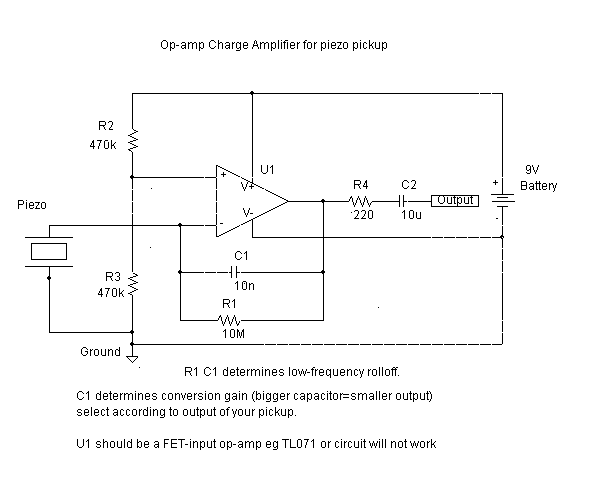
A charge amplifier is a circuit whose equivalent input impedance is a capacitance that provides a very high value of impedance at low frequencies. Thus contrary to what its name may suggest, a charge amplifier does not amplify the electric charge present at its input. Its function is actually to obtain a voltage proportional to that charge and yield a low output impedance. Hence it is a charge-to-voltage converter. Common applications include piezoelectric sensors and photodiodes, in which the charge output from the transducer is converted into a voltage. Charge amplifiers are often found in instrumentation, and in the readout circuitry of CCD imagers and flat-panel X-ray detector arrays. In read-out circuits the objective is usually to measure the very small charge stored within an in-pixel capacitor, despite the capacitance of the circuit-track to the readout circuit being a couple of orders of magnitude greater than the in-pixel capacitor.
Advantages include:
- Enables quasi-static measurements in certain situations, such as constant pressures on a piezo lasting several minutes[1]
- Piezo element transducer can be used in much hotter environments than those with internal electronics[1]
- Gain is dependent only on the feedback capacitor, unlike voltage amplifiers, which are affected greatly by the input capacitance of the amplifier and the parallel capacitance of the cable[1][2]
Contents |
[edit] Design
Charge amplifiers are usually constructed using op amps with a feedback capacitor. They thus act in a similar manner to an integrator. Since the transducer acts in a similar manner to a differentiator, the two transfer functions cancel and the output voltage is proportional to the charge produced by the transducer. Stray capacitance at the input to the amplifier is not detrimental to operation because this capacitance is always at a virtual ground.
[edit] Applications
- Accelerometer signal conditioning
- Guitar pickup amplifiers
- Vibration transducers
- Nuclear instrumentation
[edit] Precautions
Cable from the transducer to the amplifier should not be subject to vibration as extra charges can be generated by friction and lead to unwanted noise output.
[edit] References
- ^ a b c Piezoelectric Measurement System Comparison: Charge Mode vs. Low Impedance Voltage Mode (LIVM). Dytran Instruments. Retrieved on 2007-10-26.
- ^ Maximum cable length for charge-mode piezoelectric accelerometers. Endevco (Jan). Retrieved on 2007-10-26.