Talk:Catharism
From Wikipedia, the free encyclopedia


 Archives |
The opening para of the Cathar (ie not Catharism) article says that Catharism lasted for 'a short while'. In fact it lasted for about 200 years. The first recorded Cathars in the Languedoc are spoken of in the 11th Century. Monstegur fell in the mid 13th Century. Shouldn't this be looked at? Come to think of it, why are there two articles here - Cathars & Catharism - one of which is much longer and more detailed than the other? Shouldn't they be merged? ThePeg 12:41, 24 January 2007 (UTC)
[edit] Cathars and Conspiracy Theory
-
- Should there be a reference here to the claims made by conspiracy theorists that
the Cathars allegedly believed in the secret marriage of Jesus to Mary Magdalane and their "Holy Bloodline"?
I realize that such things are all over the place, but at least a debunking of the claim would probably be relevant. I think there is some suggestion that the claim that they believed in a "mystical marriage" might be supported by historical evidence, but I'm only going by hearsay here. Anyone help?
- There is no such reference in this article, for a very simple reason. No one who has done even minimal reading is under the false impression that Cathars believed anything of that sort. Reading about Cathar views on marriage might set a misguided reader straight: E. Le Roy Ladurie, Montaillou: The Promised Land of Error, would provide some nourishment for the famished mind. It's available in paperback, so there's no excuse for not reading it, if one has even a passing curiosity about real Cathars. --Wetman 18:46, 25 January 2007 (UTC)
-
- The peg is right: two hundred years (arguably three) is hardly a short time.
- Wetman is wrong. The Holy Bloodline loonies did not make up the story about people in the Languedoc believing that there had been a relationship between Jesus & Mary Magdelene. There's a reference to it in the contemporary Song of the Cathar Wars (By the way E. Le Roy Ladurie was writing about a period some hundred years later than the start of the Crusade). The Song of the Cathar Wars is available in Occitan, French and English and would provide some nourishment for the famished mind. It's available in paperback, so there's no excuse for not reading it, if one has even a passing curiosity about real Cathars.)
- Does anyone know why this article is flagged as not neutral, and who flagged it?
- I propose to amend the text & remove the flag unless anyone has some reasons not to Springald 16:47, 29 January 2007 (UTC)
Good plan. Des Vaux de Cernay also mentions the sexual relationship between Jesus & Mary - see [http://www.languedoc-france.info/120113_propaganda.htm this page] for a reference.Gcp 20:05, 31 January 2007 (UTC)
The article was vigourously opposed as being NPOV by various commentators who felt the article was over favourable to the Cathars and unfair on the Catholics.
Regarding the Cathars and Mary Magdelene, its worth remembering that the Cathars disapproved of all sexual congress so its unlikely that they would have believed that Christ would have been married to Mary Magdelene. On top of which they believed Christ was wholly spirit and without material form so its unlikely any sexual activity would have taken place. What is more likely is that they shared the Gnostic belief that Mary was either chief among the Apostles or at least equal to them. The Cathars were traditionally more sympathetic towards women than Catholic Christianity would have it. The Christ/Mary connection may well also have been an echo of the Gnostic Christ/Sophia connection but was probably thought of spiritually rather than physically. If any changes in the text happen over this issue these considerations should be taken into account.
The Cult of Mary Magdelene has always been widespread in southern France, even orthodox Catholics believing that she travelled to the Languedoc to spread the faith there (hence the Dan Brown theory that she settled there with Christ and sired the Merovingian Dynasty). The likelihood is that the Mary Magdelene/Southern France comes from echoes of Goddess-worship in the region in pre-Christian times. The Cathar region is full of Divine Feminine images -Rennes le Chateau, Lourdes, even the Pilar in Zaragoza across the Pyrenees. Its also the region where the Holy Grail legend really took off, the Grail being another Feminine image of receiving. Only a real Dan Brown Fruitloopian would take it all so literally. Spirituality resonates down through the ages and evolves and expresses itself as human religious feeling develops.
In answer to Wetman's comments about Cathar views on marriage, Montaillou was a Cathar outpost unearthed by the Inquisition almost a hundred years after the fall of Montsegur and thus not very representative. The ringleaders of that particular community were rather corrupt sexually, but no more so than the average Catholic clergyman of the time! ThePeg 23:51, 3 February 2007 (UTC)
- "its worth remembering that the Cathars disapproved of all sexual congress so its unlikely that they would have believed that Christ would have been married to Mary Magdelene. On top of which they believed Christ was wholly spirit and without material form so its unlikely any sexual activity would have taken place." This is true, but on the other hand Cathars did like to develop dualist explanations; hence what Pierre des Vaux de Cernay says of their views on Jesus and Mary Magdalene -- he links it with the idea that there was both a spiritual Jesus and a fleshly Jesus -- may carry some conviction. However, it's definitely concubinage that Pierre is talking about, not marriage. Andrew Dalby 17:51, 5 February 2007 (UTC)
That's interesting and very possible. Am I wrong or did the Cathars believe that someone was substituted for Christ on the cross - Simon the Cyrene or someone? I may be mixing this up with another sect. ThePeg 18:17, 5 February 2007 (UTC)
- The Mary Magdelene thing. Isn't the point that the supposed sexual relationship between Jesus & Mary is not a fiction dreampt up by Dan Brown or the Fruitloopians. It is mentioned numerous times by contemporary Catholic Inquisitors & chroniclers. This in itself is interesting and I'm not sure why it should not be mentioned in the article. There's no point arguing about what the Cathars might have thought or should have thought if we have documentary evidence of contemporary accusations.Gcp 19:58, 7 February 2007 (UTC)
Well hang on, after the above discussion do you mean by this that a) the Cathars believed Magdelene and Christ were lovers, b) that the Catholics said that the Cathars believed they were or c) that they believed what Dan Brown believed ie that they were lovers and sired the Merovingian dynasty? Could you clarify a little? I would also like to know the sources. Also, should we have an article on the Fruitloopians. They're quite a interesting sect. :-) ThePeg 22:50, 9 February 2007 (UTC)
- PoV: I just re-read the articles and can't see any pro Cathar bias - though I can see some pro Catholic bias. Could someone list the supposed points that are regarded as pro-Cathar POV otherwise it's not going to be possible to identify them, let alone deal with them Gcp 19:58, 7 February 2007 (UTC)
-
-
- The more I look at it the more I agree with Gcp here. There are some really wierd statements here, like citing the Cathars' pacifism as bizarre and anti the mores of the period even though it is EXACTLY in keeping with the tenets of Christianity. It may well have been a minority position (it still is) but in an era which claimed it was following Christ they were the only ones trying to live up to his words - in this respect anyway. Hmmmm. ThePeg 10:11, 14 April 2007 (UTC)
-
With respect to all parties, this article was flagged in part because of the evidenced pro Roman Catholic position of the lead editor Dominck That bias led in turn to a series of posts (now in archive) which had little or no substantive contribution to make for the creation of a serious scholarly article. As these archived posts remain, the AGC has been asking History departments in academic institutions to develop specific guidelines for students preventing them from citing these Wikipedia pages in assignments. Our position is the articles on Cathar or Catharism in Wikipedia are not an acceptable citation, even though it may lead one to a citable source. Middlebury College recently adopted this policy.
To be fair, Dominck withdrew gracefully, the commentaries have grown in stability and may yet reach such a mature perspective to rank alongside other articles about past and present religious movements thus qualifying for inclusion as a NPOV scholarly citation.
As for the Cathar/Mary talk; there is Mary, wife of Joseph and Mary Magdelene, we go with ThePeg on this. Conspiracy theories, flights of fantasy, unschooled comments and spurious remarks are precisely why these articles were marked.
Fruitloopians? Is this not the Cereal Cult that worships Dr. Kellog?--AGC Webman 16:52, 17 February 2007 (UTC)
A fascinating link, Webman. Notice on the ancient parchment the five sided star marking the proverbial spot? As every good Fruitloopian knows, the five-pointed star is the symbol of the eternal female, the paths of Venus etc etc. As the Fruitloopian Prophet Cocopoppe and his three disciples, Snappe, Crak-El and Poppe tell us, the true Divine Marriage of Christ and the Eternal Female is the ultimate answer to the salvation of the Universe. May the Weetabix Be With You. ThePeg 17:35, 25 February 2007 (UTC)
[edit] Merging the two articles
Yes there should be a merging , but with an ever watchful eye from more experienced Wikipedians to ensure neutrality is upheld. For more details about our position on merging the two articles we have placed a statement on our website.AGC Webman 18:25, 8 February 2007 (UTC)
- Agreed, a dead sect and its followers are historically the same thing - there is only a need for different pages between belief and believers when there is a large scale of change in the nature of the believers in their history. Since Cathar history is relatively short, the two pages are thus redundant. That being said, I haven't the sources in my possession to accurately merge them myself! Rockfall 21:21, 17 February 2007 (UTC)
[edit] Theology again
The theology of cathars seems a bit vague. I think it should be stated in clear and unambiguous language that the theology of the cathars was a dualist one, that is they believed in the existence of two gods, the good god of the heavens or spiritual world, and the bad god, oft given the name satanael, of the corporeal world. This is the basis of the heresy which the catholics so vehemently and violenlty opposed. If this is accepted then it is reasonable to trace the origin of dualist theology and thus the cathars, back through Bulgaria, past Mani to Zororaster; unless of course its is suggested that the bogomils have no intellectual or theological antecedents and that their theology was discreetly their own. Smileyc 14:11, 9 February 2007 (UTC)
Even this isn't quite right. The Cathars were what is known as 'mitigated dualists'. 'Mitigated dualists believe in two warring powers in the universe but one is lesser than the others. This was the Cathars' belief. The being who created the world - Satan/Satanael/Lucibel/Lucifer - was a fallen angel and thus not as powerful as God, that was why, according to the Cathars, we could escape him through Christ's help. Aboslute dualists believe in two equally balanced Gods. This wasn't the Cathar's view. It was Mani's though. ThePeg 22:47, 9 February 2007 (UTC)
- Responses to The Peg & Smiley
- 1)Re Mary Magdelene - what we know for sure through several sources is that the Catholics accused Cathars of believing in a sexual relationship between Jesus & Mary. In some accounts Mary was Jesus' "concubine". This is in itself an interesting accusation because the same belief was current in the earliest period of Christianity.
- 2)Great idea about Fruitloopians
- 3)Mitigated Dualism. Both strands of Dualist thought got to the Languedoc. The Cathars of the Languedoc were initially Mitigated Dualists but later became Absolute (In Italy the two factions argued with each other until they were both exterminated)
- 4)By the way, in response to Smiley, the evidence is much vaguer than you seem to think. Also, I'm not sure why you imagine it OK to refer to the Cathar belief system or indeed any belief system as a "heresy". Accusations of heresy necessarily imply a POV.
- Gcp 18:33, 12 February 2007 (UTC)
Err, ok, perhaps even for the discussion page i should have been more precise and indicated that the view that catharism is heresy is a catholic view. I would be interested to know what you mean by the evidence is much vaguer? Do you mean the claim that catharism is a dualist theology isn't supported by evidence? I'd be interested to read your views.
The use of the word heresy issue is an interesting one has been argued over on this site before. As I understand it the word 'heresy' has its roots in the Latin word for 'choice'. What's difficult is that technically speaking the word heresy doesn't have to be pejorative. The Cathars regarded the Church as heretical, for instance. It depends upon your POV. In this instance, it has to be remembered that the Cathars themselves had no name for their belief. They were simply Good Men and Good Women. If we refer to them as Albigensian or Cathar then we have to be aware that these terms were created by their persecuters who called their beliefs the Albigensian Heresy or the Cathar Heresy. Thus the use of the word in this context is the same. Re the Mary Magdelene thing. As the source is primarily Catholic we don't know the exact nature of what the Cathars believed on this subject. However, we do know that the early Gnostics believed that Mary was the woman who loved Christ and that she was one of the Chief Apostles (if not THE chief). We also know that later antinomian Christian movements talked a lot about her - cf the Sister Catherine Treatise, the Mirror of Simple Souls and the writings of Meister Eckhart (not antinomian but accused of being a heretic) - in these terms. Some of these other sources emerged from areas which had been centres of Catharism beyond the Langeudoc. Its possible that these ideas were part of the intellectual/spiritual climate of the era thanks to the Cathar presence in those parts (I'm talking here of the Rhineland and places like Cologne where the Rhineland Mystics and the Free Spirit movements took off). Its important to look carefully at what these mystics say about Mary - that she was the woman who loved Christ the most, that she loved Christ in the right way, that she had her own very female process of initiation into the Christian Mysteries. We also have to remember that in these contexts sexuality and sexual imagery is often absorbed in an extraordinarily visionary way into spirituality in much the same way that it is in the Song of Songs, as an expression of the marriage of the Male and Female in the Soul and between Mankind and God (again, very Gnostic) and between men and women in the flesh. For the later Mystics, the discussion of Mary Magdelene also includes women in a discussion of God and Christ in a way which the Church has traditionally excluded. This was not only progressive in that it counteracted the male bias and misogyny in the Christianity but also made it more comprehensive in our understanding of the world in relation to the Spirit. Its also, presumably, was particularly appealing to women of the time such as the Beguines. My point with all this? That the reductionist Catholic view of the Cathar idea of what Mary Magdelene represented would have been deliberately crude and unsympathetic. There would have been no effort to understand what the Cathars might have been saying. They would have said that another shocking thing about the Cathars was that they believed Christ experienced physical love with Mary. As I have tried to explore here, the truth would probably have been much more subtle than that. Unfortunately we will never know (short of seances) as we have no records of what the Cathars believed from Cathar sources. Finally, on the Fruitloopians. Having suggested the idea, I realise its hard to write about them. Any thoughts? ThePeg 12:20, 16 February 2007 (UTC)
Gcp, would you like to help me write an article on the Fruitloopians? We could have some fun. :-) ThePeg 01:18, 17 February 2007 (UTC)
- On the use of the word heresy, I think it does have perjorative connotations in English (You can still be tried for heresy). I think the key thing is consistency. I'd be happy to see Cathars and even Fruitloopians labelled as heretics as long as Catholics, Episcopalians, Baptists, etc are as well.
- On the "vaguer" business, I think it's important to remember that Cathar ideas varied over time and from place to place - so a lot of sweeping statements are not precisly correct. On the two flavours of Dualism good sources are Runciman, The Medieval Manichee, and Wakefield & Evans, Heresies of the High Middle Ages. Having said that, I think we can agree that all Cathars were Gnostic Dualists. Two examples of vagueness: not all Cathars called the bad god Sataniel; again take the statement "If this is accepted then it is reasonable to trace the origin of dualist theology and thus the cathars, back through Bulgaria, past Mani to Zororaster; unless of course it is suggested that the bogomils have no intellectual or theological antecedents and that their theology was discreetly their own." - Some serious scholars (I'm not one of them) disagree about the direct link back to Zoroastrians and do not necessarily identify the Bogomil link as the weak link in the chain.
- On the Mary Magdelene question, I don't have strong views but I do think an interesting point is that modern Fruitloopians did not invent the idea of Mary being Jesus's wife/concubine
- Re the discusion below about the early use of the term Cathar, another point I've always found fascinating is that Mani's family belonged to a sect called the Katheroi (literally, Cathars). Again no big interest in pushing it, but I find it an astonishing piece of information.
- Fruitloopian article: Great idea. Might take some time. Big area to cover.
- Gcp 19:18, 21 February 2007 (UTC)
-
- Well, true, you could say that Cathars and Catholics should both be classified as 'heretics', and that would be most consistent. You have to remember, however, that we are dealing with theological history. At the time that the Cathars were preaching and spreading (12-early 14th century), the status quo was the Catholic Church. Historians of the period, regardless of their personal beliefs almost always refer to the Cathars as "heterodox" and the Roman Church "orthodox". This is not a value judgement - merely a reflection what was considered mainstream at the time. In simple historical terms, it is easier to classify medieval groups such as the Cathars as "heretics". Note that some groups that come under the topic of medieval "heresy" were not in fact heterodox in their beliefs, merely unlicensed by the Papacy (such as the Patarini of Milan). Basically, while you could argue that it is a pejorative title, it is also the accepted historical term for these groups - more as a means of historical convenience - the groups had similar characteristics.
-
- On a related note: be careful when using Le Roy Ladurie in regard to Cathars. Montaillou was a village of the early 14th century that marked a revival of Cathar belief and was in a sense unrelated to the main movement that was extinguished in the Albigensian Crusade. Its value is more as a mircohistory, rather than a scope of Cathar belief. The sources were also written by a member of the Inquisition (and a future Pope), so draw what conclusions you wish. Rockfall 23:45, 21 February 2007 (UTC)
-
-
- "Well, true, you could say that Cathars and Catholics should both be classified as 'heretics', and that would be most consistent." It seems to me that it would be just as consistent not to refer to anyone as a heretic. This seems to be by far away the best solution - and one that most impartial modern historians now adopt. Following your favoured reasoning about the mainstream, perhaps you could let us know the exact date that you think we should stop referring to early Christanity as a Jewish heresy. Fruitloopian 16:10, 24 February 2007 (UTC)
-
GCP - That is a good, resonant coincidence re Mani. Even more coincidental is the name of the chief Sun God of the Etruscans, the original inhabitants of Tuscany which was also a centre of Catharism. The Sun God, the equivalent to Zeus and Jupiter was called Cathar. Given the fact that the Albigensian Christianity was very much a religion of Light (as is Christianity as a whole) this is a striking coincidence too. Quantum Physicist David Bohm always used to argue that the etymology of words revealed their true meanings and psychological links with the past. Well, there's some amusing evidence.
Rockfall - you're right about the Montaillou thing. I've pointed out a similar thing in the past. Montaillou is only partially representative of Cathar ideology. Interestingly, we know a lot about what happened to the Languedoc Cathars and something about the Lombardy ones but little about the Flanders/Rhineland ones or the ones in Spain...
Re the Magdelene thing. In the book Mary of Magdala by Mary R Thompson she points out that the mystery of Mary's relationship to Christ lies in part in the Greek word used to refer to her in the Gnostic Gospel of Philip, where she is referred to in the following way: "There were three who always walked with the Lord: Mary, his mother, hs sister and Mary Magdelene, the one who was called 'companion'". The word for 'companion' in Greek is, she says, koinonos, which translates as 'partner' and 'consort' as well as 'companion'. The Gospel also talks about Christ kissing her on the lips. Now we don't know for sure whether the Cathars had access to these Gospels. What we do know is that they claimed an apostolic connection to the very early Church so its not impossible that they could have had access to similar documents or at least ideas. As I've written above, I reckon they did have some kind of access to them as these ideas crop up a lot in Cathar-influenced areas and movements at later times. The Thompson book is interesting as it argues that Mary of Magdala was an apostle and early church leader who, legend has it, came to the south of France (hence the Fruitloopian mother of Jesus' kids idea). Thompson, rather interestingly, resists the idea of Mary as mother and lover in that it reduces her status from apostle and leader. Interesting...
Finally, good to see a Fruitloopian finally speaking out on these pages. For too long the cult has been deemed heretical and has had to fear for its life. At last it can speak out without fear of reprisals. A historic moment.
And even more finally, can someone give me the reference for the original mention that the Cathars believed Mary was the wife of Christ? ThePeg 17:29, 25 February 2007 (UTC)
- To The Peg: Good man. Several quick points (in a rush). Re the "...kissed her on the lips...". If I remember "lips" is a guess. There's actually a gap in the MS. (Almost too good to be true!). Re Etruscan god: you're winding me up, right? If not, reference greatly welcomed. Re Fruitloopian, there's not only a user but also already a Fruitloopian page that some editors are trying to get removed (heresy or blasphemy?). How do we oppose this? Re Montaillou - I think everyone agrees - no-one is claiming otherwise are they?Gcp 21:24, 27 February 2007 (UTC)
- To Rockfall: In case it gets lost in the cascade of text, there is a question - in fact two questions - for you further up the page Gcp 21:24, 27 February 2007 (UTC)
Gcp - yes, you're right, there is a gap in the manuscript. 'Lips' is a guess. As for the Etruscans, no I'm not kidding you. As the Etruscans used a non-Latin script its not literally spelt Cathar but it is pronounced that way. Nice coincidence, don't you think? Especially as there is a link between the Cathars and Tuscany. I've seen the Fruitloopian article. I'm pleased there's a user but I think the Wiki Inquisitors don't look kindly on the existence of the article. If Eckhart himself couldn't defend himself then I fear it will not last the duration. Re Montaillou - my reference is to a debate on an earlier discussion page. A user called Almarina used the Montaillou story as representative of the Cathars and their morality. Actually, if you're interested, check out the not unrelated Brethren of the Free Spirit article. They have a lot in common with the Cathars, although they don't share the view that Matter is Satanic. In fact their view on these things is closer to some of the Gnostic Gospels even than the Cathars. They too had an interest in the Magdelene.
To Fruitloopian - until Christianity became not specifically a Jewish sect it was exactly what you say, a Jewish heresy and was seen as such by the Jewish authorities. Once it broke out of the Middle East and travelled across the Roman Empire and beyond, picking up non-Jewish converts it became a religion in its own right. Interestingly, in the early days of Islam some Christian authorities saw it as a heretical Christian sect. So it depends on your point of view. ThePeg 14:22, 1 March 2007 (UTC)
- Hi The Peg. Etruscans - fantastic. Shame about the Fruitloopian article. Thanks for clarification about Montaillou. Will certainly follow up on the Brethren of the Free Spirit (Good name!). Re comments to Fruiloopian: spot on. I read this as a good reason for avoiding referring to any religious group as heretical. Re your query above concerning Jesus & Mary being married, take a look at the blue box on [http://www.languedoc-france.info/120113_propaganda.htm this web page]. Gcp 16:39, 2 March 2007 (UTC)
- Regarding the Etruscan deity, her name is more correctly transliterated and pronounced Cautha (as best as we can tell - bear in mind that there is a lot of uncertainty about the Etruscan language); she seems to have been the daughter of the sun, and a solar deity, but should not be considered the equivalent of Zeus/Jupiter (who was not a sun god). She wasn't even, as far as we can tell, the chief solar deity; that was likely Apulu (the Etruscan name for Apollo). Also, there is no evidence of her being worshiped at all for over 1000 years prior to the rise of the Albigenses. So there's likely no connection. - Alan —The preceding unsigned comment was added by 66.31.47.139 (talk) 22:14, 28 March 2007 (UTC).
-
- Thanks for the clarification here. My point wasn't that there was a concrete link (ie the Etruscans lead to the Cathars somehow) directly but a coincidence only (Cathar/Cautha). The Tuscany/Cathar link is to do with the fact that the Italian version of the Cathar movement took hold strongly in the region, particularly in Viterbo (sideline: Viterbo is an interesting place for esoteric Christianity. It was also a centre of Christian Kaballah). This may have been part of a long standing Tuscan vs Roman rivalry but its interesting nonetheless. Indeed the Romans did a similar thing to the Etruscans as the RC Church did to the Cathars: wipe them out then smear their memory with accusations of decadence and immorality. Re Etruscan language: I met a man in Spain who said that the Etruscans 'spoke Basque' by which I think he meant the two civilisations were linked. The Basque language is known as Eskudar. Does anyone know if anyone has ever tried to compare Etrsucan with Eskudar? The Basques are said to be one of the oldest people in Europe. I wonder if anyone has explored this? Might be a fruitful line of enquiry. ThePeg 23:53, 11 April 2007 (UTC)
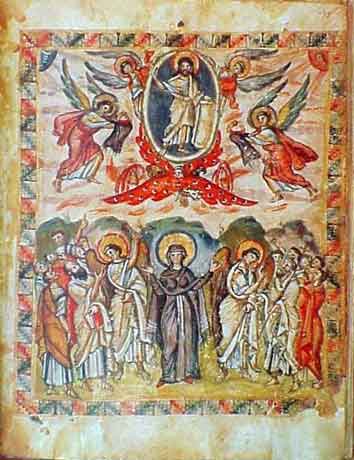
Gcp - All good stuff.To continue the Magdelene debate - the interesting thing in the blue box you cite is that there was a gradual process of conflating several women in the Gospels into the role of Mary Magdelene (the woman taken in adultery, the woman out of whom seven evil spirits were purged, Mary of Bethany, sister of Martha and Mary of Magdala, who stayed by the Cross as Christ died long after the Apostles had fled and was the first to encounter the risen Christ). The Catholic church went through a gradual process of putting all these women together, which lead to Mary of Magdala being seen as a penitent prostitute. Confusion heaped on confusion. There's a lot of evidence - even in the Gospels - that the historic Mary of Magdala was as much an apostle/disciple and leader of the early church as Peter etc. In Acts she is on the Mount of Olives when Christ ascends after further instruction - just as she is in the Pistis Sophia. The Byzantines clearly thought she was important as will be seen from this Byzantine painting of the Ascension: http://www.mlahanas.de/Greeks/Medieval/Art/BArt1.jpg. We often forget that the Bogomils emerged from Byzantium & Middle Eastern traditions. The South of France had a long tradition of Feminine Worship. There's no reason why this whole Magdelene issue came from a synthesis of the two. ThePeg 11:57, 4 March 2007 (UTC)
[edit] First Council of Nicaea - 325 AD - Cannon 8 Concerns Cathars
There is a translation of the declaration of the First Council of Nicaea, 325 AD at:
http://www.piar.hu/councils/ecum01.htm
FIRST COUNCIL OF NICAEA - 325 AD
CANON
"8. Concerning those who have given themselves the name of Cathars, . . ."
The implications here are that the Cathars existed at 325 AD in such numbers that the Council of Nicaea considered them a problem, apparently involved in/with the gnostic hereseys of Arius.
Thus the Cathars were around MUCH longer than a few hundred years in Southern France. 325 AD to 1200 AD gives 875 years as a minimum. More likley longer.
20:04, 13 February 2007 (UTC)20:04, 13 February 2007 (UTC)20:04, 13 February 2007 (UTC)71.167.197.183 Bill Keck wjkeck3#yahoo.com
PS: I am not interested in "Da Vinci Code" issues, but rather Gnosticism & historical accuracy about Cathars.
These weren't the same Cathars. They were a different group. ThePeg 12:22, 16 February 2007 (UTC)
-
- Not only were they a different group, but the translation listed above is wrong. The group article 8 of the Council was speaking of are the Novatians.
Indeed so. Continued thanks to ThePeg for clarity. --AGC Webman 14:59, 17 February 2007 (UTC)
- "These weren't the same Cathars. They were a different group." - I wonder how you know that. The translation is technically but not materially wrong. Perhaps you would like to reassess Bill's question in the light of this: "The name 'Cathari' had already been used to describe themselves by the Novation sects of Anatolia in the fourth century (See Epiphanius, Aversus Haereses p 505)" which I cite from Runciman, The Medival Manichee, Appendix III v. Cathar 16:16, 28 March 2007 (UTC)
I'll find my sources but while I'm doing so its worth remembering that the European Cathars never called themselves Cathars, it was a name given them by their enemies which stuck, along with the term Albigensians. In fact they never gave themselves an offical name at all, so even if the Novatians called themselves Cathars the later Cathars didn't, making it odd that they would have chosen that name in the 4th Century but not used it later. Also, its worth checking what the earlier Cathars' doctrines were. A name is not the same as a set of ideals. Although having said that there may be echoes of Arianism in the later Cathar's view of the nature of Christ. I'm happy to be wrong about this but I have read other sources which contradict it. To this day no-one really knows where the Cathars of the Languedoc came from. The Bogomils are described as their primary source but no-one knows where they came from either. People talk about Manicheans, Paulicians, Gnostics, Zoroastrians but no-one actually knows for sure.ThePeg 15:26, 10 April 2007 (UTC)
[edit] "Cathar Cross"
I have changed the caption on the yellow cross illustration, since the symbol was by no means a Cathar one -- it was imposed on them (and all other heretics, not just Cathars) by the inquisitors. Cathars did not venerate the cross. I'm also not wild about the illustration itself, which seems like a generic cross rather than the one described in the sources. Given (Inquisition and Medieval Society) describes the cross as follows: "The vertical arm of these crosses was 2 and one half palms high while the transverse arm was 2 palms wide. The thickness of each branch of the cross was 2 and on half fingers. One cross was worn on the chest and one on the back between the shoulders." (p. 84) His reference is to Lea, Inquisition of the Middle Ages 1:468. I'd check where Lea got that (it doesn't seem to be in Bernard Gui), but my copy of Lea is at the office and I am not. Alaraxis 02:14, 15 March 2007 (UTC))
[edit] Theological Edits
The opening paragraph contained the following sentence: The fundamental doctrine of the Cathars that Roman Catholics regarded as heretical was interpreting the 'resurrection' as a doctrine of 'Rebirth', as against a physical raising of a dead body from the grave.
This strikes me as slightly misleading. The principal issue was the dualism of the Cathars (already mentioned a couple of sentences prior), which stated that all material things, including the body, were evil. The Cathar denial of bodily Resurrection (and, if this is mentioned, it might be useful to make explicit that they were talking about the Resurrection of the Body, which Christians believe people are going to go through at the end of time, and not about the Resurrection of Jesus) is a derivative issue – that is, it is the logical consequence of dualism (if the body is evil, we can’t have bodies in heaven). So the primary beef was over the dualism issue. I have altered the opening paragraph to reflect this.
I have also inserted a parenthetical clarification about Zoe Oldenbourg, who is widely recognized among Medievalists as inaccurate and having a pro-Cathar bias. For evidence, cf. Prof. Charles Wood’s review in Speculum ), 645-7, in which he states:
“[S]urely no history, however popular, has the right to misuse its evidence in order to argue a thesis not in fact supported by that evidence. This is precisely the sin of Mme Oldenbourg, who, in her desire to glorify the beliefs and honour the martyrdom of the Catharist perfecti, has warped her evidence to such a degree that her book can hardly be considered true history.” - Alan 66.31.47.139 22:37, 28 March 2007 (UTC)
I would agree with your first point - there was a lot more elements to Cathar theology that the Catholic Church objected to than their idea of Resurrection as happening in this life. Dualism was key, as was the rejection of the Old Testament God but the Church also disliked the giving of sacrements and holding of rites without pay and without the authority of the Church, nor did they like the Cathar readiness to allow women to become Perfectae and to preach and speak on an equal footing to men. Equally unpopular was the Cathar rejection of oaths to nobility or church and the anti-Catholic preaching. Most unpopular was the fact that the Cathars were quite simply the biggest spiritual threat to the Church and the fastest growing heresy in Europe with supporters among the best families in the Languedoc. In ither words, the Cathars were particularly unpopular with the Church because they were increasingly popular with the people.
In the end though, the article needs to be a lot more comprehensive on the theology of the Cathars than it is. Everyone has been moaning about it but clearly no-one feels qualified to correct it!
Re the second part of your post - you'll have to cite more than just one critic if you're going to dismiss Oldenbourg. I find this issue is treated like the Arab-Israeli conflict. People think there's a bias if anyone is criticised or anyone is praised. The fact remains that the scars of the Cathar Crusade are still in the Languedoc. Southern French defiance of the North still is partly fuelled by what happened and the region has recently embraced this part of its history. Of course, you can say that is economic. The Cathars are good business. But the region increasingly calls itself the Pays Cathars and has devoted a lot of time to researching the sect. If there is a bias in Oldenbourg's book its worth going into it in detail. Its hard not to read any account of the suppression of the Cathars without being horrified by what was done to them and the region. I've read O'Shea and Sean Martin's version of the story and others and I haven't found anything which dispelled this feeling. Please expand before changing the text!
One last note. On the Mary Magdelene thing & the 'two Christs'. The only thing I can find out about the dual Christs comes from the Gnostic Bishop Valentinus who believed that the two Christs were the same Christ at different phases. The earthly Christ was the Christ before the Baptism (in fact not the Christ at all as he hadn't been anointed yet). After his encounter with John the Bap when the Holy Ghost descended then Jesus became the Christ and took on his spiritual nature. The theory is that this is where the Cathars got the idea. The Cathar belief was that following Christ meant realising the Holy Spirit in oneself. In other words, by undergoing the same spiritual process of Christ - bodily 'death', spiritual 'resurrection' in this world - one became ready not only to do God's work here but achieve salvation and deliverance from reincarnation in Satan's Kingdom of Matter. This is why people believe that the roots of Esoteric Christianity from the Inquisition onwards come from the Cathars who transmitted it from the early Church. The thinking goes that the Esoteric Christianity of the Cathars went underground - into the Spiritual Franciscans, the Rosicrucians, the Brethren of the Free Spirit etc.
Its the Gospel of Philip which talks about the companion to Christ being Mary of Magdala. In fact the Gospel builds a female Trinity to the male Trinity of Christianity - Mary the Virgin Mother, her sister and Mary of Magdala. Whether this is literal truth or a way of expressing a female archetype to the male is up for debate. Whatever the case the Cathars clearly embraced the idea of a female energy to Christianity.
Til soon.
ThePeg 15:37, 29 March 2007 (UTC)
Another interesting point about the issue of Resurrection etc. Paul is really clear in his epistles that the Resurrection is of the Spirit, that that which is corruptible ie Matter cannot enter the Kingdom of Heaven. It was Ireneus who insisted that the Resurrection was of the flesh and made it an article of faith for the Church. This was because the early Christian Gnostics shared the Cathar belief in a spiritual Rebirth in this life. So in terms of Scriptural Justification the Cathars are closer to Paul than the Church. Similarly, its worth remembering that in the story of Nicodemus that Christ is very clear that there has to be a Rebirth 'in water and the Holy Spirit' before its possible to enter the Kingdom of God. So once again the Cathars were following scripture. ThePeg 17:39, 29 March 2007 (UTC)
Here's the Nicodemus passage. See my note below about scripture and Cathar belief. There's so much here which links in with Cathar ideas of rebirth and Spirit/Matter dualism as well as their concept of the indwelling of the Holy Spirit in Parfaits:
There was a man of the Pharisees, named Nicodemus, a ruler of the Jews: The same came to Jesus by night, and said unto him, Rabbi, we know that thou art a teacher come from God: for no man can do these miracles that thou doest, except God be with him. Jesus answered and said unto him, Verily, verily I say unto thee, Except a man be born again, he cannot see the kingdom of God. Nicodemus saith unto him, How can a man be born when he is old? can he enter the second time into his mother's womb, and be born? Jesus answered, Verily, verily I say unto thee, except a man be born of water and of the Spirit, he cannot enter into the kingdom of God. That which is born of the flesh is flesh; and that which is born of the Spirit is spirit. Marvel not that I said unto thee, Ye must be born again. For the wind bloweth where it listeth, and thou hearest the sound thereof, but canst not tell whence it cometh, and whither it goeth: so is every one that is born of the Spirit. John 3: 1-7
Do you think we need to radically rewrite the article and go into this kind of detail? ThePeg 15:23, 10 April 2007 (UTC)
Further to this last, its worth looking at the opening of John to understand more about what the Cathars thought. It should be remembered that this passage was read as part of the induction ceremony of the Cathars and that John's Gospel was particularly venerated by them. The passage describes John the Baptist and then Christ:
He [John the Baptist] was not that Light, but was sent to bear witness to the Light. That [Christ] was the true Light, which lighteth every man that cometh into the world. He was in the world, and the world was made by him, and the world knew him not. He came unto his ownm and his own received him not. But as many as received him, to them gave he power to become the sons of God, even to them that believe in his name: which were born, not of blood, nor of the will of the flesh, nor of the will of man, but of God. John 1: 8-13
Now there are contradictions here from a Cathar point of view. John says Christ/God/the Light made the world, which the Cathars didn't believe, but earlier, as we know, the passage talks about the Light shining in the Darkness and the Darkness comprehending it not. This is classic Cathar/Gnostic/Manichean/Zoroastrian Light vs Darkness dualism. But more significantly you can see where the Cathars drew their idea that there were two orders of existence - the Light/Spirit realm and the Flesh/Matter realm. Of all the Gospels John makes no mention of Christ's birth or even childhood, although Mary is referred to as his mother. Perhaps here we get a sense of the Cathars' belief that Christ came directly from God as the Gnostics did. Having said that, the next line in the passage talks about the Word becoming Flesh. I wonder how the Cathars got round that one?
But what seems interesting to me is how its pretty clear that the Cathars drew their doctrines from a close reading of the Gospels. They didn't just pluck things out of thin air. This must have explained why they could dispute so effectively with the Church before the whole thing became violent (whole cities used to turn out to see Cathar Perfecti debate openly with Church representatives). I don't know if anyone has ever gone through the Gospels with a fine toothcomb and tried to understand the Cathars through it but someone should. The way in which they went out in twos around the Languedoc, for instance, is almost word for word taken from the instructions Christ gives to his apostles in Luke and the other Gospels. Fascinating.
One thing which puzzles me. We know that the Cathars didn't build any churches or chapels but held services in peoples homes and in natural places such as fields, forests and caves. For a movement which thought matter and nature were evil holding ceremonies in natural places seems odd to me. Any thoughts?
I offer all this up in light of whether the article needs rewriting or editing along some of these lines of investigation. ThePeg 11:53, 11 April 2007 (UTC)
[edit] Cathars & Marriage
Re the issue of Cathari and their attitude to marriage which certain anti-Cathar posters here have suggested was immoral and sexually licentious. Whatever they said and whatever we think of it there is, interestingly, a scriptural source for their lack of interest in the legal form of marriage (remember that Perfecti had no sexual relations at all). In Luke Christ says this to 'certain of the Sadducees' who ask him a convoluted question about marriage, divorce and the resurrection:
And Jesus answering said unto them, The children of this world marry, and are given in marriage: But they which shall be accounted worthy to obtain that world and the resurrection from the dead, neither marry, nor are given in marriage: Neither can they die any more: for they are equal unto the angels: and are the children of God, being the children of the resurrection. Now that the dead are raised, even Moses shewed at the bush, when he calleth the Lord the God of Abraham, and the God of Isaac, and the God of Jacob. For he is not a God of the dead, but of the living: for all live unto him. Luke 20:34-38
It seems the Cathari knew their Bible extremely well. Someone should really go through every Gospel and the Book of Acts and cite every scriptural evidence which corresponds to a Cathar belief one day. It would illuminate a lot. :-) The real mysteries of what they believed are in there, it seems. ThePeg 13:13, 10 April 2007 (UTC)
[edit] Cathars, Old Testament & Satan
Further to my series of Gospel quotes backing up Cathar beliefs, here is something in John which may go some way to explaining their relationship to the Creator God of the Old Testament being Satan. Here is Jesus talking to a group of Jews who are puzzled by why he talks about freeing them as they are 'Abraham's seed, and were never in bondage to any man':
Jesus saith unto them: If ye were Abraham's children, ye would do the works of Abraham. But now ye seek to kill me, a man that hath told you the truth, which I have heard of God: this did not Abraham. Ye do the deeds of your father. Then said they to him, We be not born of fornication; we have one Father, even God. Jesus said unto them: If God were your Father, ye would love me: for I proceeded forth and came from God; neither came I of myself but he sent me. Why do ye not understand my speech? even because ye cannot hear my word. Ye are of your father the devil, and the lusts of your father ye will do. He was a murderer from the beginning, and abode not in truth, because there is no truth in him. When he speaketh a lie, he speaketh of his own: for he is a liar, and the father of it. And because I tell you the truth, ye believe me not. John 8 39-44
You can see how the Cathars may have extrapolated (rightly or wrongly!) from this text that the God of the Old Testament was therefore the Devil. The Cathars get less and less mysterious every day!
Again, I offer up - should this be going into in the article? ThePeg 20:55, 11 April 2007 (UTC)
[edit] New Edit
I'm trying to do a big re-edit of the article, cleaning up the language & trying to include more detail while staying true to the two sides of the argument. Its quite difficult as its a knotty thicket of an article with a really loose structure. It will take me some time but I would welcome feedback. Doing my best to preserve the NPOV thing. :-) ThePeg 11:54, 15 April 2007 (UTC)
Oops... Someone got there before me and someone has merged the Cathar and Catharism articles. It still needs a huge rewrite as there are still glaring misstatements here eg the Manichean origins are disputed (as is wearisomely thrashed out on these discussion pages everywhere), Nicetas was a Bogomil Bishop and thus from the East and not northern France etc. Still work to be done here. ThePeg 22:59, 10 May 2007 (UTC)
Although space and time is limited in this forum it can be conclusively shown that the Albigenses had a definate link to the Paulicians which can in turn be traced back at least to the New Testament Church (and perhaps even earlier to the Solomonic dynasty). A definate link is also proven between the Albigenses (Cathari) and the Waldenses. An even further link is established between the Waldenses and the Anabaptist and Protestant movements. Most Anabaptist and Protestants would be utterly shocked to know they owe heritage to the Cathari ! Most Catholics would also be shocked to know they owe some of their foundational teaching (such as Apostolic Succession) to the ancesters of the Cathari !
Mr. C. 05:16, 14 May 2007
Mr C's post is full of half truths. The only thing that links the Cathars to the Protestants is their resistance to the Catholic Church and its corruptions. Doctrinally the Cathars and later Protestant movements such as Lutheranism, Calvinism etc were poles apart. The Cathars were the first major, large-scale threat to the spiritual and political hegemony of the Roman Church. After them a host of other heretical sects broke out - Lollards, Free Spirits, Beguines, Beghards, Joachimites, Hussites etc - all of which were broken on the Catholic wheel but, in doing so, paved the way for the ultimate rejection of Catholicism by the Protestant nations. Even then, doctrinally speaking, few of these movements interpreted scripture in the way Luther or Calvin did, nor did they agree with the socially hierarchial vision of these two thinkers. The Cathars were the first link in a chain which lead to the great schisms which broke Western Christianity up but doctrinally they were pretty much a one-off. They were Gnostic and dualist from the start and if anything became MORE so rather than LESS so as the conflict with the Church went on. Before Nicetas they were Mitigated Dualists, after him they were Absolute Dualists and ended up embracing this doctrine fully in the light of the depredations they suffered at the hands of the Crusaders.
Actually a lot of the evidence suggests that calling the Cathars Dualist and/or Gnostic is a rather superficial view of their version of Christianity. At its centre was an iniatic/esoteric/mystical vision of the Christ message which needs really looking at.
Having said all this the Cathars had an enormous effect on the development of Christianity in the West, but largely by default. The Mendicant Orders of Catholicism came into being out of a reaction to the Apostolic ethic of the Perfecti (St Dominic actually told the Pope it was the only way to compete with them ideologically & St Francis' ethic was embraced because it could be used as a counterbalance to criticism of the Church's wealth) and the translation of the Bible into the Western vernacular started with the Cathars (thus there is a link between the Cathars and, say, the King James Version of the Bible). Its also true that they worked with the Waldensians when the Crusaders started to persecute them both in the Languedoc but even then what linked them was an Apostolic vision of Christianity rather than an intepretive one. The Waldensians were not dualists, for instance, and didn't believe in reincarnation. It was the republican/egalitarian/anti-wealth ideals of the two sects which linked them, not the nuts and bolts of spiritual discourse.
So the Cathars were hugely influential but largely as a counter-force to the Church. Doctrinally they had nothing in common with later Protestant movements. ThePeg 23:01, 14 May 2007 (UTC)
Don't worry overly, Mr C. If you read my post most carefully you will see that in essence I agree with you on the basis that the Cathar were the first 'heretical' Christian movement to seriously challenge the Church and so paved the way for all the later movements, including the ones you mention, to rebel as well. In fact each time the Church suppressed one of these 'heresies' they eroded their own power as they earned the hatred and distrust of whole communities and, later, nations. There's no coincidence, for instance, that the Huguenots flourished in the Languedoc and found themselves fighting Catholic forces from the north (again). The Languedoc never forgave the north or the Church for what they did to the region during the Crusades against the Cathars. Political and religious freedom was big for the southerners.
I also pointed out that the Cathars indirectly transformed Christianity in Western Europe. What I disagreed with you about was that they influenced the Protestant movements doctrinally and/or spiritually. So, yes they were at the fountainhead of the growing anti-Catholic movement which eventually became the Reformation but spiritually they were poles apart from what many of the later Protestant movements believed. In fact they were Protestant only in so far as they 'Protested' against the Church but they didn't share beliefs with many of the later movements. So in this sense they can be seen as the precursors of all the movements that followed but really only in this sense. ThePeg 10:20, 15 May 2007 (UTC)
[edit] Were the Cathari Proto-Anabaptists?
Cathar was a catch all term for heretics with ascetic and iconoclast tendencies. To think that all Cathari fit into the same theological mold as portrayed by most Cathar histories is ridiculous and is a gross misunderstanding of human nature and theological evolution. For example are all Baptists predestinationists? Are all Pentecostals snake handlers? When most people refer to Albigensians they are referring to the later Cathari that were living close to the time of the massacre at Montsegur. Gibbons and others say these late Albigensians came closer and closer to orthodox Christianity before they were exterminated as a group. In fact they were so close to orthodoxy that remaining Albigensians merged with the Waldensians which left the Albigensian mark on both doctrine and customs of the Waldensians. The earlier Cathari were so infested with docetism and gnosticism that they were sharp enemies of the early Waldensians. This began to change and toward the latter part of their history both groups were working very close together until they ultimately the remaining Albi's merged with the Waldenses. True there were still some die hard Gnostics at Montsegur but there were also many closer to orthodoxy and it is this group that forms an integral part in the evolution of the Anabaptist movement. Wylie says the Waldenses became fused with the Cathari (The Waldenses, by J.A. Wylie, pg 288). Of the Waldenses he says "their moral teachings recall those of the Cathari...The analogy is striking.... We shall notice several other [analogies between Cathari and Waldenses] relating to organization and structure" (Wylie, pg. 247). New Advent Catholic Encyclopedia states "Some points in this teaching [of the Waldenses] so strikingly resemble the Cathari that borrowing of the Waldenses from them may be looked upon AS A CERTAINTY. Both sects also had similar organization." Emilio Comba says the Waldenses could NOT escape the influence of the Cathari and also the Waldensians had a "reacting influence" on the Cathari. Another source stated the Albigenses "received the belief of the Waldensians " (Perrin, op. Cit., b.i., p. 1). Comba reports of the Cathari and Waldenses that it is "hard to distinguish them apart. They fought side by side" (History of the Waldenses of Italy, Comba,pg. 46). Comba further says the "Waldenses and Cathari were able to approach each other in a brotherly fashion, to the extent of living in harmony under the same roof ....when in the face of such dangers as threatened all now brought near together under the shelter of the Alps" (pg. 96). He continues "The fact that becomes most INCONTESTABLY EVIDENT is the ultimate and intertwined co-existence of Wadenses and Cathari. What brought them thus together? Was it a misunderstanding or a compromise?" Vincent Ferreri visited the Alps and there he too commented on their co-existence..."He himself was no longer able to distinguish between the doctrine of the Waldenses and that of the Cathari...It is therefore evident that a mingling had taken place between the Waldenses and the Cathari in the very bosom of those valleys" (pg. 96). According to Delroy Gayle the Waldenses wrote up a statement of faith at this time that conspicuously avoided the doctrine of the Trinity which the Albigenses refused to believe in. So while the Albi's were coming closer to orthodox Christianity they obviously carried some of their original doctrine in with them. Dr. Marvin Arnold asks "Who were these Albigensians that vain historians, parroting Rome, have so slandered?...Most were pious Bible readers. Great numbers had the Holy Ghost knowing glossolalia and the Christ water baptism. They were good citizens of elevated culture possessing dignity and godly pride. Morally they were far above Catholic conductual-averagism...Most of them were continuing Montanism" ( Apostolic Church History Outline, pg. 38). Arnold says there were MANY of these Albigenses that were not Docetic, Gnostic, nor believers in reincarnation. Historian Fred Conybeare reports "Reinerius...testifies that the Cathars were divided among themselves into MANY shades of opinion, some being more dualistic or Manichean then others; he also attests that as early as the year 1223 the opinions and observations of some of them had undergone important changes. It is not even safe to assume that the Cathars of the Rhine were the same as those of Gascony" (Key of Truth, pg. cxlviii). Conybeare later adds that "it does seem probable that in at least two of the sects of the age of the Reformation we have a survival of the same ancient form...these two sects are the Anabaptists and the Unitarians...from the former come the great Baptist Churches of England and America and the Mennonites of Germany" (pg. cl). John T. Christian says "The Anabaptist movement was the continuation of the old evangelical faith maintained by the Waldenses and other Mediaeval Christians" and goes on to demonstrate that many of the preachers of the Waldenses became widely known Anabaptist ministers (History of the Baptists, Ch. Vll). I could quote numerous sources showing the Waldenses were fundamental orthodox Christians and that they were a link in the chain not only to the Anabaptists but that also the Waldenses and Anabaptists were links in the chain to the great Moravian Church revival under Christian David in Germany. Various histories of the Mennonites proudly proclaim their Waldensian ancestry. However I quote only the Albigensian connection which was the link I was criticized for citing. Yes, the Albigensians certainly left their mark on both doctrine and customs of the Waldenses and ultimately the Anabaptist and Protestants. True there were still many die hard Gnostics but there were others that were more evangelical and orthodox and it is this group, for so long maligned by historians, that forms an integral part in the evolution of Anabaptist and Protestants. There was more going on here then Gnosticism and religiously biased history had skipped over that fact. It is time for a careful revision of Church history. Like it or not the Albigensians strongly affected the history of religion and many of her marks are still in our Churches today.
Mr. C. 15:22, 17 May 2007
The correct author is Emilio Comba, a Waldensian historian. His work: History of the Waldenses of Italy, from their Origin to the Reformation Emilio Comba, D.D. Waldensian Theological College Florence, Italy London: Truslove & Shirley, 7. St. Paul's Churchyard: 1889. ISBN: It is always best to read the quotes in full context. This book may be purchased on Amazon.com or from the Waldensian Society.
J.A. Wylie, History of the Waldenses. Church History, 1985.
For more accurate works on this subject matter a reader may wish to review: Alexis Muston, The Israel of the Alps: A Complete History of the Waldenses and Their Colonies. John Montgomery, Translator. Baptist Standard Bearer, 2001. Pbk. ISBN: . pp.572.
Prescot Stephens, The Waldensian Story. A Study in Faith, Intolerance and Survival. Lewes: The Book Guild Ltd, 1998. Hbk. ISBN: . pp.398
Giorgio Tourn, The Waldensians: THE FIRST 800 YEARS ). Camillo P. Merlino, Translator. Charles W. Arbuthnot, Editor. Torino, Italy: Claudiana Editrice, 1980. --AGC Webman 14:49, 19 May 2007 (UTC)
I am sorry. I made a few typo's and from memory spelled Comba's name with an o instead of with an a. You are so much smarter than me. I guess I just mistook this for a discussion forum instead of an exam. Mr. C.
Yes I do agree that it is best to read the full context, however I didn't have time to waste on this forum (that is just going to be changed and criticized anyway)to type in the entire volumes of the books. Check up on every quotation and you will find nothing has been quoted out of context. This is accurate history. Unorthodox...but accurate. Mr. C.
Mr C. you're not Mr Comba are you? :-)
Whatever the case, in all the sources I have read while it is true that the Waldenses and the Cathars ended up as allies they weren't to begin with. Also, the Cathars predated the Waldenses by quite a while. The first Cathars are recorded as far back as the 11th Century while the Waldenses were a purely 13th Century phenomenon. Nor did they share key doctrinal elements. THe Waldenses were not dualists or gnostic by inclination. What they shared was an egalitarian/republican Christianity and a desire to get back to basics.
Having said this its true that once they were allies because of persecution they did reciprocally influence each other. There were definite links and the Waldensians went on to influence people like the Lollards in England, thus also indirectly spreading certain Cathar influences.
So again, there are truths to both sides. ThePeg 21:37, 21 May 2007 (UTC)
Well said. Mr.C.
Let's remember that the Waldensians (personally, I think "Waldenses" is rather clumsy) were a movement founded by an individual, Waldo of Lyons, who lived in the late 12th century. Waldo was quite orthodox in his theology, actually -- he just wanted to preach and be poor, rather like Francis of Assisi. He also wanted to read the Gospel and other texts in the vernacular, and thus had some church types translate them for him. The best source for Waldo's early career is the Dominican Inquisitor Etienne de Bourbon, which you can find in translation in Wakefield and Evans' classic compilation of texts having to do with medieval heresy. Certainly, the movement founded by Waldo, the "poor men of Lyons," changed thereafter, but it would be ludicrous to consider the two groups allied in any real way in, say, the thirteenth century in France (we have rather less evidence for Germany, though there are scholars working on that). They were quite hostile to each other, actually, and their ideas were quite divergent. As opposed to the sources listed above (which are not based on recent scholarship) I recommend the books of Gabriel Audisio on the Waldensians, and also Euan Cameron. I would recommend Grado Merlo as well, but his books don't exist in English translation, though I believe there are versions of some of them out in both Italian and French.Alaraxis 23:57, 8 August 2007 (UTC)
[edit] Consolamentum & the Paraclete
Here's an interesting thing that I found on the Antonin Gadal website (condemned by many on this site as being too speculative) but which is probably worth thinking about. When we talk about the Consolamentum we think of it as rather like the Last Rites. We also translate it as "the Consolation". But we tend to forget that "the Consoler" is a translation of "Parakleitos" or, in English, "the Paraclete".
The Paraclete, if we remember, is promised to Mankind by Christ in John's Gospel. Another translation is "the Comforter". It is also referred to as "the Spirit of Truth" and is synonymous with the Holy Ghost/Spirit or Divine Breath (Agyion Pneuma being the orginal Greek).
If we also remember how important the Holy Spirit was to the Cathars, that they believed that once one became a Perfecti one became semi-divinised by the indwelling of the Holy Spirit, much in the same way as the Apostles were in the Book of Acts, then the idea of the Consolamentum becomes much more significant. Thus the Consolamentum is a ritual of the Holy Spirit or Paraclete, perhaps causing the recipient to become filled and purified by it. Should this be included in the article?
I also find it fascinating that anti-Cathar posters and thinkers see the Consolamentum as a cheat or opt-out causing, letting people off their sins at the moment of death. They seem to forget that a) this is what people criticise the Catholic idea of Confession for doing b) that forgiveness of sins was what Christ came to preach and that c) there is no evidence that Cathar Credentes were any more let off living a Christian life than any other kind of Christian. LeDurie claims that Cathar Credentes weren't called upon to do anything very much but it would be good to see some evidence of this. Similarly, how much were Catholic believers called upon to change their lives according to their faith? The evidence is that living a "Christian" life was pretty rare in those days anywhere. Probably the Perfecti and the best of the Catholic clergy tried to manage it but I am fascinated as to how people criticise the Cathars, forgetting that at the time the Catholic followers were probably no better and, in the case of the priesthood, by all accounts, rather worse! ThePeg 14:04, 26 May 2007 (UTC)
ThePeg 13:59, 26 May 2007 (UTC)
There is no doubt that the consolamentum was believed to transfer the Holy Spirit. It was also ordination, absolution, and baptismal regeneration all in one. It was their one and only rite. It was only given to some before death because the majority of the common people could not live the strict ascetic lifestyle required by Cathar Perfecti. I have also read several sources that claimed there were instances of glossolalia and other spiritual gifts among the Cathari. Does anyone have access to any primary sources that either say or hint that glossolalia (speaking in tongues) was practiced at any time among the Cathari?
Mr. C.
I think its worth clarifying what the Endura was in this context. People like to say the Cathars encourged suicide but this isn't the case. The Endura, a form of fasting, was only undertaken when death was clearly inevitable. The aim, again, was to purify the soul and the body before death so as to ensure a better state in the next incarnation. It was also aimed at quickening death so as not to prolong suffering. As I say, it was only undertaken when there was no further possibility of life and even then was a matter of choice. It wasn't euthanasia nor was it suicide as we understand it. ThePeg 14:57, 27 May 2007 (UTC)
[edit] Cathars & Waldensians
I know we've been arguing about this but I still take issue with the line which says the Cathars ended up merging with the Waldensians. The Cathars were a much bigger movement than the Waldensians. As I've argued they became allies because of joint persecution but stayed as separate sects. I think this should be amended. No other source I have read says that the Cathars merged with the Waldensians in the way suggested here. ThePeg 16:47, 28 May 2007 (UTC)
Everything I have read and researched thus far says the surviving Cathari merged with the Waldensians. Those that didn't were exterminated. Perhaps it should be worded "the few surviving Cathari eventually merged with the Waldensians and those that did not were ultimately exterminated." Mr.C.
I think that's a good idea. Research I've done says a lot of the male Cathars became Franciscans. ThePeg 20:00, 29 May 2007 (UTC)
I think the great misunderstanding here is individual definitions of the word "merge." If by "merge' one means that one group in huge numbers joined another group by mutual consent then NO there was no merging of Cathari and Waldenses. However if by "merge" one means a few dropped from one group and individually joined a larger group then YES there was a merging of Cathari and Waldenses. (As a matter of fact it would have been almost impossible for the latter NOT to have happened.) In my above post I used the words merge and mingling interchangeably. The concept for calling such a seemingly insignificant "joining of a few" with another group as a merger is largely drawn from the New Testament scripture wherein Christ speaking of the Church states, "Where two or three are gathered together in my name there am I in the midst." If two or three can be considered a church then a few leaving one group for another can be considered a traceable merge. A stream of water (we will call it the Mother Stream)) may break off into three different streams (Streams #1, #2,and #3). Joe may trace the stream in front of his home, which is stream #1, back to the Mother Stream and claim his is a continuation of the main stream. Jack may trace stream #2 which runs through his property back to the Mother Stream and claim HIS is a continuation of the main stream. Jerry may trace the stream on his property, stream #3, back to the Mother Stream and contest HIS is a continuation of the main stream. Which one is correct history? They all are. However Joe's stream, #1, would be the only stream that Joe could trace back from his house to the Mother Stream. Streams # 2 and # 3 would be irrelevant and having split off earlier would be irrelevant to the tracing of his stream (#1). All churches today, no doubt, all stem from a common Mother Stream. HOWEVER only through ONE of those streams can John Doe trace his personal denomination through back to the Mother Stream. If John Doe believes his denomination to be the true Church then it is the particular stream that John Doe has traced his denomination through that is the true history of the Church. He may consider the others heretics. Whether John Doe is correct or NOT that HIS church is the true Church he is still absolutely correct that his history is the true history OF HIS DENOMINATION. When I state a certain group can be traced through a chain of other groups in history I am stating the history of that ONE particular group. I am not tracing the other groups because they are irrelevant to my particular groups history. It would be ludicrous to think that there was not a succession of links for ANY denomination. Every one of them came out from another one. None sprang from thin air. My interest is in tracing my group and a few others of interest back through history. It is interesting and it is enjoyable. If a history omits the fact that there was a minor "merger" of sorts because it seems insignificant then I do not have access to a piece of history that IS significant to me. Mr. C.
You put it well, Mr C, however the difficulty remains that the wording of the article at the moment suggests that the ultimate end of the Cathars was to become the Waldensians, even if what you mean is that some individuals joined them after Catharism was destroyed.
The problem is that there are so many truths, half-truths and distortions surrounding the Cathars that the issue of what should be said about them is extremely complex territory. For instance, even though the main drama of the Cathars happened in the Languedoc there wer significant Cathar communities in Spain, Italy, Flanders and the Rhine which we seem to know next to nothing about. Evidence suggests that Cathar ideas and possibly writings had a huge influence on groups like the Brethren of the Free Spirit, the Spiritual Franciscans, Meister Eckhardt, the Beguines, the Hussites and the Lollards. At the most basic level this emerged from the Cathars' anti-Church standpoint and desire to return to the egalitarian, anti-materialist morality of Christ. Ideologically other elements of their faith, such as the individuals ability to merge with God or the Holy Spirit in this life and the role of women in spirituality also flowed in part from them. The one doctrine which did NOT spread was the idea that Matter was Evil and from the Devil. Other suggested influences of Catharism include the development of the Grail Legend via the Troubadours and Minnesingers and the continuation of what became known as Esoteric Christianity in underground groups such as the Rosicrucians et al. And, of course, as you have pointed out, the Cathars' opposition to the Church and the Church's reaction laid the seeds of the Reformation to come.
The point, then, seems to me, that an article about the Cathars needs to be clear and unambiguous about what we understood they believed and what their influence was - indeed they indirectly caused the founding of the Mendicant Orders in Roman Catholicism - whether we agree with or even approve of what they preached. The Waldensians were a much smaller and much less influential sect. Therefore to say in the opening paragraph that in their later phase they merged with Waldensians as if this was a defining element of their history is misleading as it gives the Waldensians an erroneous position in the history of European Christianity and downplays what the Cathars were and did.
I would suggest that the reference to the Waldensians should go in a paragraph at the end in which the influence and aftermath of the Cathar movement and its suppression can be discussed. This way I think everyone can be happy. What do you say? ThePeg 13:53, 3 June 2007 (UTC)
The parsing does need to be precise for the reasons you have stated in your second paragraph. This is dodgey ground due to the dearth of extant records and as official Waldensian history does not recognize the confluence. We will work with Mr. C. off-Wiki and attempt a joint edit text that he can then propose on the basis of our mutual agreement. --AGCWeb 23:03, 3 June 2007 (UTC)
Ok. ThePeg 21:46, 4 June 2007 (UTC)
I don't know where you guys have gotten on this, but I will simply say that there is no verifiable EVIDENCE that supports any joining of Waldensians and Cathars. Their spheres of influence were quite different, after all. I don't know of any Cathars in the Piedmont, yet that was where the Waldensians took refuge in the end (and where they have survived until the present). Yes, there were late Cathars in Lombardy -- but just because both are currently part of Italy doesn't make them kin. The Piedmont was a mountainous country of villages. Lombardy is a plain with lots of cities. Late Waldensians were concentrated in villages, and late Cathars were in cities. Susan Taylor Snyder has an article titled "Cathars, Confraternities, and Civic Religion: The Blurry Border between Heresy and Orthodoxy" in a recent Brill publication called Heresy and the Persecuting Society in the Middle Ages (2006). I recommend it.Alaraxis 00:05, 9 August 2007 (UTC)
Welcome back Alaraxis and thank you for the clarity and scholarly citations. This was our position from the start. While some individuals may have sought sanctuary or comfort of association with those sharing a spiritual opposition to the Church of Rome, such cases were so rarely documented they can scarcely be called fact, let alone a "merger" into another ecclesial community.--AGCWeb 20:46, 14 August 2007 (UTC)
[edit] Good God/Bad God
I'd like to bring something fresh up...
Now I know I have described the Montaillou community as not properly representative of Catharism but in the book there is a discussion about God & the Demiurge/Satan. According to this some Cathars didn't think everything in the world was created by the Devil, only the things which hurt us eg wolves, snakes, blights, disease etc. So how Absolute was their Absolute Dualism? ThePeg 23:00, 17 August 2007 (UTC)
the only sources on Cathars is the Catholic ones, therefore there is probably some distortion, as their history was written by their opponents. Also, rejecting all physical things is hard, so some Cathars may have not been as against it as others. Rds865 (talk) 21:29, 25 April 2008 (UTC)
As far as I can see, the Cathars were against MATERIALISM rather than totally rejecting MATTER. Although MATTER was a block to understanding the LIGHT it was human belief in temporal power that the Cathars preached against. The famous Cathar Prayer rendered by one of the last Parfaits indicates that it is the lure of power and materialism that was the temptation used by Satan to seduce the Angels of Light to forget their divine inheritance... ThePeg (talk) 20:02, 7 May 2008 (UTC)
[edit] Good!
Simply put, the article is very nice to read, well done!! Said: Rursus ☻ 10:29, 14 September 2007 (UTC)
NICE TO READ??? ITS A MESS! Its worse than it ever was, with bad English, bad scholarship and distortions everywhere! As a serious resource on the Cathars its like a car crash. I am very disappointed. ThePeg (talk) 00:32, 17 January 2008 (UTC)
[edit] Map
A map with areas of Cathar activity, and important places mentioned in the article would be a nice addition.--84.20.17.84 (talk) 09:27, 29 November 2007 (UTC)
[edit] War
Obviously during the Crusade, some people fought the crusaders. Were they non-Cathar locals, credentes betraying their pacifism out of survival, credentes theologically justified somehow or what? Do we know the Cathar theological attitude about being invaded? --84.20.17.84 (talk) 10:14, 29 November 2007 (UTC)
Cathars were completely pacifist and against violence and killing. Once they had to resort to fighting they were, in a sense, doomed, as to fight the Devil with the Devil's weapons (as they might have called it) was to lose to the Devil. In the event no Parfait ever fought. They were fought for by Credentes and Languedocians/Catalans/Occitans who were hostile to the Crusaders and the French and, more often than not, had Cathar relatives. ThePeg (talk) 00:35, 17 January 2008 (UTC)
That's not true at all. Cathars were quite prepared to kill people who got in their way, and it is a matter of record that they specialised in maintaining a culture of silence through assassinations and fear of assassination. Xandar (talk) 11:02, 5 May 2008 (UTC)
Evidence please. I want one example of a Cathar Parfait who killed anyone. And I don't count Bellibaste who became a Parfait AFTER his criminal past (and remember St Paul was a murderer before he converted). Cathar-sympathetic families AND Languedoc nobility fought the Crusaders but that was to do with a palpable threat to their countries and people. So evidence please. And when I say evidence I want CHAPTER AND VERSE ie references. Bottom line is that the burden of blood is heavier on the side of the Church - indisputably so. No Cathar sympathiser or defender of Languedoc did anything LIKE the sack of Beziers. ThePeg (talk) 19:57, 7 May 2008 (UTC)
[edit] Category:Vegetarianism and religion
Can we get an explanation of this put into the article? Sherurcij (Speaker for the Dead) 23:29, 14 February 2008 (UTC)
[edit] Cathars and Waldensians
To say there was no merger, not even minor, of Cathari and Waldensians is not historically correct. As a matter of fact it would have been IMPOSSIBLE for there NOT to have been minor streams of merger of Cathari with both Waldensians and Franciscans.
MrCreveal (talk) 19:38, 7 May 2008 (UTC)
We know there were mergers and alliances between the two movements, but that isn't what is being argued about. What is being argued about is whether the Cathar movement eventually BECAME the Waldensians.
Further, the Waldensians were a much smaller sect and they were REFORMIST ie they viewed themselves as WITHIN the Catholic Church whereas the Cathars didn't. At first the two movements were not supportive of each other, but Papal persecution pushed them into alliance. ThePeg (talk) 19:59, 7 May 2008 (UTC)
Well put.
I might add that VERY early in the movement the Waldensians viewed the Roman Catholic Church as the Great Mother Whore prophesied in the book of Revelations. MrCreveal (talk) 22:38, 7 May 2008 (UTC)
[edit] Distress
I would like to register my personal distress at how this article has changed. Its now a wreck - contradictory, muddled, full of false assertions and completely confusing. Really what is needed is almost a double article, setting out the Cathar view of things and the Church's view, otherwise it is almost impossible to be impartial. THe opening paragraph is a perfect example. How could the Cathars have thought God created the world if they thought Satan had created it, thus obscuring the true God as the paragraph above says? Ridiculous. And then the section says the origins of Catharism were Manichean, Paulician etc and THEN it says they weren't (that they were homegrown) and then it says they were!
When I first started researching the Cathars this article was where I started. This was two years back. It was informative and clear and set out what the Cathars believed in a helpful way - without endorsing or criticising them. Since then someone or some people have got in there and pushed different agendas until the Cathars are presented as a ridiculously incoherent sect.
An article on Catharism, to be objective, should only set out what Cathar beliefs were and what happened to them. Everyone knows what the surviving Church believes. Setting out the Cathar doctrines isn't endorsing them. Its just saying what they believed so people can make up their own ideas.
Writing this in the PLEA that someone will address this - please!
ThePeg (talk) 22:44, 7 May 2008 (UTC)
[edit] The threat of Catharism
Its actually amazing how the Cathars remain so controversial! This was a minor sect in a region of Europe with no armies or temporal power. The only threat they posed to the Church was one of words. And yet the Pope described them as 'worse than the Saracens', and yet they had invaded nowhere and killed no-one. Nor were they threatening any holy sites like Jerusalem or Bethlehem.
The only competition they offered to the Church was spiritual. Even Bernard of Clairvaux, who preached the First Crusade and set up and wrote the Apologia for the Templars acknowledged that 'no-one could be more Christian'. And yet the brutal fact is that they were hunted down and slaughtered.
Now here in the 21st Century it still seems impossible to just set out impartially what they said without someone attacking it. Incredible! What is this massive threat they pose(d)?
ThePeg (talk) 22:51, 7 May 2008 (UTC)
The Roman Catholic Church had become very rich and powerful. The common man had become disgruntled with the widespread corruption within the Church. The memories of Ambrose, Vigilantius, and Claude had been passed down through the generations and sympathizers with their teaching as well as to the former Arians still lingered quietly in the valleys. Occasional outspoken critics of iconoclasm such as Abelard and Arnold further fueled the fire. The Cathari found very fertile soil for their doctrinal stance. The movement grew so fast that it startled the drowsy, wealthy Church that had dominated for so very long. One of the Catholic leaders exclaimed "the mountains are INFESTED with them." The common man readily identified with this movement and there were also some leaving the ranks of the Catholic Church. It was a threat to the uncontested power the Church had wielded for so many centuries. It was this soil so thoroughly tilled and fertilized by the blood of the Albigenses and the Waldensians in which the Protestant Reformation and the Anabaptist Movement took root. This is a fact long ignored by most historians.MrCreveal (talk) 00:21, 8 May 2008 (UTC)
Your comments are out of touch with the reality of this specific discussion. What has this to do with the Distress section post of ThePeg (talk)? Please move your remarks to a new section more appropriate least others do it for you. The lack of cohesion in the article and discussions is exactly what ThePeg (talk) is referring to. His plea is one that must be addressed in order to gain any credibility for this article. It should be noted that those who post such distractions are rarely registered users. One way we can improve the integrity of this article is to disallow additions from anonymous persons attempting to force their personal views or those with a personal bias planting misdirection in an effort to hijack the article. --Nicotheus (talk) 02:10, 9 May 2008 (UTC)
Nico, if your rude comment was meant for me I will clarify a few issues for you. First of all I am NOT an anonymous user. I am a registered User. Secondly my comment was not an attempt to infuse a personal view. Thirdly I was merely answering Pegs question. Peg asked, "What is this massive threat they pose(d)?" I gave a simple answer...from the soil of discontent rose a movement that was a threat to the powerful Roman Catholic institution.
Nico, your speech betrayeth thee. I know who you are and the simple taking on of another User name does not change your rude behavior, hateful attitude, and quick tempered attacks. Please move your remarks to a new section more appropriate least others do it for you. MrCreveal (talk) 17:40, 9 May 2008 (UTC)
That the Cathari were a threat to the authority of the uncontested Roman Catholic Church is not a personal view. That the Cathari and Waldensians prepared the soil for the Protestant Reformation and the Anabaptist Movement is not a personal view. Perhaps the only personal view in this discussion that needs addressed is the one insinuating I have not the right to post in this forum without being attacked.MrCreveal (talk) 16:20, 12 May 2008 (UTC)
The REAL threat of Catharism has not been adequately addressed in the article. The article barges in with the description of Catharism as one of dualism and gnosticism as though this was the major issue. In fact the major issues were iconoclasm, Maryolatry, corruption in the Church, greed, etc. The Waldensians, which were neither dualists nor gnostics, were just as equally persecuted as were the Cathari. To focus on dualism and gnosticism misses the fact that the initial and core threat was the cry for return to fundamental truths, freedoms, and spiritual ethics. The Cathari were not a new age pop culture but they were sincere people searching for an alternative to corruption and greed that was being propagated in the name of the Lord. Dualism and gnosticism just happened to be the polar opposite of what they were opposed to. When I rebelled against the government involvement in Viet Nam I ignorantly advocated anarchy. Anarchy was not really the issue. The issue was the governments involvement in a useless war I felt to be unfair. The issue was our innocent young men who bravely gave their lives in a war in which the government leaders sat back in their plush offices and observed. My temporary embracing of anarchy was just an extreme polar opposite of the real issue which was the war.
Iconoclasm, prayers to beings other than Almighty God, the Church becoming rich from oppressing the poor, ever increasing corruption and greed....these were the true issues of Catharism. The non materialistic doctrines of dualism and gnosticism was simply a polar opposite that was part of a movement intent on overcoming spiritual decadency. MrCreveal (talk) 17:11, 12 May 2008 (UTC)
I think you make very valid points but I disagree fundamentally that dualism and gnosticism were not essential to the Cathars. Although we must remember that these 'inner' doctrines were reserved for the Parfaits, the esoteric/spiritual doctrines they held to were an essential part of their spirituality and, in terms of the spiritual evolution of Western Europe, were as much what was handed down by them to later movements and groups such as the Lollards, Rosicrucians, Templars and others as their grassroots protest against the corruption of the Church. Both elements are key to understanding the Cathars. Cathar 'inner' doctrines continue to play a role in modern spiritual/esoteric groups such as the followers of Rudolf Steiner and the Lectorium Rosicrucianum.
Catharism was a political and a spiritual movement/rebellion against the Church. The political element did indeed inspire the movements you speak of. The spiritual element fed into all sorts of other things. But both elements need to be studied. ThePeg (talk) 23:47, 11 June 2008 (UTC)