Campbell Island, New Zealand
From Wikipedia, the free encyclopedia


Photo courtesy John Baxter and www.aspen-ridge.net


Campbell Island (Motu Ihupuku) is a remote, sub-Antarctic island of New Zealand and the main island of the Campbell Island group. Campbell Island proper is located at . It covers 115 km² and is surrounded by numerous stacks, rocks and islets like Dent Island, Folly Island (or Folly Islands) and Jacquemart Island, the latter being the southernmost extremity of New Zealand. The Island is mountainous, rising to over 500 metres in the south. A long fiord, Perseverance Harbour, nearly bisects it, exiting to the sea on the east coast.
Campbell Island was discovered in 1810 by Captain Frederick Hasselburgh of the sealing brig Perseverance, which was owned by the Sydney-based company Campbell & Co. (whence the island's name). It became a seal hunting base, and the seal population was almost totally eradicated.
On the 4th of November 1810 the island's discoverer Captain Hasselburg (or "Hasselburgh", there are several spellings), who had returned from Sydney, was drowned in Perseverance Harbour, together with Elizabeth Farr, a young woman born at Norfolk Island, and a twelve or thirteen year old boy George Allwright. Farr was probably what would now be called a "ship girl" but the presence of a European woman at this distant place in those remote times gave rise to the legend of The Lady of the Heather the title of a romantic novel developing the theme. The accident happened when William Tucker was present, on the Aurora, another unusual character in the sealing era who became the source of a legend and a novel. <Peter Entwisle, Taka: a Vignette Life of William Tucker 1784-1817, Dunedin: Port Daniel Press, 2005, ISBN; 0-473-10098-3, pp.73-75. > The remoteness and striking appearance of the sealing grounds, whether on mainland New Zealand or the sub-antarctic islands, and the sealing era's early place in Australasia's European history, supply the elements for romance and legend which are generally absent in the area's colonial history.
The first sealing boom was over by the mid teens of the 19th century. The second was a brief revival in the 1820s. The whaling boom extended here in the 1830s and 40s. In the late 19th century the island became a pastoral lease. Sheep farming was abandoned during the depression of the 1930s.< Ian S. Kerr, Campbell Island, a History, Wellington: A.H. & A.W. Reed,1976.>
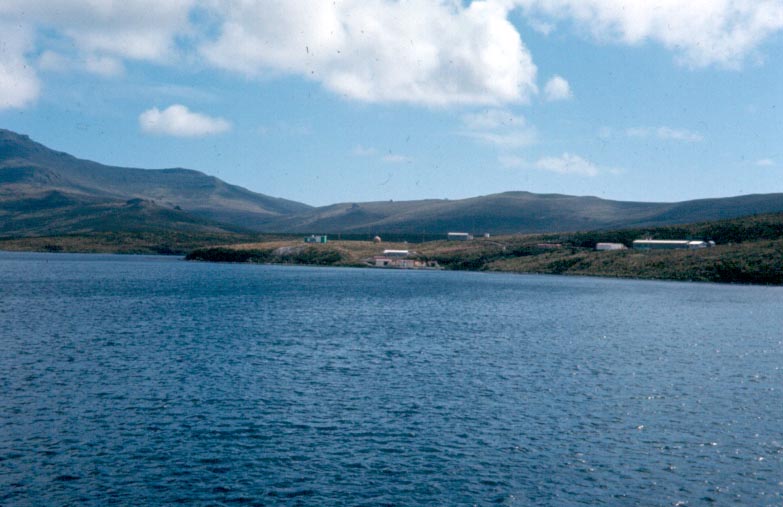
During World War II a coast guard station was operative at Tucker Cove at the north shore of Perseverance Harbour. After the war the facilities were used as a meteorological station until 1958, when a new one was established at Beeman Cove, just a few hundred metres further east. This station was manned permanently until 1995 when a fully automatic station was established. Today, human presence is limited to periodic visits by research and conservation expeditions.
In 2001 brown rats (Norway rats) were eradicated from the island nearly 200 years after their introduction. This was the world's largest rat eradication. The island's rat-free status was confirmed in 2003. [1] Since the eradication, vegetation and invertebrates have been recovering, seabirds have been returning and the Campbell Island Teal, the world's rarest duck, has been reintroduced. [2] Other native landbirds include the New Zealand Pipit and the Campbell Snipe, a race or species of New Zealand snipe only discovered in 1997 and as yet undescribed. The snipe had survived on Jacquemart Island and began recolonising the islands after the rats had been removed.
The area is among one of five sub-Antarctic island groups designated as a World Heritage Site by UNESCO. [1]
Contents |
[edit] Gallery
[edit] Images of Campbell Island
 Vagrant adolescent male Elephant seal Mirounga leonina resting in the tussock grasses |
 New Zealand Sea Lions disporting themselves among the tussock grass |
 Campbell Island landscape (taken during a unusually warm and dry late summer) |
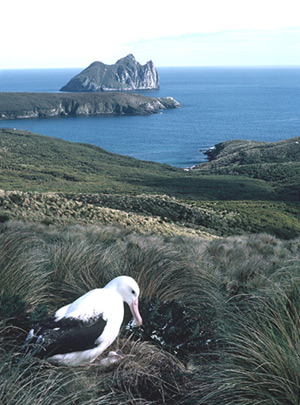
 Southern Royal Albatross, Diomedea epomophora with chick on mound nest on Campbell Island |
 Campbell Island landscape with a megaherb community in the foreground |


[edit] See also
- Campbell Island Teal
- Megaherbs
- Campbell Island group
- New Zealand sub-antarctic islands
- List of antarctic and sub-antarctic islands
- Rat Island, where rats are also being eradicated
[edit] References
[edit] External links
- Topographic map, Campbell Island, NZMS 272/3, Edition 1, 1986.
- Long description of Campbell Island and especially its history
- Short description of Campbell Island with a picture
- Picture of a Southern royal albatross nesting with a chick on Campbell Island with Dent Island in the background
- Picture of Perseverance Harbor, Campbell Island
- Picture of Campbell Island
- Picture of Campbell Island
- Picture of Campbell Island
- Picture of the vegetation on Campbell Island
- Picture of the vegetation on Campbell Island
- Picture of Campbell Island
- Picture of Campbell Island
- 2 Pictures of Campbell Island (very slow connection)
|
|||||||||||