Talk:California High-Speed Rail
From Wikipedia, the free encyclopedia


Contents |
[edit] New line neccesitated between Bakersfield and Los Angeles
For decades in the interstate era, 1955 to present, maps containing railroad mileage in California indicate no railroad between those two cities.
I have assumed that Interstate 5 consumed that space. This article needs to address the issue of the right-of-way and entirely new track and rail bed of the train between those cities.Dogru144 23:39, 27 December 2006 (UTC)
[edit] Not neccesarily all that neccesary
If you really look at the maps there's a route that follows the 14 freeway out to Palmdale, which then cuts north to Mojave, west over and through Tehachapi, then down to Bakersfield. It isn't used by Amtrak, but there's a right of way for railroad purposes even if it is currently only being used for cargo.Phil 21:38, 28 December 2006 (UTC)
[edit] Far Better Idea (an much cheaper)
I have a great idea that would save tens of billions of dollars. Since most of the time in an airplane is checking in/out, and there are plenty of flights between LA and SF Bay Area, why not just build high speed rail where u need it most -- heavily traveled shorter corridors of about 100-150 miles, where it doesn't make sense to fly or drive. This means Bay Area to Sacramento, San Diego to Los Angeles, San Jose to SF and in Los Angeles area. Amazingly, there would be no problems with blasting tunnels through mountains (very expensive, 80% of the costs in Japan!) These would be easy and u could grab the right of way already there from the Altamont, Coaster, Metrolink, Caltrain. Of course u would want to not allow cross traffic as the 3 above do, and u would get commuters as well. The major reason commuters don't use public transport is because its slow, and has bad connectivity, and those going to work far outnumber those going on major trips. This would really make sense as it unarguably be much faster and more convenient than either planes or cars, as planes don't really do short trips, and if they do, its waiting, then all up and down. As for LA-SF, leave the longer trips to planes, for truckers, they should just widen the I-5, its only 2 lanes wide and mostly goes thru vast nothingness.
- This isn't a discussion forum, but I generally agree; however, I think an SF/LA line could be competitive. --Golbez 01:43, 8 June 2007 (UTC)
Reply to Golbez: The current plan has a few faults, political and budgetary. One is it requires a choice between two routes, San Francisco Bay Area or Sacramento, and whoever gets left out will probably be inclined not to support the bill politically. The above plan would be politically easier as its more inclusive, maybe even 1/4-1/3 the cost, don't forget the huge mountains between Bakersfield - LA and SF - San Joaquin Valley, blasting through is super expensive, and u must blast thru, fast trains cant go up and down and sharp curves) and we could always build the LA-SF section later if we need it. San Diego to LA in 35 minutes, Irvine to LA in 20 minutes, San Jose to San Francisco in 20 minutes, and San Francisco to Sacramento in 35 minutes, Riverside to LA in 20 minutes, even in rush hour, no land grabbing, no mountain blasting, and we can finish 10 years earlier (2015 not 2025), $20-30 billion cheaper than current plan, same basic effect on commuters, it is very compelling. Think how many freeways that would relieve...LA-SF is only 1 freeway(I-5), similar end-to-end time as a plane isn't compelling at all.
- Just one correction: fast trains CAN go up and down just like others, thanks to kinetic energy (inertia), good power-to-weight ratio and optimized aerodynamics. One train achieved 350+ mph there: [1] (without losing contact with the ground!). In Europe gradients happen to be as high as 4%. Okay, not enough to go thru Calfornian Mountains without building tunnels, though. ;o) MatP 21:08, 10 July 2007 (UTC)
[edit] Budgeted amounts
If you look at the text of the budget, as amended, it says that a total of "1,159,000" is to be set aside "for support of High-Speed Rail Authority, Program 10-High-Speed Rail Authority, payable from the Public Transportation Account, State Transportation Fund." However, the Fresno Bee keeps quoting a figure of $15 million. Similarly, various news outlets reported that the Budget that came out of Conference set aside $55 mil; the text of S 77, however, claims a figure of just "41,159,000." What am I missing here? —lensovet–talk – 11:16, 11 August 2007 (UTC)
- The CHSA wanted ~$90m; the governor wanted to give them $1,159,000; the house wanted to give ~$45m; the senate wanted to give ~$55m. Given all that, we'll only know what the CHSA will get when the budget has Arnie's signature on it. Tompw (talk) (review) 14:32, 11 August 2007 (UTC)
[edit] Coast Route High Speed Rail
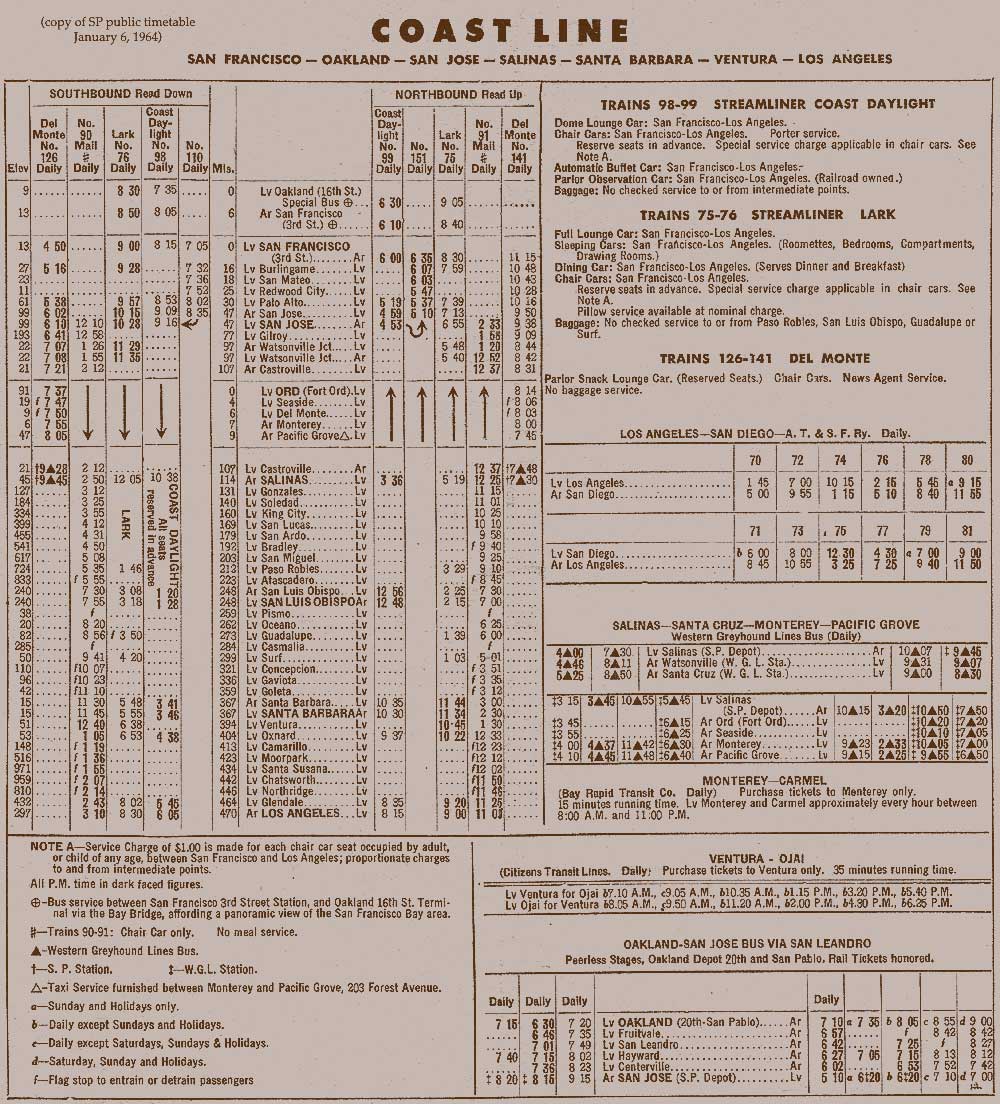
I noticed the map of proposed high speed corridors appears to include the coast route as a possibility. Have there been any propositions for a coast route connecting San Jose/Salinas/San Luis Obispo/Santa Maria/Santa Barbara and the greater LA area? It seems like the only rail link right now is the Coast Starlight, which takes a disgusting 12 hours 10 minutes from Emeryville to Los Angeles Union, which is a downgrade from previous lines which could make it from LA to San Jose in 8:49 back in 1964. I know there's issues of right of way with freight trains, terrain, and single tracks for most of the coast route, but something still seems wrong about it taking 12 hours to get from the SF Bay to LA. --Rc251 05:17, 19 September 2007 (UTC)
- The current HSR project aims to serve areas with the biggest populations and potential for growth – at this point this implies the Central Valley more than anything. The Valley also has much bigger issues with air quality that the HSR could help alleviate. Lastly, a route along the coast would be far from straight (and would rouse the anger of many who would claim that it would spoil pristine views of the beach), resulting in lower average speeds. —lensovet–talk – 06:01, 19 September 2007 (UTC)
- Another reason why the coast route would be a questionable choice is earthquakes. Much of the coast route is along or close to the San Andreas fault, where sizable earthquakes occur frequently, and geologists expect the parts to the west to eventually—possibly within our lifetimes—become a separate landmass. 192.235.1.34 18:35, 27 September 2007 (UTC)
- Please do not encourage the common misconception that the parts to the west of the San Andreas will eventually become an "separate landmass". It is total fiction; at the end of your lifetime, L.A. will be only 3-6 inches closer to Alaska rather than becoming an separate landmass. Anyways, back to the original poster's point, I think this route was selected due to the possibility of using Talgo trains on the current trackage (which is the coast route mentioned) which, according to the current standards used in America (see: Acela) it would qualify as HSR. Frozenbrains 22:25, 27 September 2007 (UTC)
[edit] Oakland station
I think the Oakland station will be located at Oakland's Jack London Square. Does everyone agree?
Native94080 (talk) 20:55, 23 December 2007 (UTC)Native94080
- Dare I ask, does it matter at this time? Butterfly0fdoom (talk) 21:32, 24 December 2007 (UTC)
-
- I disagree, as the trains would be traveling through a street. Mix road traffic with 300+ mile trains, and problems can occur. User:The real simmer 3 (talk) 4:58, 12 April 2008 (UTC)
[edit] San Francisco station
I think the San Francisco station will be located at San Francisco's renovated Transbay Terminal. Does everyone agree? Native94080 (talk) 20:55, 23 December 2007 (UTC)Native94080
- Dare I ask, does it matter at this time? Butterfly0fdoom (talk) 21:32, 24 December 2007 (UTC)
- That is the current plan; however, exact station locations remain to be picked. I don't really see how this could be a matter of "agreement," however. —lensovet–talk – 21:39, 25 December 2007 (UTC)
[edit] Richmond Station?
Will this service include a stop at the Richmond station, where it meets with BART when coming from Sacramento & Stockton?
Nevermind, I just looked at the route from Stockton. The route from Stockton does not go through the Bay Area.
Native94080 (talk) 20:59, 23 December 2007 (UTC)Native94080
[edit] Station speculation
It's way too early to be speculating about where the HSR stations might be. The planning for the new line will probably evolve even while it's being built. (Construction is still a long ways off.) Let's wait until the locations of stations are announced by authorities before adding that info to the article. Information on wikipedia must be verifiable. Alcuin (talk) 03:55, 25 December 2007 (UTC)
In the Final Project EIR, the Sacramento Valley Station is identified as the preferred Sacramento station location. In fact, all preferred station locations have already been identified, with the recent selection of the Pacheco Pass corridor. I think it is proper to directly link several of these stations directly from this article as proposed HSR stations.
--PSurfliner (talk) 06:30, 26 December 2007 (UTC)
- Let's put a link to the source, then, and make it clear in the article that the routing/stations are proposed. Alcuin (talk) 17:32, 26 December 2007 (UTC)
Should the wikilink for the Sacramento station remain as it is now? The user Butterflyofdoom (name spelling slightly different) undid my wiki-link modification to where the Sacramento station will be located. I wiki-linked the station location to the Sacramento Valley station; Butterflyofdoom un-did my revision, and it is now wiki-linked to the city of Sacramento (not wiki-linked to the Sacramento Valley station itself). Consensus needed.
Native94080 (talk) 07:48, 28 December 2007 (UTC)Native94080
-
- I don't see why Sacramento station link has to point to Sacramento Valley Station at this time. First of all, the Sacramento Valley Station is only one of the possible station locations in Sacramento. Secondly, extension to Sacramento is years away. I think current link to Sacramento the city is good enough. --Will74205 (talk) 18:33, 29 December 2007 (UTC)
I was merely editing the article according to Alcuin's statement. The table says "proposed route", and the PDFs that contain the specific station locations is cited at the bottom of the table. Butterfly0fdoom (talk) 07:44, 2 January 2008 (UTC)


![[1]](http://farm2.static.flickr.com/1234/603571347_4492a74976_o.jpg)