Image:Bubble interference (red).png
From Wikipedia, the free encyclopedia
No higher resolution available.
Bubble_interference_(red).png (237 × 211 pixels, file size: 10 KB, MIME type: image/png)

| This is a file from the Wikimedia Commons. The description on its description page there is shown below.
|
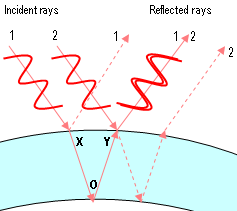
In this diagram we look at two rays of red light (rays 1 and 2). Both rays are split as before and follow two possible paths, but we are interested only in the paths that are represented by the solid lines. Consider the ray emerging at Y. It consists of two rays on top of one another: the bit that went through the bubble wall for ray 1 and the bit that was reflected off the outer wall of ray 2. Ray one has travelled XOY further than ray 2. Since XOY happens to correspond to the wavelength of red light, the two rays are in phase (the humps and troughs are together).
Source: english wikipedia, original upload 9 March 2004 by en:User:Theresa knott (selfmade)

\
File history
Click on a date/time to view the file as it appeared at that time.
| Date/Time | Dimensions | User | Comment | |
|---|---|---|---|---|
| current | 17:46, 30 July 2005 | 237×211 (10 KB) | Saperaud | (In this diagram we look at two rays of red light (rays 1 and 2). Both rays are split as before and follow two possible paths, but we are interested only in the paths that are represented by the solid lines. Consider the ray emerging at Y. It consists of t) |
File links
The following pages on the English Wikipedia link to this file (pages on other projects are not listed):


