Talk:Brutalist architecture
From Wikipedia, the free encyclopedia


[edit] Brutalist hospital
I was introduced to Brutalism for the first time when I was working as an assistant chaplain at St. Mary of Nazareth Hospital Center in Chicago. The building has been described as a "giant concrete air conditioner". It struck me as pretty funny that a hospital would be built in a brutalist style!
Jschroe
- There's another brutalist hospital in Kuala Lumpur, according to [1], though the picture of it at that site looks more Internationalist to me. - [[User:KeithTyler|Keith D. Tyler [flame]]] 04:07, Nov 15, 2004 (UTC)
Home Office Building history? Anyone? - KeithTyler 20:56, Oct 12, 2004 (UTC)
- Basil Spence etc. 1976. I added it to the caption. Wetman 22:20, 12 Oct 2004 (UTC)
-
- Thanks. I moved it into the list for consistency. - KeithTyler 22:26, Oct 12, 2004 (UTC)
- The consistency should run the other way, with at least a date in the captions. Very informative to have the dates as the eye runs down the images. Wetman 00:06, 13 Oct 2004 (UTC)
- Is it necessary to duplicate the information? Since the list will be more exhaustive than the row of images, and any building in an image should also be in the list, the list seems the place to include that information, so that it can be included there for all structures (not just those in the images). I guess the only case where I could see duplicating either the year built or the architect in the image captions would be if we wanted to sort the images by either year or architect, but I don't necessarily see a need for that either. If we didn't have the list, or if the list was demerged into its own article, then I could see the sense in putting that info in the captions much more. - KeithTyler 22:40, Oct 13, 2004 (UTC)
- Such questions are best answered by looking at the page and thinking of the reader. Wetman 05:06, 14 Oct 2004 (UTC)
- Thank you KeithTyler! much more orienting with dates, since the entry is about a style, which evolves in time. Wetman 19:59, 14 Oct 2004 (UTC)
- I decided to compromise. I think the condensed form of architect and year fulfills the desire for giving more meaning to the images without entirely duplicating information elsewhere in the article. So, you're welcome. Thanks for pushing me to consider it. :) - KeithTyler 21:58, Oct 14, 2004 (UTC)
- Thank you KeithTyler! much more orienting with dates, since the entry is about a style, which evolves in time. Wetman 19:59, 14 Oct 2004 (UTC)
[edit] Sort
I don't know if there is a WP convention on sorting lists of buildings, but I'm going by the following arbitrary rules:
- If the building is named after a person, use the initial of the person's last name.
- If the building is an unnamed building, or if the entry indicates a group of buildings, from a larger campus, use the name of the campus owner (e.g. a school).
- Include "university" etc. as part of the name.
- If a group of buildings all have similar names with the exception of indications of where they are located, sort them in order of year built (especially if they were designed by the same person).
- KeithTyler 22:51, Oct 13, 2004 (UTC)#
Another for gallery
http://images.google.co.uk/imgres?imgurl=http://www.c20society.org.uk/images/casework/luder_carpark.jpg&imgrefurl=http://www.c20society.org.uk/docs/listings/04_autumn.html&h=240&w=422&sz=56&hl=en&start=1&tbnid=7_fwuF8YDbJO5M:&tbnh=72&tbnw=126&prev=/images%3Fq%3Dgateshead%2Bcarpark%26gbv%3D2%26svnum%3D10%26hl%3Den%26sa%3DG
Under Gateshead carpark.
~andy
[edit] Rees Carillon
My best online research suggested (though not definitively) that Wes Corgan was the designer of the Rees Carillon. However, the webmaster of the Rees Carillon page, Karel Keldermans, responded that the architect's name was Fred Turley. - [[User:KeithTyler|Keith D. Tyler [flame]]] 17:43, Nov 8, 2004 (UTC)
Could disputes like this come down to architectural practice vs. project architect? FrFintonStack 11:22, 29 March 2006 (UTC)
Now that I revisit this, it seems WP:NOR would invalidate the Turley assertion, since I got it from email. (Grr, grr, and grr. Doesn't pay to do any real legwork around here anymore.) - Keith D. Tyler ¶ (AMA) 17:50, 29 March 2006 (UTC)
- Only under a fanatical interpretation of WP:NOR. Post the email here. You're an established user with no history of trouble, it's not a horribly controversial matter, I can't think why your assertion of its authenticity would be questioned. - Jmabel | Talk 04:59, 5 April 2006 (UTC)
[edit] Private Eye
You might want to mention Private Eye's architecture column "Nooks and Corners", which began life as "Nooks and Corners of the New Barbarism", with "new barbarism" clearly intended as a reference to "new brutalism". -- Jmabel | Talk 01:09, Mar 3, 2005 (UTC)
- Do you have more detail? I personally have no access to this publication. Anyone that does, please fill us in. - Keith D. Tyler ¶ [AMA] 21:02, Mar 4, 2005 (UTC)
[edit] Barbican
Is London's Barbican [2] considered brutalist? And if not, how does it differ? -- Jmabel | Talk 01:18, Mar 3, 2005 (UTC)
- It certainly appears to be, and it fits right in with the golden era of the style in Britain during the depressed 60s. - Keith D. Tyler ¶ [AMA] 21:02, Mar 4, 2005 (UTC)
- I'm planning an expedition to take some photos of the Barbican soon, as the ones we have don't really show all its brutalist glory ;).Keithlard 17:45, 7 October 2005 (UTC)
- Good luck, but due to the site's design I found it very hard to find any pictures that showcased the estate's Brutalism. From what I could see, you'd need to be inside the square to really appreciate it, and then you have to pick one particular angle from the inside to take a picture of, but no one angle will fully expose the variety of Brutalistic elements used in various portions of the lot. Perhaps a panoramic or partial panoramic from the inside might do it justice. Or maybe something taken from a roof of one corner. But I don't think one picture can capture the design, based on the pictures I've seen. - Keith D. Tyler ¶ 20:32, 7 October 2005 (UTC)
- I have some I took today (as I was passing), will upload to Commons later and see if theres anything you like. Justinc 20:43, 15 October 2005 (UTC)
- Most brutalist looking is Image:Barbican Estate Tower 2005.jpg. There are a few otehrs that are ok-ish. Justinc 01:26, 16 October 2005 (UTC)
- Good luck, but due to the site's design I found it very hard to find any pictures that showcased the estate's Brutalism. From what I could see, you'd need to be inside the square to really appreciate it, and then you have to pick one particular angle from the inside to take a picture of, but no one angle will fully expose the variety of Brutalistic elements used in various portions of the lot. Perhaps a panoramic or partial panoramic from the inside might do it justice. Or maybe something taken from a roof of one corner. But I don't think one picture can capture the design, based on the pictures I've seen. - Keith D. Tyler ¶ 20:32, 7 October 2005 (UTC)
[edit] Arndale
How about the Arndale in Manchester (the 1972-79 Wilson & Womersley part, not the recent additions)? -- Jmabel | Talk 01:20, Mar 3, 2005 (UTC)
- Not IMO. Much too much glass, focus on smooth and shiny, hardly any concrete or visible structure -- the glass facades and what not do what they can to obscure the nature of the building rather than exploit and embarass it. Modernist I think but much too technological and recent IMO, not sure the exact style, but it's been popping up since the mid 90s at least (e.g. [3]). - Keith D. Tyler ¶ [AMA] 21:02, Mar 4, 2005 (UTC)
- Are you sure you are talking about the original Wilson & Womersley part? The recent additions are certainly not brutalist, but I can't imagine how the Wilson & Womersley part could be described as having "too much glass", it has almost none. -- Jmabel | Talk 20:28, Mar 20, 2005 (UTC)
- My opinion was based on what pictures i could find of the building via Google image search. - Keith D. Tyler ¶ [AMA] 21:30, Mar 21, 2005 (UTC)
- Images on the web will probably uniformly show off the gleaming new, rather postmodern Marks & Spencer, not the older building, which is now seen as a bit of an embarrassment. -- Jmabel | Talk 22:19, Mar 21, 2005 (UTC)
- Yeah, there's the High-Tech glassy extension in the foreground in the photos, but also the original concrete (w/ v. small windows) tower often seen in the background. Certainly looks Brutalist to me, even if the shape is a tad uniform and structural elements under-expressed compared to many classic Brutalist structures. Not sure if it's important enough to warrent inclusion though. FrFintonStack 11:21, 29 March 2006 (UTC)
- Images on the web will probably uniformly show off the gleaming new, rather postmodern Marks & Spencer, not the older building, which is now seen as a bit of an embarrassment. -- Jmabel | Talk 22:19, Mar 21, 2005 (UTC)
- My opinion was based on what pictures i could find of the building via Google image search. - Keith D. Tyler ¶ [AMA] 21:30, Mar 21, 2005 (UTC)
- Are you sure you are talking about the original Wilson & Womersley part? The recent additions are certainly not brutalist, but I can't imagine how the Wilson & Womersley part could be described as having "too much glass", it has almost none. -- Jmabel | Talk 20:28, Mar 20, 2005 (UTC)
[edit] Freeway Park
How about Seattle's Freeway Park? [4], [5] (Sorry I keep coming up with these one by one.)
- Wow, quite beautiful, it certainly looks Brutalistic. I'm sad that I live so close to it and have yet to visit it! Will look into its history. Certainly it's recent news coverage as you noted seems to give it an additional "brutal" characteristic. - Keith D. Tyler ¶ [AMA] 21:02, Mar 4, 2005 (UTC)
- I finally uploaded my photos of the park: Commons:Category:Freeway Park, Seattle. - Jmabel | Talk 08:56, 1 January 2007 (UTC)
[edit] List of buildings
I think it's time to pare down the list of buildings to a list of *notable* buildings. I'm not sure how to determine notability though. I'd probably include for sure:
- Unite d'Habitation
- Hunstanton School
- Robin Hood Gardens
- Tricorn Centre
- Boston City Hall
- Royal National Theater
- Barbican
Probably also any building with its own article dealing with its architecture.
- Keith D. Tyler ¶ 19:26, 5 October 2005 (UTC)
- Yes agreed; I'd add Trellick Tower because it's definitely an iconic London building, and Balfron Tower because the architect famously lived there. Maybe we could institute a Brutalist Architecture category for the ones that don't make the cut; it's nice to be able to compare and contrast a whole range of brutalist buildings. Keithlard 19:43, 5 October 2005 (UTC)
-
- Created Category:Brutalist structures for the latter purpose. I'm going to copy out the list to User:KeithTyler/Brutalist structures for now and pare the article's list down to what we've agreed on so far. - Keith D. Tyler ¶ 23:10, 5 October 2005 (UTC)
-
-
- I've tagged most of the buildings from your list that have their own articles with the new cat. Keithlard 17:42, 7 October 2005 (UTC)
-
The list has been growing again. - Jmabel | Talk 20:10, 15 April 2006 (UTC)
I added St. Peter's which, while it doesn't have its own article, is an incredibly important building. FrFintonStack 01:06, 17 April 2006 (UTC)
The list is getting silly now; people seem to be adding every brutalist building they've heard of, including ones with no wikipedia page or with no photos on the page, or without even artictect or date contributions. Could we restrict the list to buildings of international significance? I don't have time at the minute, but will probably prune the list next week unless someone does it before then or if anyone has any objections. FrFintonStack 01:47, 17 August 2006 (UTC)
[edit] UK consistency
Could we try and make sure that there is consitency when giving the locations of various structures. To give locations such as Norfolk, UK and then Cardross, Scotland seems rather silly. All of those that are located in the United Kingdom should be categorised as such or, if it is preferred, to be referred to as such and such, England and such as such Scotland and so on. hedpeguyuk 09:56, 2 May 2006 (UTC)
[edit] A pun?
Has anyone ever touched upon the similarity between "Brutalism" & the word "brutal" (or "brute"), either explicitly pointing this out or alluding to it with a pun? This is so obvious that I'd be surprised if I were the first to point this out. (And until I read the article, I assumed that this is where the name came from.) -- llywrch 18:02, 16 October 2005 (UTC)
Like you say, it's obvious. I'm sure it occurs to virtually everyone, and I don't really think it's worth pointing out. FrFintonStack 17:45, 28 March 2006 (UTC)
Yeah, in fact for a while, I thought the name was derived from the appearance of the buildings, and that it was called so by critics. Eddy1701 04:10, 16 March 2007 (UTC)
[edit] Harvard architecture
(no, not seperate data and program memory) There's a great deal of architecture on the campus of Harvard University that is generally considered to be in the Brutalist school: The Holyoke Center, Mather House, the Leverett House towers, William James Hall, Canaday Hall on Harvard Yard, possibly Peabody Terrace... they were all built during the 70's, during the Brutalist heyday. Not sure how/if this information should be incorporated... --Clay Collier 10:00, 17 October 2005 (UTC)
- Can you point to any good photos showing this off? - Keith D. Tyler ¶ 18:31, 1 November 2005 (UTC)
[edit] Cameron Offices not demolished (at least, not yet)
The List of notable brutalist structures in this article lists the Cameron offices as having been demolished in 2002. Having driven past then within the last fortnight I can assure you that they haven't been - at least not yet. I beleive that the buildings are/were being (progressively?) decomissioned, but haven't seen any demolition work yet. I will remove the "demolished" reference in the article, but if anybody has any further detail, they might want to update the listing further. Adz 06:14, 1 November 2005 (UTC)
- Would you call them abandoned? - Keith D. Tyler ¶ 18:26, 1 November 2005 (UTC)
- Hmm, after seeing some of these photos I would. - Keith D. Tyler ¶ 18:30, 1 November 2005 (UTC)
- I believe that the pavillions are/were being decomissioned in stages. I know that at least one of them was occupied as late as last year/early this year and beleive that the ComSuper agency still occupies part of the building. Let me drive out there on the weekend and investigate. I'll get back to you. Adz 20:45, 1 November 2005 (UTC)
[edit] Arcaid
I question the usefulness of the Arcaid link. Nice site, but in three minutes I located only one image of a brutalist building. Perhaps a deep link to somewhere in this site would be relevant, if someone can supply one. Otherwise, I think it should be removed. -- Jmabel | Talk 07:22, 11 November 2005 (UTC)
[edit] Attribution
Recently the attribution for Boston City Hall was changed from I.M. Pei to Kallmann and McKinnell. Granted, the text above the notable buildings section says "architect". Typically I would think to equate "architect" with "designer", but it seems this is not always the case. Regardless, it seems to me that the style of a building is determined based on the design, and therefore whoever designed the building should get the credit for its position as an example of a style. How should this be addressed? - Keith D. Tyler ¶ 22:31, 9 January 2006 (UTC)
[edit] Geisel library
I don't see the Geisel library as being in the brustalist style - it strikes me more as international or postmodern Jgassens 14:26, 17 March 2006 (UTC)
[edit] History of Western Architecture
Could someone add this page to the History of Western Architecture series? I would, but I'm not sure how. 86.1.199.36 21:07, 30 March 2006 (UTC)
- It looks like that list ({{Archhistory}}) doesn't include any article this specific, and I think it should stay that way. -- Jmabel | Talk 05:01, 5 April 2006 (UTC)
You're probably right. It had had International Style which prompted my request, but that seems to have been removed now. FrFintonStack 19:04, 5 April 2006 (UTC)
[edit] Gun Turrets
"It has been suggested that the style was subconsciously based on the austere German gun turrets left littered along beaches after the second world war."
This needs to be referenced. I heard it suggested in a documentary called 'Gerry Built' (boom boom!) about German architecture in the Nazi period, but can't remember any details beyond that. Certainly, some German gun position in northern France look remarkably like elements of Denys Lasdun's Royal National Theatre. I'd be grateful if anyone had anyone more info on this, and could referencce the claim appropriately. 86.0.203.120 12:21, 3 July 2006 (UTC)
[edit] "Abject irregularities"
The article currenly makes reference to "abject irregularities". I could imagine someone thinking this, but that it seems very odd to use such a pejorative term without attribution. Perhaps it was written by someone trying to use a fancy word he or she did not understand? If this is an implicit quotation, could someone please clarify who is being implicitly quoted? - Jmabel | Talk 02:18, 1 August 2006 (UTC)
[edit] An Obvious Point..
I assume (though it is nowhere mentioned in the article) that 'Brutalism' was originally (and still is) a derogatory term of abuse directed at this style of architecture. If so, who first coined the phrase? Colin4C 16:49, 14 October 2006 (UTC)
- I'm actually not sure that the term was originally pejorative. It was embraced early enough in the style that it may have been more like a declaration of war. I'd want to see a citation before we asserted that. - Jmabel | Talk 17:47, 17 October 2006 (UTC)
- Yay for spurring some further research :) Seems that it in fact was ultimately pejorative. - Keith D. Tyler ¶ (AMA) 18:33, 17 October 2006 (UTC)
- Now I'm a little confused: in the article you've attributed the term to Reyner Banham, which certainly sounds likely, but you didn't give a citation, and you say here that it was "ultimately pejorative", but you don't say that in the article, nor do you indicate in any clear way that Banham was being pejorative. I did some quick browsing around the web and didn't find anything clear on that, but given his pro-technological orientation and functionalism, I'd have expected him to rather like this style. This suggests he meant it as a positive. - Jmabel | Talk 22:26, 20 October 2006 (UTC)
-
- Word it how you want. This link, which I added at the same time, characterises the neologism as an attempt "to express the general horror with which this concrete architecture was greeted". Sounds like it was intended as a pejorative term to me, despite that he himself actually seems to have liked the style. That's a good link, though, thanks. :) - Keith D. Tyler ¶ (AMA) 23:05, 20 October 2006 (UTC)
[edit] Missing history
Though Le Corbusier is mentioned, the role that Le Corbusier - and Pierre Jeanneret in particular in Chandigarh - played is sadly down played. I also do not think that Habitat 76 is 'classic' brutalism.Brosi 03:37, 20 December 2006 (UTC)
- I'm hard pressed to find a hard-and-fast rule as to what is Brutalism. To some extent, it seems to be a "you know it when you see it" style. Hunstanton for example. All sources insist it is brutalist, but if it is, it is in a philosophical way rather than an architectural style way, IMO.
- A lot of what people label as brutalist looks a lot more like internationalist done in concrete, or modernist with a bit of concrete or non-traditional shapes. Some label anything done in concrete as "brutalist".
- And then there are those buildings that don't get called brutalist very often, but sure do look like it to me (e.g. 50 Queen Anne's Gate).
- Anyway, I would love to have you add info on the history of the roles Le C. and Jeanneret played. - Keith D. Tyler ¶ (AMA) 18:08, 20 December 2006 (UTC)
-
- Yes I think I can add something on L.C. And yes the issue with Brutalism is that it is often in the eye of the beholder. One has to take, however, other things into consideration, as in the case of Safdi who during that period had a type of organic-geometric interest going. The other thing to mention is what could be called College Brutalism. Almost every university in the US it seems to me has at least on Brutalist building from the late 60s. There is a FANTASTIC one in Washington University in Seattle. I don't know what its name is though. Concrete of course.Brosi 14:54, 23 December 2006 (UTC)
-
-
- There is no university in Seattle called Washington University. Do you by any chance mean the University of Washington? I can't think what building you would mean there, though. Condon Hall, the former law school, is brutalist, but I can't imagine anyone considering it fantastic. Seig Hall, from that period, is pretty hideous, in that it integrated incongruous ornamental elements; most of the other buildings on campus from when brutalism was big (including several buildings around Red Square) certainly show its influence, but have brick façades. There are a few brutalist dorms. There could be something I'm not thinking of… Far and away, though, Seattle's notable brutalist achievement is Freeway Park. - Jmabel | Talk 20:40, 25 December 2006 (UTC)
-
-
-
-
- Yes you are right. I was typing too fast. University of Washington, it is. I visited only briefly, so you may have a better take on this if you know the campus, but I saw it in the photo of the Charles Odegaard Library that is on the wikipedia University of Washington site. It is to the right of the library, though. I don;t know what building it is or who designed it, but as about as brutal as it gets. Looks like an underpass for a bridge. ANyway.Brosi 00:31, 26 December 2006 (UTC)
-
-
-
-
-
- I recall seeing some very brutalist-looking buildings while crawling through exit traffic after a UW graduation. I presume they were dorms. One in particular had grid-like ornamentation in concrete at the top (leaving empty squares to the sky). I don't know if I can describe it any better. Anyway, not knowing what hall it is makes it difficult for me to add it to the list. - Keith D. Tyler ¶ (AMA) 01:06, 28 December 2006 (UTC)
-
-
-
-
- Ah, Kane Hall. Yes, that picture is on the abovementioned Red Square, and you are right: that one building, unlike the other buildings from that era around the square, is not entirely covered in brick. But I believe parts of it are: see http://static.flickr.com/53/156990877_d2e9e5f871_m.jpg: notice the part at the right. I'll probably be on the campus some time the next week or so, I'll try to get some pictures from various angles. But you are certainly right that the main entranceway is Brutalist. - Jmabel | Talk 21:00, 27 December 2006 (UTC)
- Kane Hall. Yes Thanks to remembering the name.Brosi 01:09, 28 December 2006 (UTC)
- Ah, Kane Hall. Yes, that picture is on the abovementioned Red Square, and you are right: that one building, unlike the other buildings from that era around the square, is not entirely covered in brick. But I believe parts of it are: see http://static.flickr.com/53/156990877_d2e9e5f871_m.jpg: notice the part at the right. I'll probably be on the campus some time the next week or so, I'll try to get some pictures from various angles. But you are certainly right that the main entranceway is Brutalist. - Jmabel | Talk 21:00, 27 December 2006 (UTC)
-
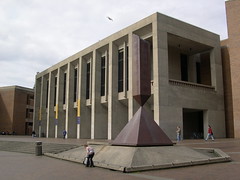
I took several more pictures of Kane Hall. As you can see, most of it is covered in brick. Only the side facing onto Red Square is raw concrete, though the forms are basically brutalist.
 |
 |
 |
 |
I'll try to get some photos some time of the more brutalist buildings on the campus (which includes some dorms, the Schmitz Hall admin building, the Gould Hall architecture building, and Condon Hall, which used to house the law school). - Jmabel | Talk 06:55, 11 January 2007 (UTC)
-
-
-
- How can we find out who designed Kane Hall. Do you have any connections to the University archives or maybe I can call the archivist - or something like that.Brosi 13:35, 11 January 2007 (UTC)
-
-
- I found it. Kane Hall designed by Walker and McGough (1969)Brosi 13:37, 11 January 2007 (UTC)


I finally photographed the truly brutalist buildings on the campus: MacMahon and Haggett Halls, both dormitories. - Jmabel | Talk 01:51, 2 May 2007 (UTC)
I'm not sure brutalism requires concrete. Certainly the "cheap" brutalism of Corbusier and Goldfinger etc. did, and concrete's neutral color and consistent texture helps bring the attention to the building's form, but I think you can get the same brutalistic design without the same materials. Moreover, IMO some sources will slander any concrete building as "brutalist" just because they don't like concrete. - Keith D. Tyler ¶ 21:10, 7 June 2007 (UTC)
[edit] 2007-01-28
- Set some place names to second row for better legibility;
- Some of those names wikilinked and disambiguated,
- In some of them, made wikilinks longer, so that UC Irvine can be seen as "University of California, Irvine" and not some acronym and a name;
- Added USA after these examples
- I left well-known city names without country names, as Seattle, Canberra, London, et al. should be easily recognizable as cities of their respective countries
- Set "Theodor Geisel Library" to point to "Geisel Library".
- Yes, I didn't know that Theodor Geisel = Dr. Seuss, but contextually a user would want to click on the library link rather than pause to choose which link is right or not. As a compromise, I added a footnote reference to Geisel as a compromise.
-Mardus 12:24, 28 January 2007 (UTC)
[edit] Brutalism and Neo Brutalism
- A question
- With my Swedish architectural education, I've been taught "Brutalism" was a 19th century style associated with William Butterfield and his All Saints, Margaret Street (1849-1859) and , often referred to as "Bacon Architecture". If I'm right, the Modernist style which emerged in the 1950s, described in this article, should therefore be referred to as Neo brutalism. Shouldn't the article be moved to Neo Brutalist architecture?
- / Mats Halldin (talk) 09:03, 8 May 2007 (UTC)
-
- The two articles you mention refer to his style as Gothic Revival. - Keith D. Tyler ¶ 20:00, 8 June 2007 (UTC)
-
-
- Yes, according to my sources, 19th century Brutalist architecture is part of Gothic Revival but distinct from it in using materials "honestly" and Butterfield is supposed to be one of the guys typical for this style. Maybe it is just how labels are used in Swedish, what do I know? (Googling on "Bacon Architecture" wasn't very rewarding.) Anyway, there is no articles on neither Neo-brutalism or Neobrutalism and Neo brutalism should, imo, be merged into Brutalist architecture or this latter article should be moved. I'm not sure how these concepts are being used in English, so its hard for me to tell.
- / Mats Halldin (talk) 20:34, 8 June 2007 (UTC)
-
-
- I can't say I've ever heard that. Do you have any references? Jgassens 22:34, 14 July 2007 (UTC)
-
- My point was that your sources don't back up your claim. - Keith D. Tyler ¶ 16:19, 16 July 2007 (UTC)
-
-
- Unless there's some clear lineage between the two styles, I don't think a merge is a good idea. - Keith D. Tyler ¶ 18:45, 19 July 2007 (UTC)
-
- Re the proposed merge-to from Neo brutalism, while I can't speak to the architectural nuances, as a matter of content I think that Neo brutalism should be merged as a branch of the topic Brutalism, pending substantial expansion of the branch. ENeville 01:14, 18 July 2007 (UTC)
Well, no, I can't back up that claim. That's why I dropped a question here rather than move/edit the article. I suppose we can leave Brutalist architecture as it is, but think the stub Neo brutalism should be merged into it. While we're at it: Brutalism redirects to Brutalist architecture, but, as far as I know, brutalism is specific to architecture, so the article might very well be moved back to Brutalism.
/ Mats Halldin (talk) 19:50, 19 July 2007 (UTC)
- As it currently exists the Neo brutalism article has no meaningful content to add to this article. - Keith D. Tyler ¶ 22:15, 19 July 2007 (UTC)
-
- OK, I redirected Neo brutalism to Brutalist architecture and removed the merge proposal (without an attempt to migrate any information). But I still think the title of this article should be discussed. Because there is such label as "Neo-brutalism", "Brutalism" should, in my opinion, be described in the article or elsewhere.
- / Mats Halldin (talk) 00:33, 20 July 2007 (UTC)
If I can weigh in here: Here and there, some uncautious writers have made an association between Butterfield and Brutalism, but made AFTER Brutalism had already been established. Certainly Butterfield never thought of his style as Brutalism and this word should not be applied to him and has no credibility in a architectural historical sense. So lets not get sidetracked here and get people confused. Brosi 20:09, 3 October 2007 (UTC)
[edit] Campus Brutalism section
This section is a horrible read. Any chance of trimming it down to one or two noteworthy examples in the text, and then perhaps creating a list or something for the dozens of others? As it is, you end up with a situation that looks as if every American architecture student has added something from their campus without citing a reference that confirms the building is truly Brutalist or not. If anything, the benchmark for including ANY buildings in this article SHOULD be a verifiable, 3rd party source like an architectural textbook. After all, I can think of lots of buildings that look like Brutalist architecture to me, but they really? Might they be Modernist, Art Deco, or some other more or less similar style? Cheers, Neale Neale Monks 08:24, 17 September 2007 (UTC)
[edit] Prince Charles and the South Bank Center
Article seems incomplete without some discussion of this controversy. It may be the most famous critique ever leveled against brutalism, or "awful modern architecture" or whatever. Priceyeah (talk) 10:37, 13 December 2007 (UTC)
[edit] NKU
Northern Kentucky University has an award winning brutalist styled building I have tried to add this to the article but it was removed. How come?--74.138.83.10 (talk) 19:54, 26 January 2008 (UTC)
- The article isn't a list of every brutalist building on the planet. (There used to be a very long list of brutalist buildings on American campuses in the article, but it was removed because it was taking up way too much of the article; WP:IINFO.) If you have sources showing the NKU building is such an important example of brutalism that it ought to be included even in a reasonably brief survey, then that would justify putting it back in. SethTisue (talk) 19:12, 1 February 2008 (UTC)


![[2]](http://www.arch.oita-u.ac.jp/a-kei/urban/sato/gazou/london05.jpg)