Big Apple
From Wikipedia, the free encyclopedia


The Big Apple is a nickname or moniker for New York City. It was first popularized in the 1920s by John J. Fitz Gerald, a sports writer for the New York Morning Telegraph. Its popularity since the 1970s is due to a promotional campaign by the New York Convention and Visitors Bureau.
Contents |
[edit] History of the term
Although the history of the Big Apple was once considered a mystery,[1] research over the past two decades, primarily by noted amateur etymologist Barry Popik[2] and Professor Gerald Cohen of Missouri University of Science and Technology,[3] has provided a reasonably clear picture of the term's history. Prior to their work, there were a number of false etymologies,[4] of which the most ridiculous was the claim, subsequently exposed as a hoax[5] and now replaced on the source web site with more accurate information,[6] that the term derived from a New York brothel whose madam was known as Eve.[7]
The Big Apple was first popularized as a reference to New York City by John J. Fitz Gerald in a number of New York Morning Telegraph articles in the 1920s in reference to New York horse-racing. The earliest of these was a casual reference on May 3, 1921:
J. P. Smith, with Tippity Witchet and others of the L. T. Bauer string, is scheduled to start for "the big apple" to-morrow after a most prosperous Spring campaign at Bowie and Havre de Grace.[8]
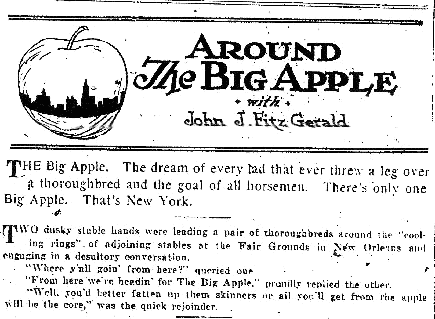
Fitz Gerald referred to the "big apple" frequently thereafter.[9] He explained his use in a February 18, 1924, column under the headline "Around the Big Apple":
The Big Apple. The dream of every lad that ever threw a leg over a thoroughbred and the goal of all horsemen. There's only one Big Apple. That's New York.
----
Two dusky stable hands were leading a pair of thoroughbred around the "cooling rings" of adjoining stables at the Fair Grounds in New Orleans and engaging in desultory conversation.
"Where y'all goin' from here?" queried one.
"From here we're headin' for The Big Apple," proudly replied the other.
"Well, you'd better fatten up them skinners or all you'll get from the apple will be the core," was the quick rejoinder.[10]
Fitz Gerald's reference to the "dusky" stable hands suggests the term's origin may lie in African-American culture. Support for this is found in the Chicago Defender, an African-American newspaper that had a national circulation. “Ragtime” Billy Tucker, a vaudeville/ragtime performer and writer for the Defender, there used "big apple" to refer to New York in a non-horse-racing context on September 16, 1922:
I trust your trip to 'the big apple' (New York) was a huge success and only wish that I had been able to make it with you.[11]
The same writer had earlier used "Big Apple" as a reference to a different city, Los Angeles. This example, from May 15, 1920, is the earliest known use of "Big Apple" to refer to any city. It is possible that the writer simply understood "Big Apple" as an appropriate nickname for any large city:
Dear Pal, Tony: No, Ragtime Billy Tucker hasn't dropped completely out of existence, but is still in the 'Big Apple', Los Angeles.[12]
By the late 1920s, New York writers other than Fitz Gerald were starting to use "Big Apple" and were using it outside of a horse-racing context.[13] "The Big Apple" was a popular song[14] and dance[15] in the 1930s. Walter Winchell and other writers continued to use the name in the 1940s and 1950s.[16]
By the 1960s, "the Big Apple" was known only as an old name for New York.[17] In the early 1970s, however, the New York Convention and Visitors Bureau (now NYC & Company, the official marketing and tourism organization for New York City),[18] under the leadership of its president, Charles Gillett, begin promoting "the Big Apple" as the city's moniker.[19] It has remained popular since that time. Mayor Rudolph W. Giuliani in 1997 signed legislation designating the southwest corner of West 54th Street and Broadway, the corner on which John J. Fitz Gerald resided from 1934 to 1963, as "Big Apple Corner."[20]
[edit] Other cities
Big Apple also refers to the literal Big Apple in Colborne, Ontario.
Manhattan, Kansas, refers to itself as "The Little Apple" in its promotional literature.
Minneapolis, Minnesota has called itself "The Mini-Apple".
In Evita, Buenos Aires is referred to as "B.A., Buenos Aires, Big Apple" in the song Eva, Beware of the City. This reference was invented by lyricist Tim Rice and does not reflect preexisting use.
Other cities with similar nicknames[21] include:
- The Big Apricot Metropolis (comics), DC
- The Big Peach - Atlanta, GA
- The Big Easy - New Orleans, LA
- The Little Apple - Manhattan, KS
- The Big Orange - Tel Aviv, Israel
- The Big Guava - Tampa, FLA
- The Big Durian - Jakarta, Indonesia
- The Big Scrapple - Philadelphia, PA
- The Big Chip - Lewisburg, PA
- The Big D - Dallas, TX
[edit] References
- ^ The Straight Dope: Why is New York called the Big Apple? (Feb. 18, 1977).
- ^ The Big Apple. This web site, owned and maintained by Barry Popik, contains updated information reflecting research by Popik and others and includes the text of significant examples.
- ^ Gerald Cohen, Origin of New York City's Nickname "The Big Apple" (1991), ISBN 3631437870.
- ^ False Etymologies.
- ^ Big Apple Whore Hoax (1800s!).
- ^ Why Is New York City Called "The Big Apple"?
- ^ Why Is New York City Called "The Big Apple"? Wayback Machine archive of earlier version of web page.
- ^ First “Big Apple”: May 3, 1921.
- ^ Numerous 1920s “Big Apple” citations in the New York Morning Telegraph.
- ^ First “Big Apple” explanation: February 18, 1924. See also the original article image.
- ^ "Big Apple" antedating; 1920s Vaudeville/Ragtime “Big Apple” Citations.
- ^ "Big Apple" antedating; 1920s Vaudeville/Ragtime “Big Apple” Citations.
- ^ 1920s Non-Horseracing “Big Apple” Citations.
- ^ “Big Apple” song by Bob Emmerich.
- ^ “Big Apple” in the 1930s (Two clubs, plus song and dance).
- ^ “Big Apple” in the 1940s-1950s.
- ^ Kurt Vonnegut, Slaughterhouse-Five 265 (1969; Delta Trade Paperbacks ed. 1999) ("That's what they used to call New York").
- ^ About NYC and Company.
- ^ Big Apple 1970s Revival: Charlie Gillett and Lew Rudin.
- ^ Mayor's Press Office, Release No. 082-97, Mayor Giuliani Signs Legislation Creating "Big Apple Corner" in Manhattan (Feb. 12, 1997).
- ^ For more extensive lists of cities with similar nicknames, see List of city nicknames in the United States and Nicknames of Other Places.
[edit] External links
- Giuliani creates Big Apple Corner from the February 1997 Archives of the Mayor's Press Office
- The Big Apple Detailed research findings on the term's history from amateur etymologist Barry Popik
- Straight Dope article