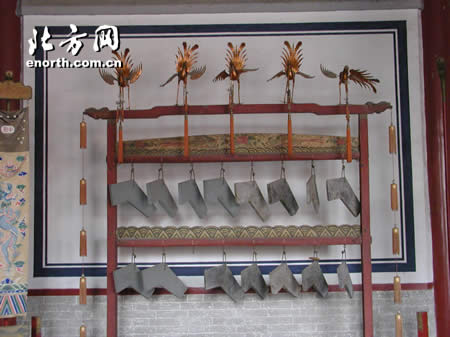
Bianqing
From Wikipedia, the free encyclopedia


The bianqing (simplified Chinese: 编磬; traditional Chinese: 編磬; pinyin: biān qìng) is an ancient Chinese musical instrument consisting of a set of L-shaped flat stone chimes, played melodically. The chimes were hung in a wooden frame and struck with a mallet. Along with the bronze bells called bianzhong, they were an important instrument in China's ritual and court music going back to ancient times.
A similar instrument was imported to Korea, where it is called pyeongyeong and still used in Korean court and ritual music.
[edit] External links
[edit] See also
| Traditional Chinese musical instruments | ||
|---|---|---|
| █ Silk (string): Plucked: Guqin • Se • Guzheng • Konghou • Pipa • Sanxian • Ruan • Liuqin • Yueqin • Qinqin • Duxianqin █ Bowed: Huqin • Erhu • Zhonghu • Gaohu • Banhu • Jinghu • Erxian • Tiqin • Yehu • Tuhu • Jiaohu • Sihu • Sanhu • Zhuihu • Zhuiqin • Leiqin • Dihu • (Xiaodihu • Zhongdihu • Dadihu) • Gehu • Diyingehu • Laruan • Matouqin • Yazheng █ Struck: Yangqin • Zhu | ||
| █ Bamboo (woodwind): Flutes: Dizi • Xiao • Paixiao • Koudi █ Oboes: Guan • Suona █ Free-reed pipes: Bawu • Mangtong | ||
| █ Gourd (woodwind): Sheng • Yu • Lusheng • Hulusi • Hulusheng | ||
| █ Percussion: Wood: Muyu • Guban █ Stone: Bianqing █ Metal: Bianzhong • Fangxiang • Luo • Yunluo █ Clay: Xun █ Hide: Daigu • Bangu • Paigu • Tanggu | ||
| █ Others: Gudi • Lusheng • Kouxian | ||
 |
This Chinese music article is a stub. You can help Wikipedia by expanding it. |