Talk:Bernhard Riemann
From Wikipedia, the free encyclopedia


[edit] Proper name
He should perhaps be referred to by his more common name of "Georg Riemann."
- Google has 11,000 hits for "Bernhard Riemann" -Georg and only 700 for "Georg Riemann". -- Curps 23:20, 16 Jul 2004 (UTC)
[edit] quaternions and vectors
Perhaps some mention of his work regarding quaternions and vectors should be mentioned 64.161.172.140 02:14, 13 Feb 2004 (UTC)
[edit] extraordinary to ordinary
"He was promoted an extraordinary professor at the University of Göttingen in 1857 and became an ordinary professor in 1859." I would like an explanation of why he went from extraordinary to ordinary. This sentence makes it seem like that's a promotion! -- Michael Currie, 29 Aug 2004
- I don't know what the case was but I interpret this sentence that from a temporary job he deserved a regular one. I don't see a reason to change it. ~~helix84 00:31, 5 October 2005 (UTC)
-
- "Ordentlicher Professor" (ordinary professor) is/was a more senior grade of university professor than "Außerordentlicher Professor" (extraordinary professor) in German-speaking countries (these titles are defunct in Germany now but AFAIK are still used in Austria) Tschild 11:12, 21 December 2005 (UTC)
[edit] Pronunciation
How do you say this guy's name? Is it like ree-man or riy-man or what? The article should reflect this.
I think, regardless of the IPA notation, the pronounciation isn't 'REE mahn' but rather 'REE mun' or 'REE munn'. Perhaps the German 'a' between consonants doesn't comply with the English 'u' between consonants from a linguist's point of view, but to the intuitive point of view of a native German speaker, it fits just right. On the other hand, American or English people with the name ending -mann are pronunced 'man', too, so this pronunciation would add to integrity.
[edit] Mystery Finally Solved
- "All of the forces were just effects caused by the crumpling or warping of hyperspace." This is the final answer. The world must be satisfied with this metaphor and is thereby excused from further thinking about the nature of physical dynamics. Of Course! It's merely wrinkled hyperspace!
- "The metric tensor held the secret to the unification of physics." Now, at last, we know that all natural dynamics are described by Riemann's metric tensor. That wasn't so difficult after all, now was it?. One wonders why it took so long for humanity to arrive at this simple and easy result.Lestrade 03:07, 18 February 2006 (UTC)Lestrade
[edit] Removal of spirited language
In two same session edits Lestrade has edited out some text that I personally had found very stimulating, being new to the topic of Riemannian geometry. Since I was disheartened to see these edits and because I feel that the deleted text would have an inspirational value (if they are in fact accurate) on others who are easily discouraged by mathematics I wish to suggest that the following passages be reinstated.
In connection with a lecture Riemann delivered in 1854 this sentence was deleted: "It was, without any doubt, one of the most important public lectures in the history of mathematics."
Then Lestrade, citing POV infraction. deleted this: "Like many of the most beautiful and fundamental theories of physics and mathematics, such as E = mc2, Riemann's great lecture is very easy to understand." and "this theorem is very easy to analyse".
While NPOV is important, it ought not get in the way of allowing encouraging language relating to the assimilation of advanced technical material when (and if) the statements in question are in fact accurate. From Lestrade's user page I cannot ascertain whether he/she might seem to have any mathematical skills making him/her suited to determine that the statements are factually incorrect. If the ubject had been of a not so technical nature I would be much more inclined to go along with the rigorous policy interpretation wielded in this case.
I feel the deletions were unwarranted and would like to see one, two or all three reverted unless some information that they are inaccurate appears. meco 20:09, 22 February 2006 (UTC)
-
-
- Meco, it seemed to me that calling a lecture, "without any doubt, one of the most important lectures in the history of mathematics" was the result of a subjective, personal judgment. Also, to call lectures and theorems "easy to understand" and "easy to analyze" is likewise one man's opinion. It is my subjective opinion that encyclopedia articles should express views that are agreed upon by general convention and are close to being objective. Your judgments may be correct, but they seem to be your own valuations. If you think that they are not mere enthusiasm, then you can put them back, or I will do it for you.Lestrade 20:28, 22 February 2006 (UTC)Lestrade
-
-
-
- I'm not competent to evaluate their degree of unbias. All I know is they triggered within me an eagerness to go deeper into the matter. That is undisputably good. In a way acting as a heuristic. We can await other opinions on this. Perhaps a rewrite of said excerpts would help. meco 09:40, 23 February 2006 (UTC)
-
-
-
-
- I'm a huge fan of Riemann, and I vote to leave them out. Such comments can have the opposite effect as well. If you browse through Wikipedia and read over and over that this and that is "without any doubt, one of the most important" something or others, you tend to shirk away from it as an overly obvious ploy for attention. These statements are biased opinions and add no value to the article.
-
-
[edit] Metric tensor illustration
I like the picture, but I'm not sure it's 100% clear when taken together with the text accompanying it, which states that you need ten numbers to describe the space. The diagram has 16 separate gij components. Those in the know understand the symmetry involved but it's not immediately apparent as it currently stands. (I don't know whether it's easiest to fix it in the diagram at the loss of precision about the ordering of indices, or in the text with a bit of extra explanation.) --Bth 14:44, 31 March 2006 (UTC)
[edit] Trigonometric series
The article references trigonometric series that are not Fourier series, but trigonometric series directly refers to Fourier series. Is there a reason? As a note, I have not entirely read the Fourier series page, but still...it seems a little suspect. JustPlainUncool
[edit] Page rendering problem in Firefox 1.5.0.7 browser
I don't know if this is the proper place to say this, but I'm being bold ;-)
At full screen width, the last two lines under the paragraph "Higher dimensions" are displayed on my browser as:
" ... the properties of a manifold, no matter how distorted it is. This is the famous metric
tensor."
The last word "metric" is covered by the diagram on the right titled "Riemann metric tensor." If I narrow the window width of the browser, one line still goes behind the diagram at its top, but the following lines 'wrap' properly and end just to the left of the diagram. I have no idea offhand if it's a problem with this article only (and thus fixable with some sort of editing), with Firefox (I'm running the latest, 1.5.0.7), or what. I just noticed it and can't offhand think of how to figure out whose problem it is.
I've made a couple of .jpg screen shots of this if anyone wants/needs to see them. --benb 04:21, 24 September 2006 (UTC)
[edit] Image caption
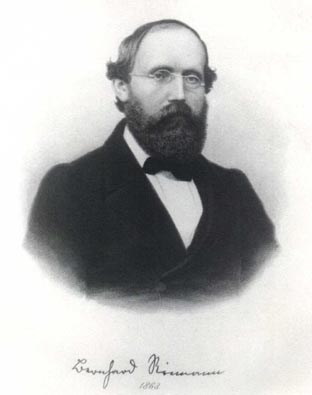
The image caption below Riemann's picture says "Bernhard Riemann, 1868", yet according to the text, he died in 1866. Any explanations? Oekaki 20:24, 5 July 2007 (UTC)
- Hi Oekaki, I added the caption to the image (already on page) when putting the infobox together.
- My research behind the image was not particularly in depth at the time. Basically the image was (is) stored in Wikimedia Commons with a link to a fuller version. I followed this link here: Wiki Riemann Full Image. Zooming in on the image the date at the bottom appears to be 1868, which I put into the caption.
- Following your query I have looked further to try and identify the original source for this image. I've not found the original but there are images, with the wider caption, present on these sites: Lueneburg University and Schiller Institute. Both of these show, by my reading, a 1863 date for the image. I'll amend this article caption to show that date.
- Of side note may be that there is a defaced version of Riemann's image, which can be seen here: Math Planet (Google Cache).
- A similar image to that used here is in an Encyclopaedia Britannica article. This also references a 1863 date - it is similar but not quite the same as the image used here. See in particular the downward angle of Riemann's glasses and bow tie.
- Further comment welcomed --- Asperal 22:11, 5 July 2007 (UTC)
-
- Thanks for the explanation and the correction! --- Oekaki 19:47, 6 July 2007 (UTC)
[edit] Date of death
I have seen sources conflict on the date of Riemann's death. One group (including St. Andrews, Britannica) give a date of July 20th.
However the New Catholic Dictionary and a Dedekind transcribed document quotes June 20th. The latter document includes, on the very last page, a claimed copy of the text on his gravestone - stating (my trans. to English) died in Selasca 20 June 1866. - assuming I have interpreted the German correctly. Please correct me if I have misunderstood either text or context.
Is anyone able to confirm the correct date? --- Asperal 22:39, 5 July 2007 (UTC)
- I think July 20th is the most probable. The text on the grave in the document by Dedekind may have been transcribed wrongly, because it says in the same document (last page, line 6) that Riemann was still alive on June 28th. Perhaps it's worthwhile to see the original. -- Jitse Niesen (talk) 21:14, 6 July 2007 (UTC)
[edit] WikiProject class rating
This article was automatically assessed because at least one WikiProject had rated the article as start, and the rating on other projects was brought up to start class. BetacommandBot 03:49, 10 November 2007 (UTC)
[edit] Multiple Grammar Changes
Hi all. I just wanted you to know that I'm not a troll. I just saw some grammar that could be better. Sorry for the multiple edits in a row. Monkeypox37 (talk) 06:09, 23 November 2007 (UTC)
[edit] middle life
I have no biographical material on hand, so I would like to ask those who know it better: In the following:
"In high school, Riemann studied the Bible intensively, but his mind often drifted back to mathematics. He even tried to prove mathematically the correctness of the book of Genesis."
1. What do we mean by "high school"? Do we mean "Gymnasium"?
2. "To prove mathematically the correctness" - What exactly does that mean? What does "correctness" mean? Should it read "consistency"? (I.e. what exactly was he doing?)
Thanks. Hillgentleman (talk) 23:38, 7 December 2007 (UTC)