Image:Arsia Mons PIA03948.jpg
From Wikipedia, the free encyclopedia
Size of this preview: 362 × 599 pixels
Full resolution (777 × 1,286 pixels, file size: 171 KB, MIME type: image/jpeg)

| This is a file from the Wikimedia Commons. The description on its description page there is shown below.
|
| Description |
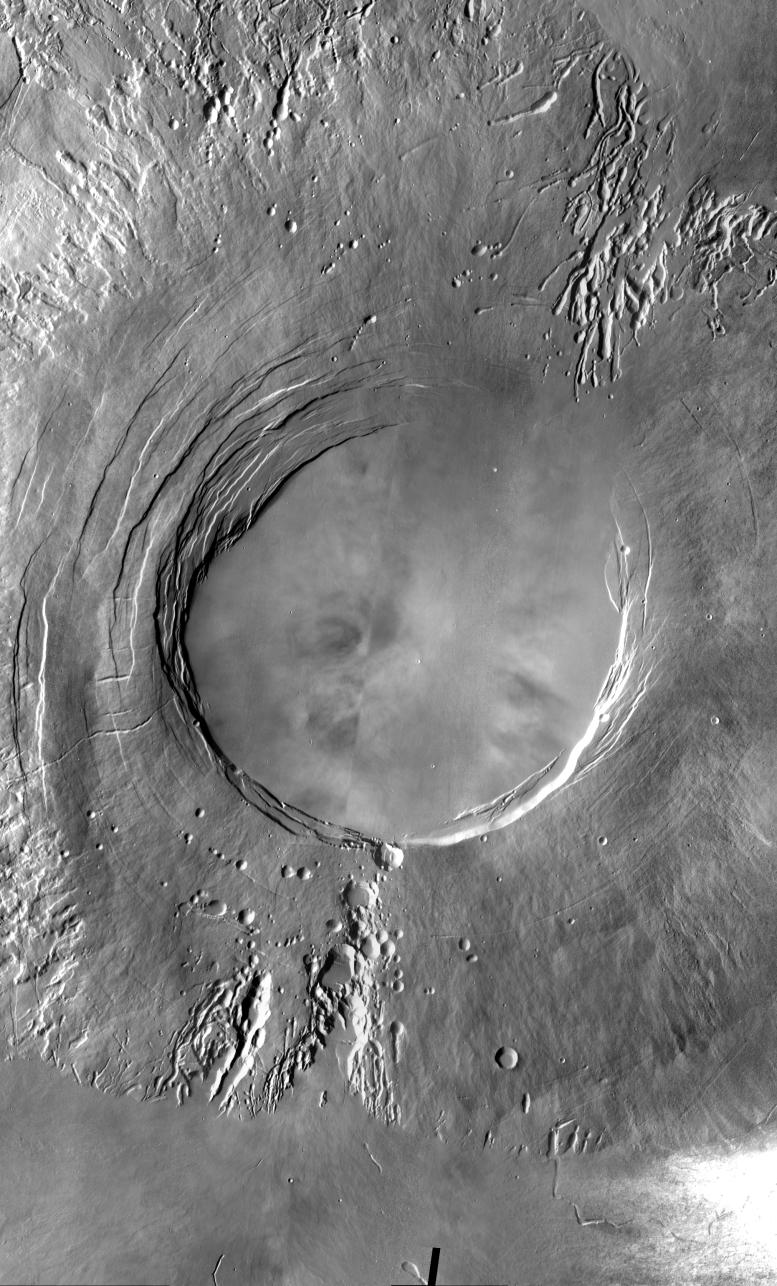
Mosaic image of en:Arsia Mons on en:Mars Original Caption Released with Image: Arsia Mons is the southernmost of the en:Tharsis volcanoes. It is 270 miles in diameter, almost 12 miles high, and the summit caldera is 72 miles wide. For comparison, the largest volcano on Earth is en:Mauna Loa. From its base on the sea floor, Mauna Loa measures only 6.3 miles high and 75 miles in diameter. The image here is a mosaic of several daytime IR images. The indentations on the SW and NE sides align with the en:Pavonis Mons and en:Ascreaus Mons to the NE. This may indicate a large fracture/vent system was responsible for the eruptions that formed all three volcanoes. Note: this THEMIS visual image has not been radiometrically nor geometrically calibrated for this preliminary release. An empirical correction has been performed to remove instrumental effects. A linear shift has been applied in the cross-track and down-track direction to approximate spacecraft and planetary motion. Fully calibrated and geometrically projected images will be released through the Planetary Data System in accordance with Project policies at a later time. NASA's en:Jet Propulsion Laboratory manages the 2001 en:Mars Odyssey mission for NASA's Office of Space Science, Washington, D.C. The Thermal Emission Imaging System (THEMIS) was developed by en:Arizona State University, Tempe, in collaboration with Raytheon Santa Barbara Remote Sensing. The THEMIS investigation is led by Dr. en:Philip Christensen at Arizona State University. Lockheed Martin Astronautics, Denver, is the prime contractor for the Odyssey project, and developed and built the orbiter. Mission operations are conducted jointly from Lockheed Martin and from JPL, a division of the en:California Institute of Technology in Pasadena. Image Credit: NASA/JPL/Arizona State University The uploader believes that the use of this image on Wikipedia with the image credit as given above complies with NASA's image use policy stated at [1]. |
|||||
|---|---|---|---|---|---|---|
| Source |
Originally from en.wikipedia; description page is/was here. |
|||||
| Date |
2006-07-17 (original upload date) |
|||||
| Author |
Original uploader was Cuppysfriend at en.wikipedia |
|||||
| Permission (Reusing this image) |
|
|||||
| Other versions | Image:Arsia Mons.jpg |


[edit] Original upload log
(All user names refer to en.wikipedia)
- 2006-07-17 16:56 Cuppysfriend 777×1286×8 (174609 bytes) Mosaic image of [[Arsia Mons]] on [[Mars]] Original Caption Released with Image: Arsia Mons is the southernmost of the [[Tharsis]] volcanoes. It is 270 miles in diameter, almost 12 miles high, and the summit caldera is 72 miles wide. For comparison, th
File history
Click on a date/time to view the file as it appeared at that time.
| Date/Time | Dimensions | User | Comment | |
|---|---|---|---|---|
| current | 03:03, 11 August 2007 | 777×1,286 (171 KB) | Webaware | ({{Information |Description=Mosaic image of en:Arsia Mons on en:Mars Original Caption Released with Image: Arsia Mons is the southernmost of the en:Tharsis volcanoes. It is 270 miles in diameter, almost 12 miles high, and the summit calde) |


