Aplomado Falcon
From Wikipedia, the free encyclopedia
| Aplomado Falcon | ||||||||||||||
|---|---|---|---|---|---|---|---|---|---|---|---|---|---|---|
 |
||||||||||||||
| Conservation status | ||||||||||||||
| Scientific classification | ||||||||||||||
|
||||||||||||||
| Binomial name | ||||||||||||||
| Falco femoralis Temminck, 1822 |
||||||||||||||
| Synonyms | ||||||||||||||
|
See text. |

The Aplomado Falcon, Falco femoralis, is a medium-sized falcon of the Americas. The species' largest contiguous range is in South America, but not in the deep interior Amazon Basin. It was long known as Falco fusco-coerulescens or Falco fuscocaerulescens, but these names are now believed to refer to the Bat Falcon (AOU 1948).
Contents |
[edit] Description
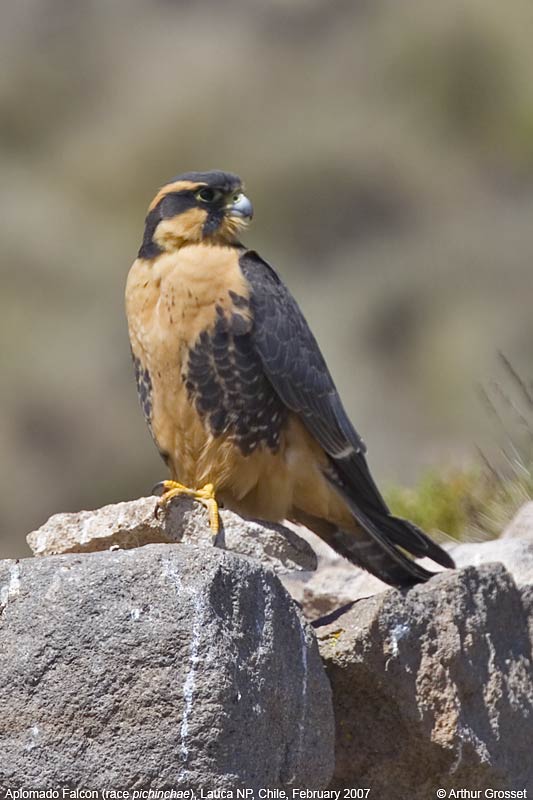
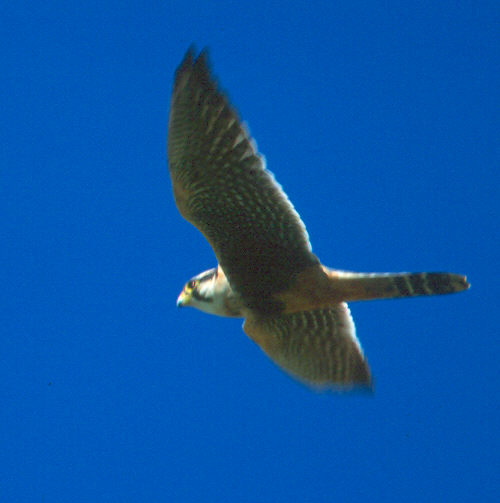
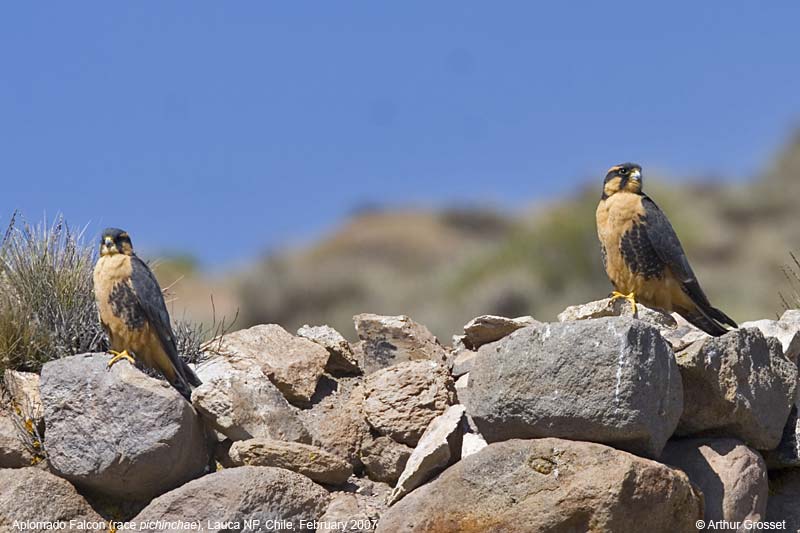
It is very slender, long-winged, and long-tailed, the size of a small Peregrine Falcon (length of 30–40 cm or 12–16 inches, average wingspan of about 90 cm or 36 in) but only half the weight (250–475 g or 9–17 oz). This resemblance in shape to the hobbies accounts for the former name Orange-chested Hobby. "Aplomado" is an unusual Spanish word for "lead-colored", referring to the blue-gray areas of the plumage. Spanish names for the species include Halcón fajado and Halcón aplomado.


In adult birds, the upperparts are dark blue-gray, as is much of the head, with the usual falcon "moustache" contrasting sharply with the white throat and eyestripe. The upper breast continues the white of the throat; there are black patches on each side of the lower breast that meet in the middle; the belly and thighs, below the black patches, are light cinnamon. The tail is black with narrow white or gray bars. Juvenile birds are very similar, but their upperparts and belly band are blackish brown, the chest is streaked with black, the white on the head and breast is buffy, and the cinnamon on the underparts is paler.
It may be confused with the Bat Falcon and the Orange-breasted Falcon, which have similar white-black-rust patterns below, but those species are built more like Peregrines and have solidly blackish heads and darker rufous bellies. These two species are generally considered to belong to the same lineage as the Aplomado Falcon. Two other Falco species of the Americas, the Merlin and American Kestrel, seem to be closer to the Aplomado group than most other falcons, but the relationships of all these lineages are fairly enigmatic. All that can be said with some certainty is that they diverged as part of an apparently largely western Holarctic radiation in the Late Miocene, probably around 8–5 million years ago.[1]
The Aplomado Falcon's habitat is arid grasslands, savannahs, and marshes. It feeds on insects and small vertebrates, especially birds, and is often seen soaring at twilight hunting insects and eating them on the wing. It also hunts at fields being burned, at which many birds of this species may gather. In Brazil, Aplomado Falcons have been observed following Maned Wolves and chasing birds that the wolves flush (Silveira et al. 1997).
[edit] Range, history, status
It ranges from northern Mexico and Trinidad locally to southern South America, but has been extirpated from much of its range, including northern and central Mexico except for a small area of Chihuahua. Until the 1950s it was found in the extreme southwestern United States, and reintroduction efforts are under way in West and South Texas. It may be returning naturally to southern New Mexico, as it was seen there every year from 2000 to 2005 and bred successfully in 2002[2]. Expansion of the reintroduction program to that area has met with criticism, because technically, all Aplomado Falcons in New Mexico are now classified as part of an "experimental" (reintroduction) population.
[edit] Status
As such, while they are still legally protected from hunting, they are not protected by Endangered Species Act requirements to preserve habitat and the like. It is believed that mainly habitat destruction caused the species' (near-)disappearance from the US and hinders reestablishment of a wild breeding population; thus, a coalition of environmental groups is attempting to have full protection restored so as not to jeopardize the success of the expanding wild population and the reintroduction efforts (Associated Press 2006).
[edit] Footnotes
- ^ See Helbig et al. (1994), Wink et al. (1998), Griffiths (1999), Groombridge et al. (2002), Griffiths et al. (2004)
- ^ Forest Guardians: Aplomado Falcon. Version of ????-???-??. Retrieved 2007-AUG-12.
[edit] References
- American Ornithologists' Union (1948): Twenty-third supplement to the American Ornithologists' Union check-list of North American birds. Auk 65(3): 438-443. PDF fulltext
- Associated Press (2006): Groups File Suit Over Endangered Falcon Protections. 2006-SEP-13. Retrieved 2007-AUG-12.
- BirdLife International (2004). Falco femoralis. 2006 IUCN Red List of Threatened Species. IUCN 2006. Retrieved on 11 May 2006. Database entry includes a brief justification of why this species is of least concern.
- Helbig, A.J.; Seibold, I.; Bednarek, W.; Brüning, H.; Gaucher, P.; Ristow, D.; Scharlau, W.; Schmidl, D. & Wink, Michael (1994): Phylogenetic relationships among falcon species (genus Falco) according to DNA sequence variation of the cytochrome b gene. In: Meyburg, B.-U. & Chancellor, R.D. (editors): Raptor conservation today: 593-599. PDF fulltext
- Griffiths, Carole S. (1999): Phylogeny of the Falconidae inferred from molecular and morphological data. Auk 116(1): 116–130. PDF fulltext
- Griffiths, Carole S.; Barrowclough, George F.; Groth, Jeff G. & Mertz, Lisa (2004): Phylogeny of the Falconidae (Aves): a comparison of the efficacy of morphological, mitochondrial, and nuclear data. Molecular Phylogenetics and Evolution 32(1): 101–109. doi:10.1016/j.ympev.2003.11.019 (HTML abstract)
- Groombridge, Jim J.; Jones, Carl G.; Bayes, Michelle K.; van Zyl, Anthony J.; Carrillo, José; Nichols, Richard A. & Bruford, Michael W. (2002): A molecular phylogeny of African kestrels with reference to divergence across the Indian Ocean. Molecular Phylogenetics and Evolution 25(2): 267–277. doi:10.1016/S1055-7903(02)00254-3 (HTML abstract)
- Howell, Steven N. G. & Webb, Sophie (1995): A Guide to the Birds of Mexico and Northern Central America. Oxford University Press, Oxford & New York. ISBN 0-19-854012-4
- Silveira, Leandro; Jácomo, Anah T. A. ; Rodrigues, Flávio H. G. & Crawshaw, Peter G. Jr. (1997): Hunting Association Between the Aplomado Falcon (Falco femoralis) and the Maned Wolf (Chrysocyon brachyurus) in Emas National Park, Central Brazil. Condor 99(1): 201–202. PDF fulltext
- Stiles, F. Gary & Skutch, Alexander Frank (1989): A guide to the birds of Costa Rica. Comistock, Ithaca. ISBN 0-8014-9600-4
- Wink, Michael; Seibold, I.; Lotfikhah, F. & Bednarek, W. (1998): Molecular systematics of holarctic raptors (Order Falconiformes). In: Chancellor, R.D., Meyburg, B.-U. & Ferrero, J.J. (editors): Holarctic Birds of Prey: 29-48. Adenex & WWGBP. PDF fulltext
[edit] External links

- Page on the Aplomado Falcon from the Peregrine Fund with photographs
- ITIS
- Photo-High Res; Article & Synopsis of Species arthurgrosset.com Photo-2(flight), Photo-3
- Aplomado Falcon photo gallery VIREO
- Aplomado Falcon videos on the Internet Bird Collection