User:Angus Lepper/Personal computer
From Wikipedia, the free encyclopedia
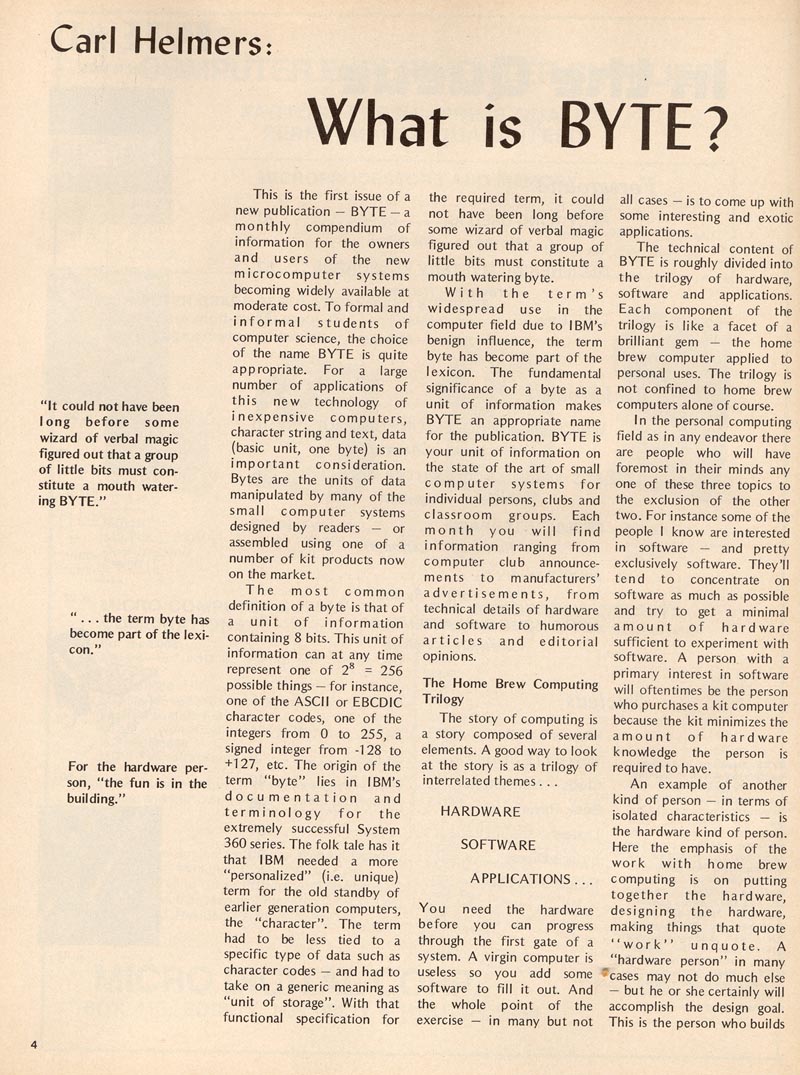
A personal computer (PC) is a microcomputer which — due to a combination of size, price and performance — is suitable for use by individuals for a range of purposes. It seems the name personal computer was first used in an advertisement for "the new Hewlett-Packard 9100A personal computer" [emphasis added] in an October 4, 1968 issue of Science. However, the OED credits BYTE with coining the term in its opening issue in May, 1976. [1][2]
Contents |
[edit] History
[edit] Applications
[edit] Types
The range of personal computers may be categorized roughly according to size and portability:
- Desktops
- Laptops (notebooks)
- Personal digital assistants (PDAs)
- Tablets
Also, more generally:
[edit] Configuration
- This section pertains to the desktop computer. For other configurations, please see more specific articles.
[edit] Components


A typical, generic modern desktop computer system will comprise:
- case
- power supply unit (PSU; usually supplied with the case)
- motherboard
- central processing unit (CPU; also referred to as the processor; sold in conjunction with a cooling system, typically a heatsink and/or fan, although liquid cooling is sometimes encountered)
- main memory
- mass storage (typically a hard disk drive, although solid state memory is entering the market)
- keyboard
- mouse (or other pointing device, such as a trackball)
- monitor
With the rise of the Internet and increase in popularity of home networks, many personal computer systems now also include a network interface card (NIC).
[edit] Peripherals
[edit] Motherboard
[edit] Central processing unit
[edit] Main memory
- See also: Random access memory
[edit] Mass storage
[edit] Input/Output
[edit] References
- ^ Clark, Aaron (December, 2000), “The First PC”, Wired, <http://www.wired.com/wired/archive/8.12/mustread.html?pg=11>
- ^ Helmer, Carl (May, 1976), “What is BYTE?”, BYTE: 4, <http://www.digibarn.com/collections/mags/byte-sept-oct-1975/one/4.jpg>