Image:Amber Fort, Jaipur, c1858.jpg
From Wikipedia, the free encyclopedia
No higher resolution available.
Amber_Fort,_Jaipur,_c1858.jpg (740 × 475 pixels, file size: 86 KB, MIME type: image/jpeg)

| This is a file from the Wikimedia Commons. The description on its description page there is shown below.
|
[edit] Summary
| Description |
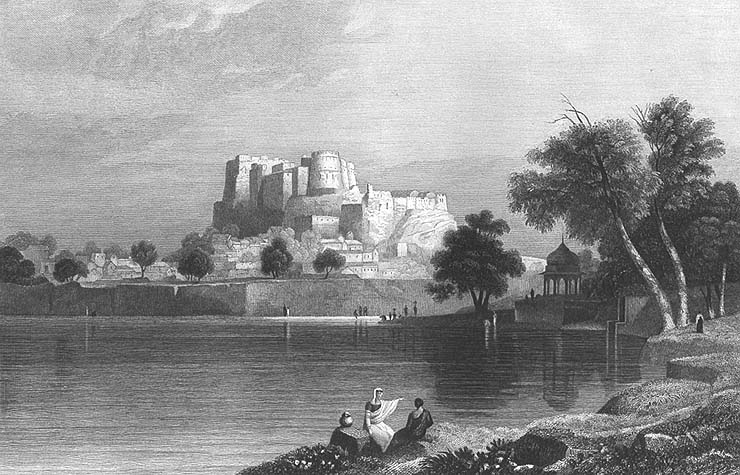
View of Amber Fort, across Maotha lake, AmberJaipur, c1858. |
||
|---|---|---|---|
| Source |
India, AMBER FORT JAIPUR ~ Old 1858 - FORTRESS OF SHUHUR, JEYPORE, RAJPOOTANA |
||
| Date |
1858 |
||
| Author |
Artist: W. Purser; Engraver: Percy Heath |
||
| Permission (Reusing this image) |
|
[edit] Licensing:
 |
This image (or other media file) is in the public domain because its copyright has expired. This applies to the United States, Canada, the European Union and those countries with a copyright term of life of the author plus 70 years.
العربية | Asturianu | Български | Català | Česky | Dansk | Deutsch | English | Ελληνικά | Esperanto | Español | Euskara | فارسی | Français | Gaeilge | Galego | עברית | हिन्दी | Bahasa Indonesia | Italiano | 日本語 | 한국어 | Kurdî / كوردی | Lietuvių | Magyar | Nederlands | Norsk (nynorsk) | Bahasa Melayu | Polski | Português | Română | Русский | Slovenčina | Slovenščina | Shqip | Suomi | Sámegiella | Türkçe | 中文(简体) | 中文(繁體) | 粵語 | +/- |

[edit] FROM THE ORIGINAL DESCRIPTION
The city of Jeypoor-capital of the Rajpoot state of similar name, one of the central provinces of India-is situated about 150 miles south-west of Delhi, in lat. 26° 56' N., long. 75° 40' E.; and is considered to be one of the handsomest towns in Hindoostan. Spacious streets, lined with magnificent edifices, intersect each other at right angles; and the palace-fortress of Shuhur, or Urneer, which rises boldly on a steep rocky eminence, and commands the entire place, is encompassed by a line of fortifications four miles in extent, and rich in those picturesque features that occasionally break the level monotony of the plains of Central India. The fortress was considered, by the late Bishop Heber, as not inferior to Windsor Castle ; and it certainly presents an object of feudal grandeur that carries the imagination of the European stranger back to the ages of chivalry and romance. Jeypoor, in addition to its being the chief mart in the north of India for the horses brought from Cabool and Persia, is also a grand emporium for diamonds and other precious gems, which are procured with little trouble or expense in the rocky districts of the principality. The garnets so obtained are particularly beautiful; and amethysts and other gems sell at comparatively low prices. Occasionally, great bargains may be obtained of the dealers in pearls, as .the common prices are much below those demanded in places more remote from the commerce of Persia.
Some historical traditions connected with the fortress of Shuhur are interesting, and strikingly illustrate the political influence that has been retained by females in provinces which have never been thoroughly subjected to the jealous domination of Mogul rulers. The late (or present) sovereign of Jeypoor was a surreptitious child, placed upon the throne wholly by the intrigues of the artful and clever woman who professed to be his mother. She had been a principal favourite of the former rajah, but was childless; and, at his death, being anxious to preserve to herself the share she had obtained in the government of the country, she imposed upon the chief officers the offspring of one of her domestics, as her own son by the rajah, born in due time after his decease, and consequently heir to the musnud. Aided by the influence of a chief of high rank and popularity, she then contrived to get herself appointed to the regency, with the title of Maha Ranee; and, as soon afterwards as practicable, she introduced the child at a banquet in the castle of Shuhur, where a large proportion of the nobles of Rajast'han were invited to attend-presenting the infant as the future sovereign of Jeypoor. By this means she secured the recognition of the child as rightful heir to the throne; inasmuch, as after the nobles had eaten rice with it in that character, the imposture, if ever discovered, would never be made a subject of dispute. The real mother of the infant was a Pariah, (or sweeper)-a class held in the utmost abhorrence by the high-born Hindoos, who' would have considered themselves polluted if a child of such an outcast race had even touched their garments. Had the true parentage of the infant been revealed at any period subsequent to the feast of recognition, many heads of Rajpoot houses must have shared in the inevitable degradation to which he would have been subjected', since all who had dipped their hands in the same dish with him would have lost caste throughout India; and, consequently, if the worst should happen in respect to discovering the imposture, their silence and co-operation were effectually secured. The ascendancy thus gained by the ambitious intriguant at length became irksome to the nobles, but the times were not favourable for resistance to her authority, and the fortunate descendant of the most degraded and despised race among the populations of the East, remained in tranquil possession of the high rank to which he had been elevated by his ambitious patroness, and in due time became the undisturbed rajah of Jeypoor.
File history
Click on a date/time to view the file as it appeared at that time.
| Date/Time | Dimensions | User | Comment | |
|---|---|---|---|---|
| current | 17:55, 24 May 2008 | 740×475 (86 KB) | Abhishekjoshi | ({{Information |Description=Amber Fort, Jaipur, c1858. |Source=[http://cgi.ebay.com/India-AMBER-FORT-JAIPUR-Old-1858-Landscape-Art-Print_W0QQitemZ280169215188QQihZ018QQcategoryZ360QQssPageNameZWDVWQQrdZ1QQcmdZViewItem India, A) |


