Talk:Abundance of the chemical elements
From Wikipedia, the free encyclopedia


Parts of this article are taken from the public domain source at http://geopubs.wr.usgs.gov/fact-sheet/fs087-02/ Please update as needed.
I'm debating the phrasing I use with regard to argon in the bottom. I know they get helium out of natural gas wells, and it would surprise me if argon isn't found in the crust at all; I know it's generally produced by distillation of liquid air, so I doubt it's a major component of the crust (since it'd be cheaper to get it there if it were), but I wonder if that's an error in the original page. Argon must occur between the grains of sandstone in greater abundance than some elements that are listed -- Pakaran 13:18, 8 Dec 2003 (UTC)
On another note, if anyone wants to make a list for the universe, see [1], which is the best source I could find. I get the following log10 figures for their numbers, keeping 3 digits, which is more than they do:
- H 4.08
- He 3.45
- O 1.20
- N .90
- C .48
- Fe .42
- Si 0 exact
- Mg -.051
- S -.481
- Ni -.678
- Al -1.05
- Ca -1.15
- Na -1.34
- Cl -1.60
Pakaran 13:30, 8 Dec 2003 (UTC)
- The standard abundance distribution used for the Sun in the astrophysics community is derived from one by Anders & Grevesse, Geochimica et Cosmochimica Acta (ISSN 0016-7037), vol. 53, Jan. 1989, p. 197-214. There have been several improvements (some minor, some important) to that distribution since 1989. Those are normally on an element-by-element basis, which are published in normal refereed journals. However, new comprehensive tables for all elements -- which is what I'd like to insert into Wikipedia -- tend to get published only in conference proceedings and are difficult to find. This standard abundance distribution is derived from both lab analysis of primitive meteorites and spectroscopic analysis of the Sun. BSVulturis 19:32, 15 December 2006 (UTC)
Could someone add some consideration on the abundance of elements on plants, animals ans specially the human body? Or, if you think here is not the place, add a link to the proper article?
Rend 01:47, 10 August 2005 (UTC)
Contents |
[edit] Human Composition
I've found about the human body, I don't know how up to date the source, sorry, I can't update right now, im in a hurry, could someone add this for me?
Most of the human body is made up of water, H2O, with cells consisting of 65-90% water by weight. Therefore, it isn't surprising that most of a human body's mass is oxygen. Carbon, the basic unit for organic molecules, comes in second. 99% of the mass of the human body is made up of just six elements: oxygen, carbon, hydrogen, nitrogen, calcium, and phosphorus.
- Oxygen (65%)
- Carbon (18%)
- Hydrogen (10%)
- Nitrogen (3%)
- Calcium (1.5%)
- Phosphorus (1.0%)
- Potassium (0.35%)
- Sulfur (0.25%)
- Sodium (0.15%)
- Magnesium (0.05%)
- Copper, Zinc, Selenium, Molybdenum, Fluorine, Chlorine, Iodine, Manganese, Cobalt, Iron (0.70%)
- Lithium, Strontium, Aluminum, Silicon, Lead, Vanadium, Arsenic, Bromine (trace amounts)
Found at: http://chemistry.about.com/cs/howthingswork/f/blbodyelements.htm
Reference: H. A. Harper, V. W. Rodwell, P. A. Mayes, Review of Physiological Chemistry, 16th ed., Lange Medical Publications, Los Altos, California 1977.
Rend 03:07, 13 September 2005 (UTC)
I'm having a little trouble with this list. I have to assume these chemists know more than I do, but simple logic makes me wonder how hydrogen can be 10% of the body? If most of the body is water (65 to 90%) and water is made up of two hydrogen atoms and one oxygen atom, how can there be more oxygen (65%) than hydrogen (10%) in the body? Something's not adding up.
Hillsc 04:49, 9 September 2006 (UTC)
The list is by mass. Oxygen atoms are sixteen times as massive as hydrogen atoms.--Syd Henderson 01:22, 16 September 2006 (UTC)
[edit] But how many elements?
This article discusses relative abundance, but not absolute abundance. How many *naturally occurring* elements are on the earth? In the universe? What are their names?
Norm
Naturally now present on Earth are all the stable elements, plus those with isotopes with half-lives of roughly a billion years or more, plus some small amounts of the unstable decay products of those. That means all the elements up lead (excepting the pure-unstable elements Tc and Pm), plus Th and U (which are unstable but with billion-year half-lives), and finally plus tiny proportions of the elements between Pb and U (the decay products of U and Th). Human activity in the Atomic Age has added traces of others. BSVulturis 19:13, 15 December 2006 (UTC)
As for which these are on the periodic table, they are all elements with numbers less than that of uranium.--Scorpion451 01:16, 13 July 2007 (UTC)
[edit] Diagrams
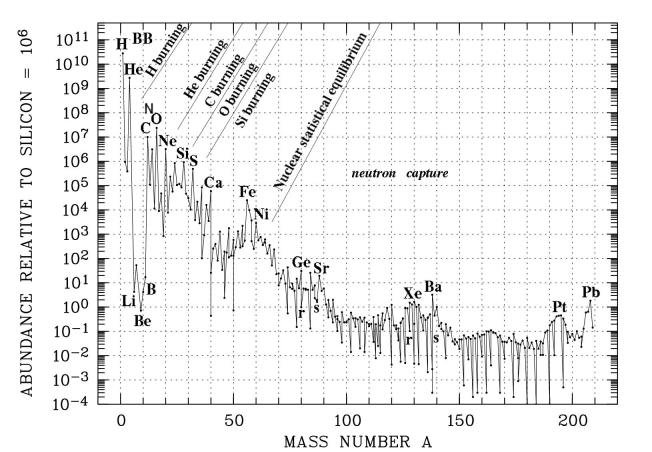
- http://universe-review.ca/I14-08-elements.jpg A picture, like this were useful (universe).
- http://rst.gsfc.nasa.gov/Sect20/A7.html On this page are not so nice diagrams (solar system, earth, sun), but it is on NASA page, these can be public domain.
--Harp 15:52, 19 January 2007 (UTC)
[edit] Missing link/article
The section Abundance of elements in the Universe speaks about (repulsive) dark energy and (attractive) dark matter. That's fine with me, and measuring their amounts probably affects what abundance of different chemical elements we may expect in the Universe. But for anyone not accustomed to the concepts dark energy and dark matter it would be appropriate with a {{main|dark matter}} and a {{main|dark energy}} or so, to explain the concepts. Rursus declamavi; 13:20, 14 February 2007 (UTC)
- OK, those links exist, but I'm still discontent: it should be clearer how dark thingies affect the abundance of chemical elements. I'll take a look later, when my template-for-star-constellations are fully implemented. L8R!! Rursus declamavi; 13:22, 14 February 2007 (UTC)
[edit] Abundance of the chemical elements in organisms
That table doesn't look correct, if "number of atoms for a thousand carbon atoms" is true. The data may be correct if it is "mass per 1000 mass units of carbon". Icek 15:37, 9 March 2007 (UTC)
- Icek is right, once I realized he wasn't objecting to the trivially true carbon figure of 1000. An organism is mostly H2O, therefore there should be more hydrogen atoms than oxygen atoms (but not more hydrogen mass than oxygen mass). Art LaPella 17:36, 9 March 2007 (UTC)
- You are of course correct, and I completely forgot the water ;). In the dry mass, there should also be more hydrogen than carbon atoms (in carbohydrates: most common monosaccharides are C6H12O6, and chained the formula is effectively C6H10O5; in fats: the most common fatty acids contain about twice as much H as C; in proteins: 17 out of 20 amino acid rests contain more H than C). Icek 17:57, 11 March 2007 (UTC)
-
-
- While you are correct that the body contains quite a bit of hydrogen, compounds such as Phenols and polycyclic compounds(which contain multiple carbon rings connected, requiring fewer hydrogen atoms- these are especially common in neurochemicals and hormones) found in the body help make up some of the difference. Other large concentrations of carbon can be found in bone, connective tissues and keratin. The quantity on the chart may seem low, but also remember that the chart is by mass, and carbon weighs 12 times as much as hydrogen, before one considers that a significant portion is carbon 14 and so weighs 14 times as much.--Scorpion451 02:07, 13 July 2007 (UTC)
-
- "chart is by mass" - not according to the chart's labeling it isn't. Abundance of the chemical elements#Organisms is labeled "atoms of the element per 1000 atoms of carbon" and "Note that this "abundance" is not the same as mass-fraction, as different elements vary greatly in mass." The table is at least mismatched with its labeling. The atom-fraction (not mass fraction) abundance in organisms should be about 50% H, 25% C and 25% O according to [2]. Art LaPella 04:47, 13 July 2007 (UTC)
Ohhh, that chart, I was looking at the human body one. It is by ratio. Yes that chart is definatly way off. Thanks for drawing my attention to that, I know where to find more reliable numbers. See if I can't fix that.--Scorpion451 05:53, 13 July 2007 (UTC)
I couldn't find the chart I saw a while back on Nasa's website, so until someone can find the right numbers the chart should be removed from the page. I'm putting it here so we still have it, but it still needs to be corrected.--Scorpion451 rant 23:01, 29 July 2007 (UTC)
[edit] Organisms
The atom-fraction abundance of elements compared to carbon, expressed as atoms of the element per 1000 atoms of carbon* (taken from Mary K. Campbell, Shawn O. Farrell - Biochemistry)
| Element | in Organisms | in Universe |
|---|---|---|
| Hydrogen | 80 - 250 | 10000000 |
| Carbon | 1000 | 1000 |
| Nitrogen | 60 - 300 | 1600 |
| Oxygen | 500 - 800 | 5000 |
| Sodium | 10 - 20 | 12 |
| Magnesium | 2 - 8 | 200 |
| Phosphorus | 8 - 50 | 3 |
| Sulfur | 4 - 20 | 80 |
| Potassium | 6 - 40 | 0.6 |
| Calcium | 25 - 50 | 10 |
| Manganese | 0.25 - 0.8 | 1.6 |
| Iron | 0.25 - 0.8 | 100 |
| Zinc | 0.1 - 0.4 | 0.12 |
* Note that this "abundance" is not the same as mass-fraction, as different elements vary greatly in mass.
[edit] Parts per million vs. percent
The first table in the article lists element abundances in parts per million and the latter two, human body and ocean water compositions, are in percent. Is there a reason for the differing representations? --dinomite (talk) 19:42, 24 November 2007 (UTC)
[edit] "Orders of Magnitude" is misused
In the elements in the universe section, the statement:
"...; oxygen has abundance rank 3, but atomic number 8. All others are orders of magnitude less common. "
is incorrect. Oxygen is only about 2 times more common than the next element down (Carbon), not "orders of magnitude" which implies a factor of 100 or more. Perhaps what is mean is that H and He are orders of magnitude more abundant than other elements. If so, this should clarified. I will go ahead an change this to "substantially lower". Feel free to improve further
Substar (talk) 03:33, 31 March 2008 (UTC)Substar
[edit] Abundance of elements in Earth's crust Graph Sucks
See [[3]] —Preceding unsigned comment added by 99.233.80.254 (talk) 05:15, 4 June 2008 (UTC)
- I almost reverted the above as linkspam, but I think he wants us to search thru the "Featured Articles" for a criticism of the graph. Art LaPella (talk) 06:34, 4 June 2008 (UTC)