Talk:A Clockwork Orange (film)/Archive 1
From Wikipedia, the free encyclopedia

Merge?
A good portion of the text here is the same as the text for the book. I know that these two articles were originally together, then they were split (see Talk:A Clockwork Orange). But given the overlap, and given the fact that most novels that have been adapted into movies share information on both the book and the film, I think that this article should be merged back. gavindow 02:03, 17 November 2005 (UTC)
- I agree. Wahkeenah 02:07, 17 November 2005 (UTC)
-
- I disagree. I think there is too much information information to just merge the articles together. That said, the content that belongs with the movie needs to be segregated from that which belongs with the book and vice versa.
-
- Also, shouldn't this discussion be at Talk: A Clockwork Orange? That's where the discussion link from the merge template goes. At least for now I'll add a post to that page with a link here so people know where the discussion actually is. Theshibboleth 08:27, 18 November 2005 (UTC)
- I think the articles should stay split, and just the "Influences" section of the book be merged to the "Influences" section of the film, with a note and a link at the book page. Kusma (talk) 18:51, 20 November 2005 (UTC)
- Strong Oppose The book and the film are two different things. Merging them together will create a whole lot of confusion. --BadSeed 07:18, 21 November 2005 (UTC)
- Exactly. One should hope that the movie and book are similar, but they are still two different items, and therefore two different entries. It's the same reason why Braveheart and William Wallace don't share a page. R'son-W 18:58, 22 November 2005 (UTC)
- Strong Oppose Plenty of Wikiprecedent for separate articles for film & book (see The Maltese Falcon, for one of many examples). | Klaw Talk 19:17, 30 November 2005 (UTC)
- Oppose. Absolutely keep them separate. By all means link the two close together, but don't merge. Turnstep 02:51, 1 December 2005 (UTC)
- Oppose. And darnit I need to buy another copy of the book to check the editorial switches to which objects are in in the catlady fight. --Alf melmac 21:54, 4 January 2006 (UTC)
Cutting influences section instead of merging
I have cut the Influences sections out and merged both articles' Influences sections into Cultural references to A Clockwork Orange (Still needs cleanup). I hope this will help in keeping the articles about book and film reasonably clean and separate. Oh, and I am removing the merge tags. Kusma (talk) 05:55, 4 December 2005 (UTC)
Removed text
I removed this text until it can be properly formatted and included in the article:
- DISCUSSION:
- the film provokes thought regarding the decision making process that is instilled in so-called civilized people. "Bad" behaviour is discouraged through law, religion and shame. One could argue that these things were not properly instilled in Alex as he matured and thus he's not responsible for his actions. Rather his parents, the church and the government are.
- The film also draws attention to what happens when one tries to rule with an iron fist. Alex treats his droogies poorly (and later the police are shown abusing their power) so they will respect his power but they eventually rise up and overthrow him as leader of their gang. Point being: excersing power is important but maintaining the respect of your followers is equally important and if you wish to control people, you must combine fear with respect.
kmccoy (talk) 17:40, 31 December 2005 (UTC)
A Joke...
a joke gone to waste.... i shall remove it
"The film opens with a view of a small orange clock, with the time approaching 12:45 PM. In European versions of the film, we instead first see a hand grenade that explodes just as the film enters its first scenes."
Von Steuben 06:43, 13 January 2006 (UTC)
Recording of Beethoven's Ninth
Does anyone have a reference for Karajan's being the recording of Beethoven's Ninth? I have always heard that it was Ferenc Fricsay's Deutsche Grammophon recording. See this link Grover cleveland 08:56, 23 January 2006 (UTC)
- Have you listened to them both, side-by-side, to be sure? Wahkeenah 12:55, 23 January 2006 (UTC)
- No I haven't. But the link I posted is prima facie evidence that Fricsay's recording was used -- does anyone have any evidence that it was Karajan's? Grover cleveland 15:57, 23 January 2006 (UTC)
- You're assuming that the advertising website is telling the truth. Wahkeenah 16:16, 23 January 2006 (UTC)
-
-
- Perhaps you are talking of Suicide Scherzo, it doesn't resemble the SN.9. 71.50.152.33 05:45, 2 December 2006 (UTC)
-
Screenshots?
Does anyone else think that we should add a screenshot or two to the article? Wikipedia already has an image of Alex from the movie uploaded, so I don't understand why we wouldn't include that in the article. --Berserk798 20:01, 19 February 2006 (UTC)
registrry
does anyone know why this film hasn't been selected for preservation at the library of congress' national registry? i mean, it's pretty culturally significant. it was made in england, but it was made by an american director.
Side effect? Unintended?
I don't think that making Alex adverse to Beethoven's 9th was an "unintended side effect." It was a deliberate part of the Ludovico technique. Tommyt 14:09, 14 April 2006 (UTC)
~It was not intentional. When the song was found to make him uncomfortable, it was unethically used to punish him (but it was only a coincidence that Alex liked the Ninth Symphony and they chose to have it as the background score). It was not planned and I doubt that they thought that the relatively short exposure to it in that context would have had the effect it had. So it was an 'unintended side-effect'. 211.29.251.50 05:25, 21 April 2006 (UTC)
Quote of the sequence in the film:
ALEX (V.O.) It was the next day, brothers, and I had truly done my best, morning and afternoon, to play it their way and sit like a horrorshow co-operative malchick in the chair of torture, while they flashed nasty bits of ultra-violence on the screen; though not on the soundtrack, my brothers. The only sound being music. Then I noticed in all my pain and sickness what music it was that like cracked and boomed. It was Ludwig van, 9th symphony, 4th movement.
ALEX Stop it... stop it, please!!! I beg of you!!! It's a sin!!! It's a sin!!! It's a sin, please!!!
Brodsky leans forward and turns down the sound.
DR. BRODSKY What's all this about sin?
ALEX That!... Using Ludwig van like that! He did no harm to anyone. Beethoven just wrote music.
DR. BRANOM Are you referring to the background score?
ALEX Yes!!!
DR. BRANOM You've heard Beethoven before?
ALEX Yes!!!
DR. BRODSKY You're keen on music?
ALEX Yes!!!
DR. BRANOM (quietly) What do you think about that, Dr. Brodsky?
DR. BRODSKY (softly) It can't be helped. Here's your punishment element perhaps. The Governor ought to be pleased... I'm sorry, Alex, this is for your own good, you'll have to bear with us for a while.
...then later...
RUBINSTEIN The, um, newspapers mentioned that in addition to your being conditioned against acts of sex and violence, you've inadvertently been conditioned against music.
ALEX Well, uh, I think that was something that they, uh, didn't plan for. You see, Missus, I'm very fond of music, especially Beethoven, um, Ludwig van Beethoven. B... E...
He leans over and looks at her writing in notebook.
RUBINSTEIN It's alright, thank you.
ALEX It just so happened that while they were showing me a particularly bad film, of like a concentration camp, the background music was playing Beethoven.
Exacta 02:29, 11 May 2006 (UTC)
Wrong Trivia
Changed the trivia bullet about the writing on the wall - it says "suck it and see", not "kick it and see" - suck it and see is a well known expression in vanilla English - which would make more sense when looking at what the graffitti is talking about. Also added reference to Moloko - is Russian for Milk Grufy 00:56BST, 22 april 2006
Doubting Something
"The film ends with a surreal image of Alex raping a woman, surrounded by applauding Victorian gentlemen, an image that suggests that his aggression is accepted by society now that Alex will be working with politicians instead of criminal outcasts."
The woman is smiling or laughing, and she is on top. It appears to be some kind of crazy wedding, not a rape. 24.117.154.106 10:51, 29 April 2006 (UTC)Justin
I vote to remove any and all lines like: "an image that suggests [X]". Kubrick detested such neat and narrow interpretations, and so do I. Also, since the scene in question is actually another one of Alex's fantasies, to say that the "image suggests that his aggression is accepted by society now" is a fallacious analysis. Exacta 02:34, 11 May 2006 (UTC)
Yes, but during his meeting in the ward with Anthony Sharp's minister character, it is made quite clear to him that his newly regained aggressiveness will be utilised to the government's benefit. I like the ambiguity that Kubrick leaves the viewer with here. At first it seems better on one hand that Alex's belligerence will be utilised for the benefit of the state. Or will it be beneficial, will he just be used as an attack dog by the state, possibly against he state's political enemies? In any case, Kubrick makes a very good point about the subjectivity of the definition of a hooligan, or whatever else one may wish to label Alex as. Is he any less of a bad person because his aggression will now be used *by* society, rather than against it?
- " [...] during his meeting in the ward with Anthony Sharp's minister character, it is made quite clear to him that his newly regained aggressiveness will be utilised to the government's benefit." Disagree strongly with this claim, which is actually a personal interpretation IMHO. Script reproduced here [1] has the following exchange (my emphases):
-
- MINISTER: [...]"You see, we are looking after your interests. We are interested in you, and when you leave here you will have no further worries. We shall see to everything .. a good job on a good salary."
-
- ALEX: "What job and how much?"
-
- MINISTER: "You must have an interesting job at a salary which you would regard as adequate. Not only for the job which you are going to do and as compensation for what you have suffered, but also because you are helping us."
-
- ALEX: "Helping you, sir?"
-
- MINISTER: "We always help our friends, don't we? It is no secret that the Government has lost a lot of popularity because of you, my boy. There are some that think that at the next eleection we shall be out. The press has chosen to take a very unfavourable view of what we tried to do.
-
- [...] Alex, you can be instrumental in changing the public verdict. Do you understand Alex? Have I made myself clear?"
Alex's "job" is unspecified, but there is no suggestion that his violence will be used by the Government. Rather, his (envisaged) post-deconditioning rehabilition is to be used as a PR exercise by a Government that has blundered badly.
(My POV: It's dramatic double-irony. The Minister is placatory, intending to produce a 'kiss-and-make-up' media triumph while rehabilitating an offender. Alex, on the other hand, has nothing on his mind except a return to health and previous form - his final fantasy suggests he foresees mingling with a higher social set, although he foresees no change in his attitude towards other people. IMHO, This sounds more in keeping with Kubrick's famously olympian and austere 'jokes' Garrick92 12:30, 7 September 2006 (UTC))
Differences
Dropped this from the differences in film and book section:
- Alex is 15 in the book. McDowell was 27 at the time of filming.
This does not reflect a deliberate change in the plot: Alex was clearly still at school in the film version. Film characters are frequently portrayed by actors whose actual ages greatly exceed the characters' ages. Ellsworth 15:30, 22 June 2006 (UTC)
- Yes, I agree with this - McDowell's age should have nothing to do with Alex's age. Question, though: Where in the film does it mention that Alex was still in school? From what I recollect, they don't actually mention it... The first time they mention it in the book is by the mother saying that Alex will be late for school, but I don't think they mention it in the film. InvaderJem
-
- Alex's mother also mentions that he will be late for school in the film version. The Rock And Roll Pirate 12:31, 18 July 2007 (UTC)
Location
A guy I work with told me most of the film was shot on location in Thamesmead. Vera, Chuck & Dave 22:26, 1 September 2006 (UTC) This is true Alex's flat is actually alongside Southmere Lake in Thamesmead. Also the underpass which the tramp was beaten in was also in Thamesmead it has now been filled in and replaced with a predistrian crossing - it lead between Castilion School to the houses on the other side of the Crossways Road.
Classical Music
Gah, I removed that bit that said that classical music was in the film because it was Kubricks trademark. Anyone who had read the book would realise that classical music is central to the novel.
- You're right. While it's true that Kubrick often fell back on classical or traditional works, it was a happy coincidence in this case. Wahkeenah 22:14, 5 October 2006 (UTC)
- I actually object to this, depending on what exactly it was originally about. Yes, Beethoven is in the book. But for instance the William Tell Overture is not, nor is The Thieving Magpie, Pomp and Circumstance, or Funeral Music for the Queen Mary. Those as far as I recall from the book are all hallmarks of Kubrick. While one was genuinely in the book, he did exhibit his trademarks in this film to high degree.Callandor 07:34, 14 January 2007 (UTC)
- It has been many years since I read the book. I recall that both the Fifth and the Ninth figured prominently in it. Wahkeenah 14:52, 14 January 2007 (UTC)
Black and White Sequences
This movie is listed in the category for "color and black and white films" but I don't recall any black and white sequences. Did someone mistak the milk bar scenes as using black and white film? -Captain Crawdad 07:05, 5 October 2006 (UTC)
- There were black and white newsreel clips of Hitler reviewing his troops and such stuff as that. If that's someone's basis for calling this a "color and black and white film", that's really a stretch. Wahkeenah 07:21, 5 October 2006 (UTC)
-
- Ahh, right, the Ninth Symphony treatment. I don't think a few seconds of newsreel footage makes this a color and black and white film. -Captain Crawdad 17:39, 5 October 2006 (UTC)
Official title?
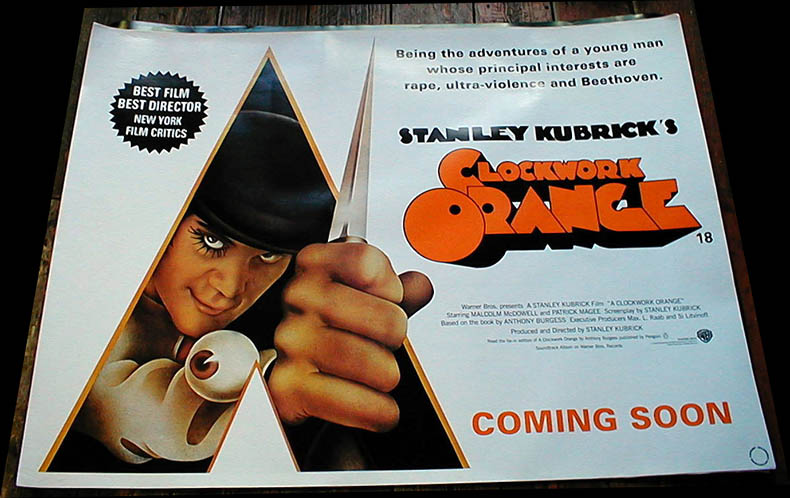
I always thought the correct title of the movie was simply Clockwork Orange, and that only the novel has the full title A Clockwork Orange. The movie posters and the covers of videos and DVDs only say Clockwork Orange, although the logo on many of them looks like it may represent a letter A. However two of the movie-based poster designs at art.com don't have anything resembling a letter A. I did a quick google search for online articles, but didn't find anything to answer this question.Spylab 17:01, 10 October 2006 (UTC)Spylab
- Check your Leonard Maltin book. He goes by what it says on the title card. Or, for that matter, check you copy of the film and see what it says on the title card. Or I will, when I have time. Wahkeenah 17:28, 10 October 2006 (UTC)
- Ok. I don't have them with me at the moment, so I'll have to check later.Spylab 17:46, 10 October 2006 (UTC)Spylab
- I have confirmed that the official title is A Clockwork Orange.Spylab 22:52, 10 October 2006 (UTC)
- And I confirm your confirmation. I think the poster-makers just thought "Stanley Kubrick's Clockwork Orange" sounded better than "Stanley Kubrick's A Clockwork Orange". Maybe somebody thought that sounded like someone saying that Stanley himself was a clockwork orange. Also, I'm guessing the copyright date and the other blah-blah on the "A CLOCKWORK ORANGE" title card is not to be taken as part of the title, although one never knows, as the official title of Dr. Strangelove was about that lengthy. Wahkeenah 23:18, 10 October 2006 (UTC)
- Revelation! Look at the poster. Alex is emerging from a large, stylized letter 'A'. And now you know the rrrrrrrrest of the story! Wahkeenah 01:13, 6 December 2006 (UTC)
- And I confirm your confirmation. I think the poster-makers just thought "Stanley Kubrick's Clockwork Orange" sounded better than "Stanley Kubrick's A Clockwork Orange". Maybe somebody thought that sounded like someone saying that Stanley himself was a clockwork orange. Also, I'm guessing the copyright date and the other blah-blah on the "A CLOCKWORK ORANGE" title card is not to be taken as part of the title, although one never knows, as the official title of Dr. Strangelove was about that lengthy. Wahkeenah 23:18, 10 October 2006 (UTC)
-
-
- I dimly remember that the supraliminal 'A' in the poster (eyeball on cuff prominent)[2] was deliberately designed by Philip Castle to recall Man Ray's Object to Be Destroyed[3] (which is itself a reference to the USA's Great Seal). Can anyone verify? Garrick92 15:15, 24 January 2007 (UTC)
-
-
-
-
- I have found a sensible source (well, an authoritative one - the Masonic Grand Lodge of British Columbia and Yukon) that links the CO poster to the Great Seal, which I shall now add. This is one of my all-time favourite wikipedia finds, and I shall treasure it forever. Garrick92 11:15, 29 March 2007 (UTC)
-
-
Age
In the film, Alex is apparently 18, as said in the paragraph about the differences between the movie and the book, so I changed that part of the plot. Hope I did right, otherwise please change it back (and please explain, I'm interested^^) Gabriele, 10-18-06
his age was set at fifteen when prior to my edit, i changed it back to eighteen after seeing your mention of this and that no one had responded
No references
Just tagged this page. The only reference for the entire article is the novel. I am amazed at this since it is a fairly popular movie. DarkSideOfTheSpoon 05:28, 30 October 2006 (UTC)
Colons
This is a very minor complaint, but it seems like the writer for some of these sections was insanely colon happy. Most of them seem to be used incorrectly as well... Anyone agree? Joe Brooks 13:14, 4 November 2006 (UTC)
- Feel free to perform a colonectomy as needed. Wahkeenah 15:59, 4 November 2006 (UTC)
The REAL QUESTION should be why do you care? If its not a matter of life or death iI don't see why it would matter.
To the above user who apparently didnt sign their comment, he stated that it was indeed a minor complaint and quite frankly, excessive use of devices like that can make for an awkward read. Please sign your comments. Glassbreaker5791 03:00, 13 July 2007 (UTC)
Sex scene description
I think - I repeat, I am NOT sure - that before Alex has sex with the two girls from the record store, he gets them drunk. If I do in fact remember correctly, I think this should be included briefly in the description of the scene, perhaps nothing more than "...nonetheless, he takes them home and, after a few drinks, has sex with them both." As well, it mentions later in the article that, as opposed to in the novel where Alex rapes the young girls, the sex here is consensual. I don't think that's entirely the case here, since Alex is essentially drugging them first. Thoughts? Zhankfor
- No. Alex is walking through the record store, to the sound of part of the electronic version of Beethoven's Ninth (the same section that will later be playing during his aversion therapy session featuring the Hitler footage) and finds the two chicks looking through the album bins. He hits on them a bit and offers to let them come to his place to list to music filled with "angel trumpets and devil trombones... you are invited!" The film cuts immediately to his bedroom and the highly sped-up threesome scene to the strains of an electronic William Tell Overture, which if you watch it at normal speed, you see that nothing actually happens, it's just a bit of comic relief. Unless Kubrick pulled such a scene from the final cut of the film, Alex does not get the babes drunk first. Wahkeenah 00:47, 15 November 2006 (UTC)
-
- OK, thanks. Maybe I'm mixing up the book with the movie, it's been a long time since I've looked at either. [[User:Zhankfor|Zhankfor}}
- You were right, it's in the book; I just found it. He gave them each some Scotch. As the old saying goes, "Candy is dandy, but liquor is quicker!" Wahkeenah 05:52, 15 November 2006 (UTC)
- OK, thanks. Maybe I'm mixing up the book with the movie, it's been a long time since I've looked at either. [[User:Zhankfor|Zhankfor}}
well im not an expert on drugs (though i have done my far share) but aren't "angel trumpets and devil trombones" some kind of a psychoactive drug?
-
- No, they're trumpets and trombones (respectively). There are fungi named after trumpets and devils and angels, but any similarity ends there. Garrick92 15:27, 30 March 2007 (UTC)
-
-
- Well, Brugmansia are also called Angel's Trumpets and used as drugs, sothis indeed might be a reference to drug use in the film.--85.182.34.104 (talk) 21:16, 6 January 2008 (UTC)
-
Unconscious?
Apparently the gent at 172.159.252.65 disagrees with me, but I'm absolutely positive Alex isn't left unconscious after being hit with the milk bottle. He is, in fact, screaming about being blind and calling his former droogs bastards. I could be wrong, but generally unconcious people don't talk.
- You're right; he was momentarily blinded and/or disoriented by his "friends" smashing the full milk bottle across his face, filling his eyes with milk, but apparently not glass. Wahkeenah 00:24, 16 December 2006 (UTC)
100% you are right. he was knocked out, atleast in the movie version. bloodreaper
- In the movie he was NOT knocked out. It was as I described. Wahkeenah 00:50, 31 March 2007 (UTC)
Christian?
This article claims that Burgess was a "devoted Christian". The WP article on Burgess states that Burgess "lapsed from Catholicism early in his youth", with no suggestion that what he "lapsed" into was any other variety of Christianity. I suspect that the Burgess article is right and this one is wrong (for instance, the first quotation at http://www.positiveatheism.org/hist/quotes/bushcoolframe.htm#BURGESS doesn't sound very Christian), but I don't know. Anyone have anything more authoritative? Gareth McCaughan 01:36, 17 December 2006 (UTC)
-
- Burgess regarded himself as a lapsed Catholic, but in his two volumes of autobiography he still tends to talk of himself as a Catholic. On other occasions in the same works, he comes across as agnostic, and on other occasions outright gnostic (there's one marvellous description of God and sinners in which he compares God to 'a field of sentient snow, which screams when you absent-mindedly piss on it'). I don't think 'lapsed Catholic' is the same as 'non-Catholic'. The same as you supposedly can't be an ex-Jew. More theologically-minded contributors might be able to phrase that more succinctly. Garrick92 14:12, 9 January 2007 (UTC)
The Orange Theme
I enjoyed the text that gave credit to A Clockwork Orange for providing the influance for Cygnus X's "The Orange Theme". However, the only text that remains of that reference is simply the name and title under the "soundtrack" section. Since the song was not included on the soundtrack, and no reference for its inspiration is given, i am deleting it from the article. Please re-add this once the reference has been found. Psydude 21:20, 2 March 2007 (UTC)
FALSE! that all DVDs are X-versions
I just rented this DVD at a Phoenix, AZ (USA) library, and in fact it was the rated-R version. The article should reflect "most" DVDs are the non-x version
- The remastered blu-ray is also Rated R. Go-go-wikipedia blanket statements! Gront 22:21, 1 December 2007 (UTC)
MISTASKEN IDENITY
Wasnt the character alex actualy played by Julian Sands(forgive me if i spell the name wrong)the same actor who played the warlock in the movie "Warlock" blood reaper
No. No he wasn't. HalfShadow 23:26, 10 March 2007 (UTC)
Well the voice is a dead ringer if he isnt. blood reaper
Ah. So he doesn't have the same name as the actor credited with playing the role, and he doesn't look anything like him either, but he does sound like him? Suddenly I understand why you ask. It is because you are mad. Next! <dings little foyer bell> Garrick92 15:24, 30 March 2007 (UTC)
Sony Pictures Classics
I don't understand. If this is distributed by Warner Brothers... why did I watch a Sony Pictures Classics edition of the film? PyroGamer 12:35, 22 March 2007 (UTC)
trivia - popular culture
the video for the song pacifier by Shihad is a total homage to this movie. im sure this info used to be in this article. is it valid? Snapnz86 23:13, 26 March 2007 (UTC)
Differences between the book and movie
I have changed 3 things in the section detailing differences between the book and the movie: - removed the part that said some nadsat words are changed: although only once or twice, the word "vino" is used in the book to mean blood as well (as in "the red vino on tap"). I don't believe any of the vocabulary is actually changed in the movie. - added a note about the snake not being in the book. Since Alex raves about it when visiting his parents after being released, I thought it relevant. - changed the part that said the cat lady was killed with a bust of Beethoven in the book. That was just plain wrong - she is killed with a "malenky silver statue" of a naked woman. There is mention of a bust of Beethoven: Alex is trying to get to it when the cat lady, lying on the floor, grabs him, which leads to the killing blow. All this is done from memory, but I'm pretty sure I'm right. 84.193.231.219 21:04, 23 April 2007 (UTC)
A or Not?
Response to the comment below, so it won't get lost: In the film poster, Alex is emerging from a giant "A". Wahkeenah 23:52, 3 May 2007 (UTC)
- Hey you're right! But that still doesn't explain the soundtrack... 218.186.9.1 02:39, 4 May 2007 (UTC)
- That's not the official soundtrack album, it's a collection of Walter/Wendy Carlos' renditions of various music, some of which was used in the film and some was not. The CD version has that cover on the inside and a different cover on the outside, with Beethoven drawn inside a large "A", a parody of Malcolm McDowell's appearance inside the "A". The clincher, though, is the film's title card which reads A Clockwork Orange. The title card is what counts, not any poster or album cover. Wahkeenah 03:00, 4 May 2007 (UTC)
- I uploaded a collage of the title cards (of which there are only three at the beginning) to put to rest the question raised here and some months ago about whether there's an "A" in the title. There is. Wahkeenah 03:42, 4 May 2007 (UTC)
- It's also amusing that on the cover of the DVD it has that much-discussed poster; on the DVD disk itself it says only "Stanley Kubrick's Clockwork Orange"; and on the DVD's edge it says "A Clockwork Orange". Wahkeenah 03:46, 4 May 2007 (UTC)
- That's not the official soundtrack album, it's a collection of Walter/Wendy Carlos' renditions of various music, some of which was used in the film and some was not. The CD version has that cover on the inside and a different cover on the outside, with Beethoven drawn inside a large "A", a parody of Malcolm McDowell's appearance inside the "A". The clincher, though, is the film's title card which reads A Clockwork Orange. The title card is what counts, not any poster or album cover. Wahkeenah 03:00, 4 May 2007 (UTC)
I know the title is a Clockwork Orange but the picture of the DVD cover of the film does not seem to have "a" written anywhere before "clockwork orange". The same is true for the 1972 Soundtrack. Should the title of the article be changed to match the DVD cover and the 1972 cover? Some references here
Shown on tv
Has "A Clockwork Orange" been shown of tv . Will be on TCM or AMC? —The preceding unsigned comment was added by 75.0.98.175 (talk) 22:52, 11 May 2007 (UTC).
Fair use rationale for Image:ACO Carlos LP.jpg

Image:ACO Carlos LP.jpg is being used on this article. I notice the image page specifies that the image is being used under fair use but there is no explanation or rationale as to why its use in Wikipedia articles constitutes fair use. In addition to the boilerplate fair use template, you must also write out on the image description page a specific explanation or rationale for why using this image in each article is consistent with fair use.
Please go to the image description page and edit it to include a fair use rationale.
If there is other other fair use media, consider checking that you have specified the fair use rationale on the other images used on this page. Note that any fair use images uploaded after 4 May, 2006, and lacking such an explanation will be deleted one week after they have been uploaded, as described on criteria for speedy deletion. If you have any questions please ask them at the Media copyright questions page. Thank you.Betacommand (talk • contribs • Bot) 04:04, 25 May 2007 (UTC)
Fair use rationale for Image:Alex Korova1.jpg
Image:Alex Korova1.jpg is being used on this article. I notice the image page specifies that the image is being used under fair use but there is no explanation or rationale as to why its use in Wikipedia articles constitutes fair use. In addition to the boilerplate fair use template, you must also write out on the image description page a specific explanation or rationale for why using this image in each article is consistent with fair use.
Please go to the image description page and edit it to include a fair use rationale.
If there is other other fair use media, consider checking that you have specified the fair use rationale on the other images used on this page. Note that any fair use images uploaded after 4 May, 2006, and lacking such an explanation will be deleted one week after they have been uploaded, as described on criteria for speedy deletion. If you have any questions please ask them at the Media copyright questions page. Thank you.BetacommandBot 19:02, 31 May 2007 (UTC)
Differences between the film and the book - Error?
This is a very minor quibble, but...
"The bodyguard is played by former bodybuilder David Prowse in a non-speaking role."
Non-speaking role? I just saw the film and he did speak. I think he said he'd see who was at the door when Alex arrived, and he definitely replied "No, thank you," when offered wine by Alex. Is that enough to elevate him to a "speaking role" (or at least the rewording of the sentence)? I ask because I just walked in here and don't wish to interfere with others' work. Steve1138 01:35, 4 August 2007 (UTC)
The list says Alex claims to have been conditioned against "all music" in the movie. That's wrong. In the scene where he's been interrogated by the Writer's anti-government journalist friends (just before the drugged wine causes Alex to fall face-first into a plate of spaghetti) they specifically ask him if he's been conditioned against all music -- and Alex replies something to the effect of "No, just the Ninth, I mean Beethoven's Ninth, it was played during a horrible viddy of a concentration camp or somesuch." Alex goes on to decribe his conditioned response of wanting to "snuff it" etc. -- before his pasta plunge. That knowledge is the reason F. Alexander put the kick-ass speakers on the pool table, pointed up, playing the lovely, lovely Ludwig's Ninth to Alex in the attic in an effort to blast Alex off into suicidal space as a means of bringing down the government. Without that inside dope, hell, it might as well have been Schoenberg. I plan to fix this, but will viddy the film again, and know that I know that I know first. —Preceding unsigned comment added by 96.228.203.44 (talk) 03:53, 20 September 2007 (UTC)
Possible Mistakes in 'Plot' section
First, "As a result of this conquering of the fear of death, Alex inadvertently cures himself of his crippling psychological anguish." Is this explained in the movie? I don't recall it being mentioned at all.
Second, "Anticipating his return to havoc, Alex relives his surreal fantasy of having sex with a woman in the snow, surrounded by applauding Victorian ladies and gentlemen." It says "relives" but I don't remember him having that fantasy ever before. Ormaybemidgets 20:04, 4 September 2007 (UTC)
Re: first plot mistake. You're not mistaken: it's a mistake. While neither the film nor the novel states it explicitly, the government somehow (subliminal conditioning, who the hell knows) rewired Alex back the way he was after he wound up all bandaged up in the hospital. The government's motive: giving Alex his old rotten self back was a quid pro quo to get Alex on their side and counter the anti-governmental attacks of F. Alexander and friends, namely, that the state was using monstrous brainwashing techniques on poor Alex and others like him). Both set-up and payoff were hinted at twice. Alex tells the lady with the psychological association cards he had a dream that doctors were fooling around with his gulliver. (i.e.: brain) She tells him "patients in your condition often have that sort of dream"--but there's a crafty, calculated look in her eye. Alex, of course, responds to her flash cards with thoughts of the old in-out and smashing eggiweggs. The Minister of the Interior (or Inferior) while forking steak in Alex's mouth, implies the whole deal -- and it's as "clear as a sky of azure summer" to little Alex. Alex's last voice-over line in the film is "I was cured all right." Not "I cured myself." It's something that happened to him, something that was done to him. Lacking the novel's final chapter, he's still a clockwork orange. —Preceding unsigned comment added by 96.228.203.44 (talk) 04:11, 20 September 2007 (UTC)
Fair use rationale for Image:COtitle1.JPG
Image:COtitle1.JPG is being used on this article. I notice the image page specifies that the image is being used under fair use but there is no explanation or rationale as to why its use in this Wikipedia article constitutes fair use. In addition to the boilerplate fair use template, you must also write out on the image description page a specific explanation or rationale for why using this image in each article is consistent with fair use.
Please go to the image description page and edit it to include a fair use rationale. Using one of the templates at Wikipedia:Fair use rationale guideline is an easy way to insure that your image is in compliance with Wikipedia policy, but remember that you must complete the template. Do not simply insert a blank template on an image page.
If there is other fair use media, consider checking that you have specified the fair use rationale on the other images used on this page. Note that any fair use images uploaded after 4 May, 2006, and lacking such an explanation will be deleted one week after they have been uploaded, as described on criteria for speedy deletion. If you have any questions please ask them at the Media copyright questions page. Thank you.
BetacommandBot 12:36, 5 November 2007 (UTC)
Trivia
the really lengthy discussion of Tales from the Hood should mostly exist within the article for that vastly less known film. Nobody gives a crap about all the details of the similarities between the two 131.172.99.15 (talk) 14:29, 19 November 2007 (UTC)snaxalotl
1992?
"Set in 1992 England..." - where is it stated or mentioned that the film is set in 1992? Vargklo (talk) 04:23, 27 December 2007 (UTC)


![[2]](http://www.libraries.wvu.edu/media/scifi/images/vhs%20full/clockwork%20orange%202.jpg)
![[3]](http://www.classifieds4u.co.uk/surrealists/Ray/ManRay-Objectintendedtobedestroyed1923.jpg)