From Wikipedia, the free encyclopedia
The 1982 Atlantic hurricane season officially began on June 1, 1982, and lasted until November 30, 1982. These dates conventionally delimit the period of each year when most tropical cyclones form in the Atlantic basin.
Few storms formed in 1982, and those that did were generally weak and remained at sea. The deadliest storm of the season was Tropical Storm Beryl, which killed 115 people while crossing the Cape Verde islands. Other notable storms include Hurricane Alberto, which caused torrential flooding in western Cuba; Hurricane Debby, which reached Category 4 strength unusually far north; and a subtropical storm which formed and moved across Florida.
[edit] Seasonal activity
The 1982 season was low in activity, with only six storms forming. The season started early with Hurricane Alberto forming on the first day of the season. Alberto threatened the Southwestern Florida coast as a tropical storm, causing twenty-three fatalities in Cuba. The next storm, Subtropical Storm One, formed in June and affected the same area as Alberto. The subtropical storm caused $10 million dollars in damage.
Tropical Storm Beryl formed on August 28, after a quiet July in the open Atlantic Ocean. Beryl grazed The Cape Verde Islands, killing 115 people. Tropical Depression Three formed just behind Beryl, tracking east and north of the Caribbean sea in early September. Soon after the dissipation of Beryl, Tropical Storm Chris formed in the Gulf of Mexico on September 9. Chris stayed as a weak storm, making landfall near Sabine Pass, Texas and dissipated over land on September 13. Hurricane Debby was the next storm and the strongest of the season. The formative stage of Debby produced rainfall in Puerto Rico and soon strengthened into a Category 4 Major Hurricane. Debby passed by Newfoundland on September 18 and merged with a non-tropical low on September 20. In mid-September, Tropical Depression Six formed west of Africa, and tracked east-northeast, dissipating before reaching the Leeward Islands on September 20. Its remnant thunderstorm activity continued moving west-northwest, forming Tropical Depression Seven which moved near Bermuda on September 25 before dissipating offshore Nova Scotia. The final storm of the season, Tropical Storm Ernesto, was the shortest lasting storm of the season and stayed out to sea, dissipating on October 3.
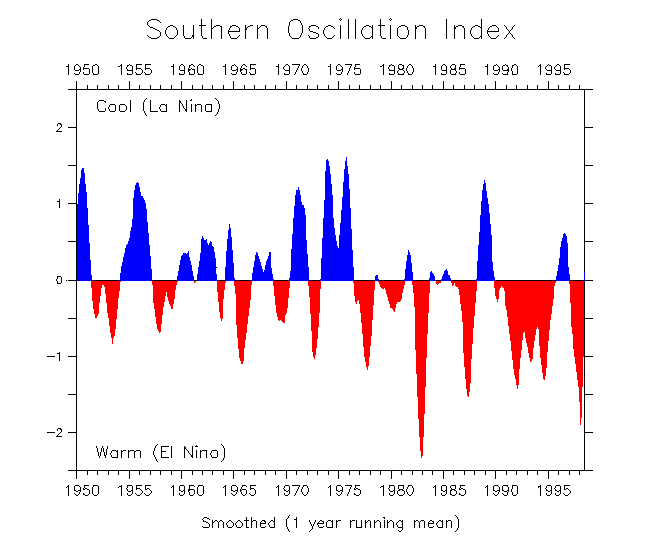
The season was very inactive because of strong vertical wind shear due to stronger than normal westerly winds aloft.[1] The wind shear was contributed by a variety of factors including an El Niño. Vertical wind shear was strong enough to disrupt convection in areas of disturbed weather so they could not develop further. The El Niño which affected this hurricane season extended into the 1983 Atlantic hurricane season.[2] Higher than average values of African mineral dust during the most active portion of the hurricane season could have also suppressed tropical cyclone activity.[3]
[edit] Storms
[edit] Hurricane Alberto
- Main article: Hurricane Alberto (1982)
On June 1, a tropical depression formed off western Cuba from an organized cloud system. It moved slowly northeastward through the Gulf of Mexico, and strengthened into Tropical Storm Alberto on June 3. Alberto traveled generally northeast on an erratic course, and briefly intensified to a Category 1 hurricane, one of the earliest hurricanes of June. Alberto then quickly weakened into a tropical storm, doubled back to the west, and dissipated near the Florida Keys on June 6. Alberto is an example of a storm to enter the Gulf of Mexico and dissipating while never make landfall, which is an unusual event.[4]
Though the storm never made landfall, 23 deaths were reported in Cuba from heavy flooding. Southern Florida experienced moderate rainfall, with a peak of 16.47 inches (418 mm) occurring in Tavernier. [5] [6]
[edit] Subtropical Storm One
- Main article: Subtropical Storm One (1982)
The first subtropical storm of the season formed in the east-central Gulf of Mexico on June 18, and took an almost straight course to the northeast for its entire life. It crossed the Florida peninsula that night, causing the issuance of numerous severe thunderstorm and tornado warnings. The storm continued, crossing the Outer Banks of North Carolina, and retained its strength until June 20 when it became extratropical near Newfoundland.
Subtropical Storm One caused three deaths in Florida, sank a trawler off the coast of North Carolina, and caused $10 million in damage (1982 USD, $20 million 2005 USD). [7]
[edit] Tropical Storm Beryl
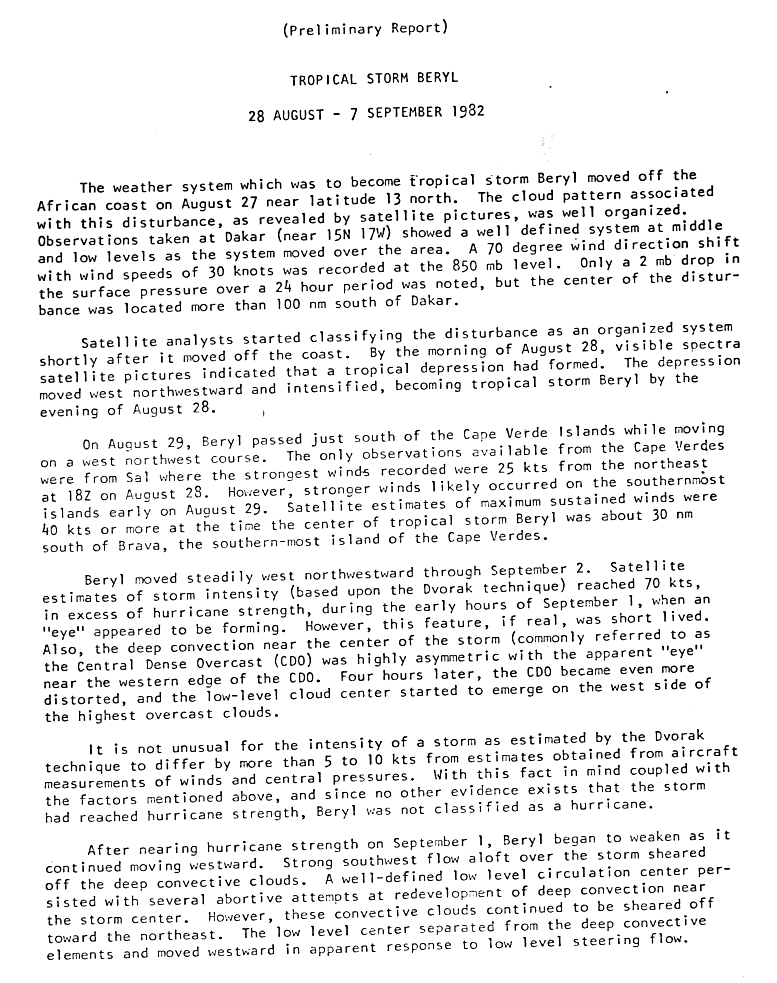
A tropical wave moved off the coast of Africa on August 27, and quickly organized into a tropical depression . By late on August 28, it intensified into Tropical Storm Beryl, and passed just south of the Cape Verde Islands. The storm steadily intensified, and attained peak winds of 70 miles per hour (110 km/h) on August 31. An eye featured developed on satellite imagery, though it quickly disappeared as upper-level wind shear increased.[8] On September 2, Beryl weakened to tropical depression status, and on September 6 it dissipated to the north of the Lesser Antilles.[9]
Early in its duration, Tropical Storm Beryl produced heavy rainfall and gusty winds on the Cape Verde island of Sal; the island was struck the hardest by the storm. The storm caused moderate damage across the archipelago, totaling $3 million (1982 USD).[10] The passage of Beryl also resulted in 115 casualties in the country. In the period after the storm's passage, the United States provided humanitarian aid and economic assistance to the country, helping the archipelago to reverse the effects of Beryl.[11]
[edit] Tropical Depression Three
This system formed east of the Lesser Antilles on September 6 to the southeast of Tropical Storm Beryl. The depression moved northeast of the Leeward Islands during the afternoon of September 7 while experiencing southwest vertical wind shear, and moved into the southwest North Atlantic before dissipating east of the Bahamas on September 9.
[edit] Tropical Storm Chris
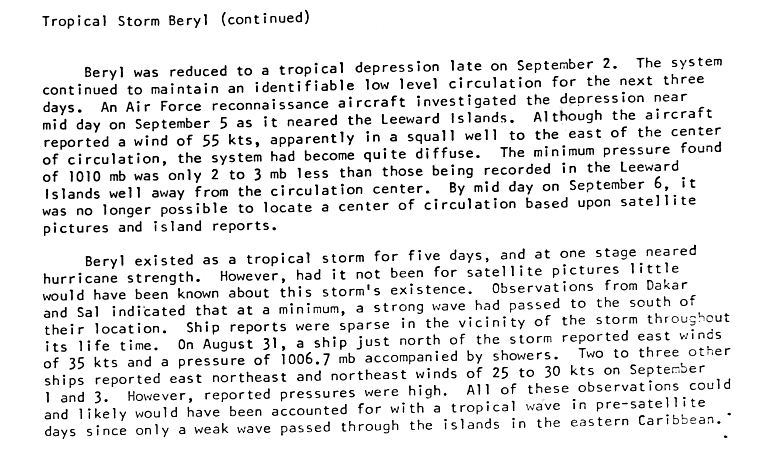
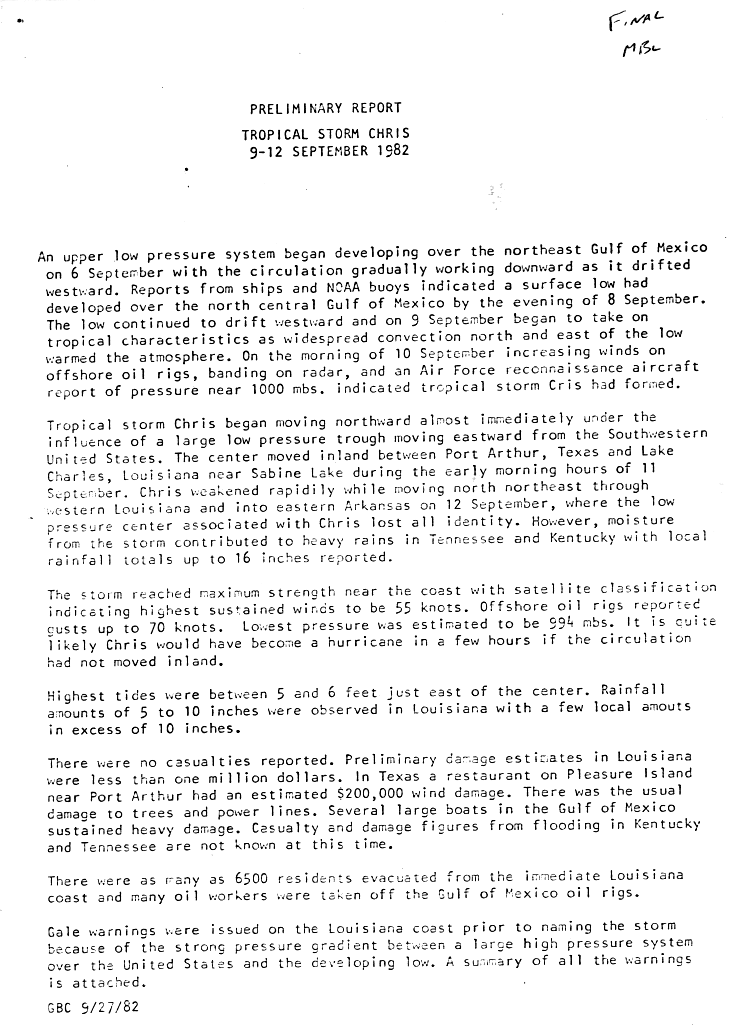
A surface low pressure area developed on September 8 in the Gulf of Mexico. It drifted westward, and the next day it organized into a subtropical depression. Under the influence of a trough of low pressure, the depression turned northward, and after steadily becoming better organized it transitioned into Tropical Storm Chris by late on September 10. The storm attained peak winds of 65 miles per hour (105 km/h) before moving ashore near Sabine Pass in Texas. Chris continued inland until it dissipated over central Arkansas on September 13. Prior to making landfall, as many as 6,500 people evacuated from southern Louisiana, while offshore many oil workers were evacuated inland.[12]
Chris produced moderate rainfall along its path, peaking at 16 inches (410 mm) in Delhi, Louisiana, with totals of over 10 inches (250 mm) in Mississippi and Tennessee.[13] The rainfall caused locally severe flooding as far inland as Tennessee and Kentucky, with flooding of some rivers reported.[14] The storm spawned 9 tornadoes, of which 4 were F2 or stronger on the Fujita scale.[15] Upon moving ashore, the hurricane produced a 5 feet (1.5 m) to 6 feet (1.8 m) storm tide, resulting in severe damage to several boats in the Gulf of Mexico. Throughout its path, damage totaled $2 million (1982 USD).[12]
[edit] Hurricane Debby
- Main article: Hurricane Debby (1982)
Debby began life as a tropical wave that degenerated shortly after leaving the coast of Africa. The wave travelled across the Atlantic, and organized into a tropical depression off the northern coast of Haiti on September 13. The depression turned north and strengthened into a tropical storm and then a hurricane. Hurricane Debby moved north-northeast, brushing Bermuda with tropical storm-force winds. It continued strengthening as it moved north, peaking at 135 miles per hour (217 km/h). Tropical storm-force winds were also recorded at Cape Race in Newfoundland when Debby passed on September 18. The storm accelerated and began weakening over the colder waters of the north Atlantic. Debby merged with a strong non-tropical system over the British Isles on September 20.
The precursor disturbance to Debby dropped heavy rainfall across Puerto Rico, peaking at 12.86 inches (327 mm) in the southwestern portion of the island. [16] [17] Only minor damage was associated with Debby.
[edit] Tropical Depression Six
This tropical depression formed 900 miles (1,400 km) west of the Cape Verde Islands on September 16,[18] and moved west-northwest across the tropical Atlantic ocean.[19] The system moved within 750 miles (1,210 km) east of the Leeward Islands before dissipating on September 20.[20]
[edit] Tropical Depression Seven
The remnant area of disturbed weather from Tropical Depression Six continued moving west-northwest into the southwest north Atlantic. A tropical depression formed from this area 275 miles (443 km) west of Bermuda on September 25.[21] The system recurved off the the north and northeast, dissipating in north Atlantic shipping lanes southeast of Nova Scotia on September 27.[22][23]
[edit] Tropical Storm Ernesto
A tropical wave formed off the coast of Africa on September 23. The west side of the wave expanded and was declared as Tropical Depression Six on September 30. The depression intensified, making a sharp turn on October 1. An Air Force plane found 40 miles per hour (64 km/h) winds with a pressure of 1003 mbar and the depression was given the name Ernesto. A second Air Force plane on October 2 found 71 miles per hour (114 km/h) winds with a pressure of 997 mbar. By October 3, Ernesto was not identifiable after merging with an extratropical low. Ernesto never approached land and caused no reported damage. [24]
[edit] Accumulated Cyclone Energy (ACE) Rating
| ACE (104kt²) – Storm: Source |
| 1 |
18.2 |
Debby |
2 |
5.45 |
Beryl |
3 |
2.06 |
Alberto |
| 4 |
1.65 |
Ernesto |
5 |
1.29 |
Chris |
6 |
0.000 |
Subtrop |
| Total= 28.5962 (29) |
The table on the right shows the ACE for each storm in the season. The ACE is, broadly speaking, a measure of the power of the hurricane multiplied by the length of time it existed for, so hurricanes that lasted a long time have higher ACEs. ACE is only rated to systems with winds higher than 35 mph.
[edit] Storm names
The following names were used for named storms that formed in the north Atlantic in 1982. No names were retired, so it was used again in the 1988 season. This is the first time these names were used since the post-1978 naming change, except for Florence and Helene which had been previously used in 1954, 1958, 1960, and 1964. Names that were not assigned are marked in gray.
- Alberto
- Beryl
- Chris
- Debby
- Ernesto
- Florence (unused)
- Gilbert (unused)
|
- Helene (unused)
- Isaac (unused)
- Joan (unused)
- Keith (unused)
- Leslie (unused)
- Michael (unused)
- Nadine (unused)
|
- Oscar (unused)
- Patty (unused)
- Rafael (unused)
- Sandy (unused)
- Tony (unused)
- Valerie (unused)
- William (unused)
|
[edit] Retirement
- See also: List of retired Atlantic hurricane names
The World Meteorological Organization retired no names used in the 1982 season.
[edit] See also
[edit] References
[edit] External links
|
Tropical cyclones of the 1982 Atlantic hurricane season
|
|

.JPG/150px-Hurricane_Alberto_(1982).JPG)

.JPG/150px-Subtropical_Storm_1_(1982).JPG)


.JPG/150px-Tropical_Storm_Chris_(1982).JPG)

.JPG/150px-Hurricane_Debby_(1982).JPG)