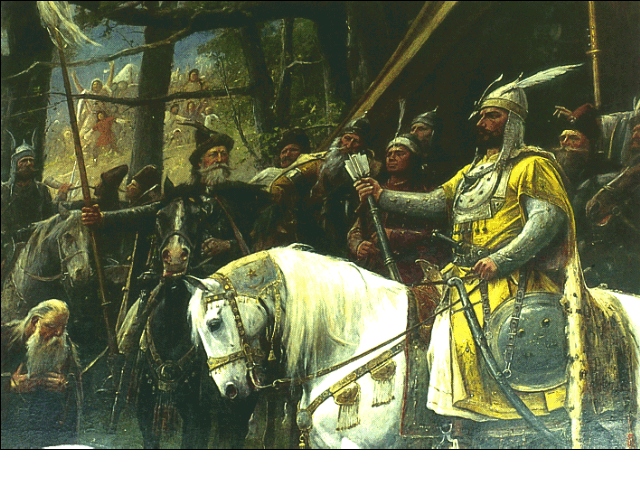
Árpád
From Wikipedia, the free encyclopedia


Árpád (c. 845 – c. 907), the second Grand Prince of the Magyars (c. 895 – c. 907). Under his rule the Magyar people settled in the Carpathian basin. The dynasty descending from him ruled the Magyar tribes and later the Kingdom of Hungary until 1301.
Contents |
[edit] His life
Árpád was the son of Grand Prince Álmos, leader of the Hungarian tribal federation; his mother's name and descent is unknown. From the chronicles he was descanted of Attila the Hun his great-great-grandchild.
In 894, Árpád and Kurszán negotiated together with the representatives of the Byzantine emperor, Leo VI the Wise the terms under which the confederation of the Magyar tribes was willing to assist the Byzantine Empire against Emperor Simeon I of Bulgaria.

.
In the spring of next year, the Magyar tribes attacked the Bulgarian Empire and defeated Emperor Simeon I, obliging him to conclude peace with the Byzantine Empire. Emperor Simeon, however, entered into an alliance with the Pechenegs, who were the eastern neighbours of the Hungarian tribal federation, and he made an attack against the Magyar troops. In the Battle of Southern Buh, Emperor Simeon I defeated their army; shortly afterwards, the Pechenegs attacked and pillaged their territories. The Magyar tribes were obliged to leave Etelköz and move to the Carpathian Basin where they settled down (Honfoglalás).
The circumstances of Álmos' death are unclear. The leaders of the seven Hungarian tribes proclaimed Árpád to Grand Prince of the Magyars[1]; therefore Árpád is considered traditionally to lead the Honfoglalás ("the occupation of the country").

In 896 the Hungarian tribes occupied the Upper Tisza river, from there they undertook numerous looting raids in central and western Europe, and in 900/901 they moved to Pannonia[2]. The Magyars entering the Pannonian fields in 896 may have represented about 200,000–250,000 people.
Based on Arabic sources, Árpád's title seems to have been kende[3] or gyula. In that time kende was the spiritual leader of the Magyar tribes, while the gyula led their military campaigns. According to legends, Árpád hold the first "parliamentary" session with 40 other "nobles" on horseback before 900 AD.
[edit] Children
- Levente
- Tarhos (Tarkacsu) (? – ?)
- Üllő (Jeleg or Jeleg) (? – ?)
- Jutocsa (Jutas) (? – ?)
- Zoltan of Hungary (947 – ?)
[edit] Legacy
Although he is not considered the founder of the Kingdom of Hungary – that was his descendant Stephen I –, he is generally thought of as the forefather of Hungarians and is often affectionally mentioned as our father Árpád. Árpád was the founder of the dynasty named after him, which would rule over the kingdom of Hungary till 1301.
[edit] Sources
- Kristó, Gyula - Makk, Ferenc: Az Árpád-ház uralkodói (IPC Könyvek, 1996)
- Korai Magyar Történeti Lexikon (9-14. század), főszerkesztő: Kristó, Gyula, szerkesztők: Engel, Pál és Makk, Ferenc (Akadémiai Kiadó, Budapest, 1994)
- Kristó, Gyula: A Kárpát-medence és a magyarság régmúltja (1301-ig) (Szegedi Középkortörténeti Könyvtár, Szeged, 1993)
- Magyarország Történeti Kronológiája I. – A kezdetektől 1526-ig, főszerkesztő: Benda Kálmán (Akadémiai Kiadó, Budapest, 1981)
[edit] References
- ^ The Byzantine De administrando imperio says around 950: Prior to this Árpád, the Magyars did never have another ruling prince ('archont') and since then up to today the ruling prince of Hungary has been from that family. However, his father was probably proclaimed Grand Prince around 855.
- ^ It is remarkable that Árpád was never mentioned by contemporary Western sources, which strengthens the idea that he was the spiritual ruler of the Magyars.
- ^ Some scholars consider Kende to be the name of a person.
[edit] See also
[edit] External links
| Preceded by Álmos |
Grand Prince of the Magyars c. 895 - c. 907 |
Succeeded by Unknown / Zoltán |